Under constant organization, molecular selection is a kinetic competition among self-replicating species, not an organism-level fitness contest. Each species i is assigned a selective value Wii, the net replication rate obtained by subtracting its degradation rate from its replication rate. The population-level average excess productivity E(t) is the composition-weighted mean of these selective values:
E(t) = ∑j Wjj
Because E(t) depends on the current frequencies or concentrations , selective advantage is relative and dynamic. Species i increases only when its own selective value exceeds the current population average, Wii > E(t). The selection equation is:
[Wii − E(t)]
Constant organization is maintained because the weighted excesses sum to zero: ∑i [Wii − E(t)] = 0. If Wii > E(t), species i grows in frequency; if Wii < E(t), it declines; if Wii = E(t), it is momentarily neutral. As composition changes, E(t) moves, so the same Wii can confer advantage early and vanish later. In the simplest selection-only case, the species with the highest Wii is eventually enriched and E(t) approaches that maximal selective value.
Core Concepts
Selective value Wii: net replication rate for species i, combining replication and degradation terms. It defines the diagonal selective value used in the selection equations.
Average excess productivity E(t) = ∑j Wjj: the population average of selective values weighted by species frequencies or concentrations. It changes as composition changes.
Selection equation (Wii − E(t)): species i increases when Wii > E(t), declines when Wii < E(t), and is momentarily neutral when Wii = E(t).
Two-Species Example
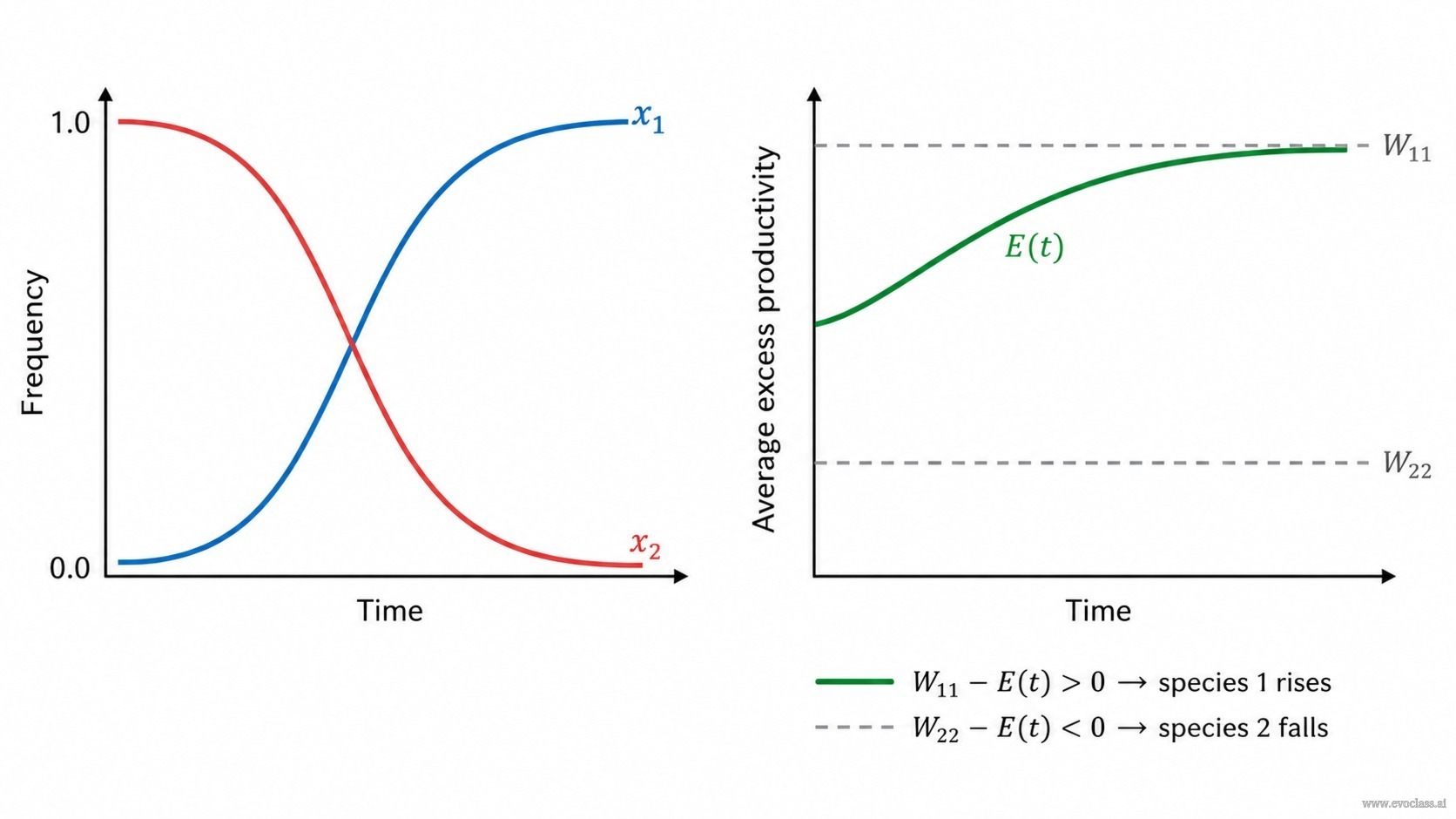
Suppose . Initially E(t) lies between W22 and W11. Species 1 has and rises; species 2 has and falls. As → 1, E(t) → W11, and the net excess of species 1 approaches zero. Selective advantage here is not a fixed property of a molecule; it is the difference between its net replication rate and the current population average.
Common Misconception
A molecule with a positive Wii does not automatically increase. It must exceed E(t). Likewise, a molecule with a negative Wii can persist if E(t) is even lower.
Selective Value and Average Excess Productivity
Under constant organization, the species frequencies x 1 and x 2 shift while the average excess productivity E(t) rises from a value between W 22 and W 11 toward W 11, because species 1 comes to dominate. As E(t) climbs, the excess W 11 − E(t) shrinks toward zero, so species 1's growth slows and becomes momentarily neutral as fixation is approached.
QUESTION 1
XVI.2. What does selective advantage mean to a molecule under constant organization?
Its absolute concentration in the reaction volume.
The difference between its net replication rate Wᵢᵢ and the population average excess productivity E(t).
Its cellular fitness relative to the other organisms in the environment.
Its total replication rate, with the degradation term ignored.
✅ Correct!
At the molecular level, advantage is Wᵢᵢ − E(t) > 0, not organismal fitness. A species grows only while its own selective value exceeds the current population average.
❌ Incorrect
Focus on net replication minus average excess productivity. Cellular fitness, raw (undegraded) replication rate, and absolute concentration are not the selective criterion here.
QUESTION 2
Which expression defines the average excess productivity E(t) under constant organization?
E(t) = ∑ⱼ Wⱼⱼ xⱼ
, an unweighted mean of the selective values
E(t) = ∑ⱼ xⱼ / Wⱼⱼ
E(t) = ∑ⱼ Wⱼⱼ, the sum of the selective values
✅ Correct!
E(t) is the composition-weighted mean of the diagonal selective values: E(t) = ∑ⱼ Wⱼⱼ xⱼ.
❌ Incorrect
E(t) averages the selective values using current frequencies or concentrations as weights, so it is ∑ⱼ Wⱼⱼ xⱼ. Ratios of frequencies to selective values, unweighted means, and plain sums ignore those composition weights.
QUESTION 3
In the selection equation dxᵢ/dt = xᵢ(Wᵢᵢ − E(t)), why is constant organization maintained?
Because the weighted excesses sum to zero: ∑ᵢ xᵢ(Wᵢᵢ − E(t)) = 0.
Because all species have the same selective value Wᵢᵢ.
Because the frequencies xᵢ are held fixed by the environment.
Because E(t) is fixed by the initial composition and never changes.
✅ Correct!
Constant organization is preserved because ∑ᵢ xᵢ(Wᵢᵢ − E(t)) = 0, so the weighted increases and decreases exactly balance.
❌ Incorrect
Check the weighted sum of excesses. Constant organization requires that the composition-weighted excesses cancel to zero; that does not require equal selective values, fixed frequencies, or a fixed E(t).
QUESTION 4
A molecular species with Wᵢᵢ < E(t) will:
increase in frequency because its replication rate is positive.
stay at constant frequency as long as its Wᵢᵢ does not change.
decline in frequency because its net replication rate is below the population average.
be unaffected, because its own replication rate is unchanged.
✅ Correct!
If Wᵢᵢ < E(t), the excess Wᵢᵢ − E(t) is negative, so dxᵢ/dt < 0 and the species declines in frequency.
❌ Incorrect
Compare Wᵢᵢ with E(t). A positive replication rate is not enough; the selective value must exceed the current average, and holding Wᵢᵢ fixed does not keep the frequency constant while E(t) moves.
QUESTION 5
In a two-species selection-only system with , what happens to E(t) as → 1?
E(t) approaches W22, and species 1 declines.
E(t) remains exactly halfway between W11 and W22.
E(t) approaches W11, and the net excess of species 1 approaches zero.
E(t) increases without bound.
✅ Correct!
As species 1 dominates, → W11. The net excess W11 − E(t) then approaches zero, so growth slows to a halt at fixation.
❌ Incorrect
E(t) is weighted by composition. When → 1, the weight on W11 dominates, so E(t) approaches W11.
Case Study: Two-Species Prebiotic Reactor
Read the scenario below and answer the questions.
A prebiotic reactor maintains constant total concentration of two self-replicating molecular species A and B. Species A has selective value min⁻¹ and species B has min⁻¹. Initially and . The selection equation is dxᵢ/dt = xᵢ(Wᵢᵢ − E(t)), with E(t) = ∑ⱼ Wⱼⱼ xⱼ.
Q
1. Calculate the initial average excess productivity E(0). Which species initially increases, and which initially declines?
Answer: E(0) = min⁻¹. Species A: (0) = , so A increases. Species B: = −, so B declines.
Q
2. Explain what happens to E(t) and to the net excess of species A as → 1. Why is selective advantage not a fixed property?
Answer: As → 1, E(t) = + () approaches min⁻¹. The net excess (t) approaches 0, so species A's growth slows and stops at fixation. Selective advantage is not fixed because it depends on composition: the same confers advantage only while E(t) < , and the advantage disappears as the population becomes dominated by A. This illustrates relative, dynamic molecular selection rather than absolute fitness.
XVI.2. What Does Selective Advantage Mean to a Molecule? 76