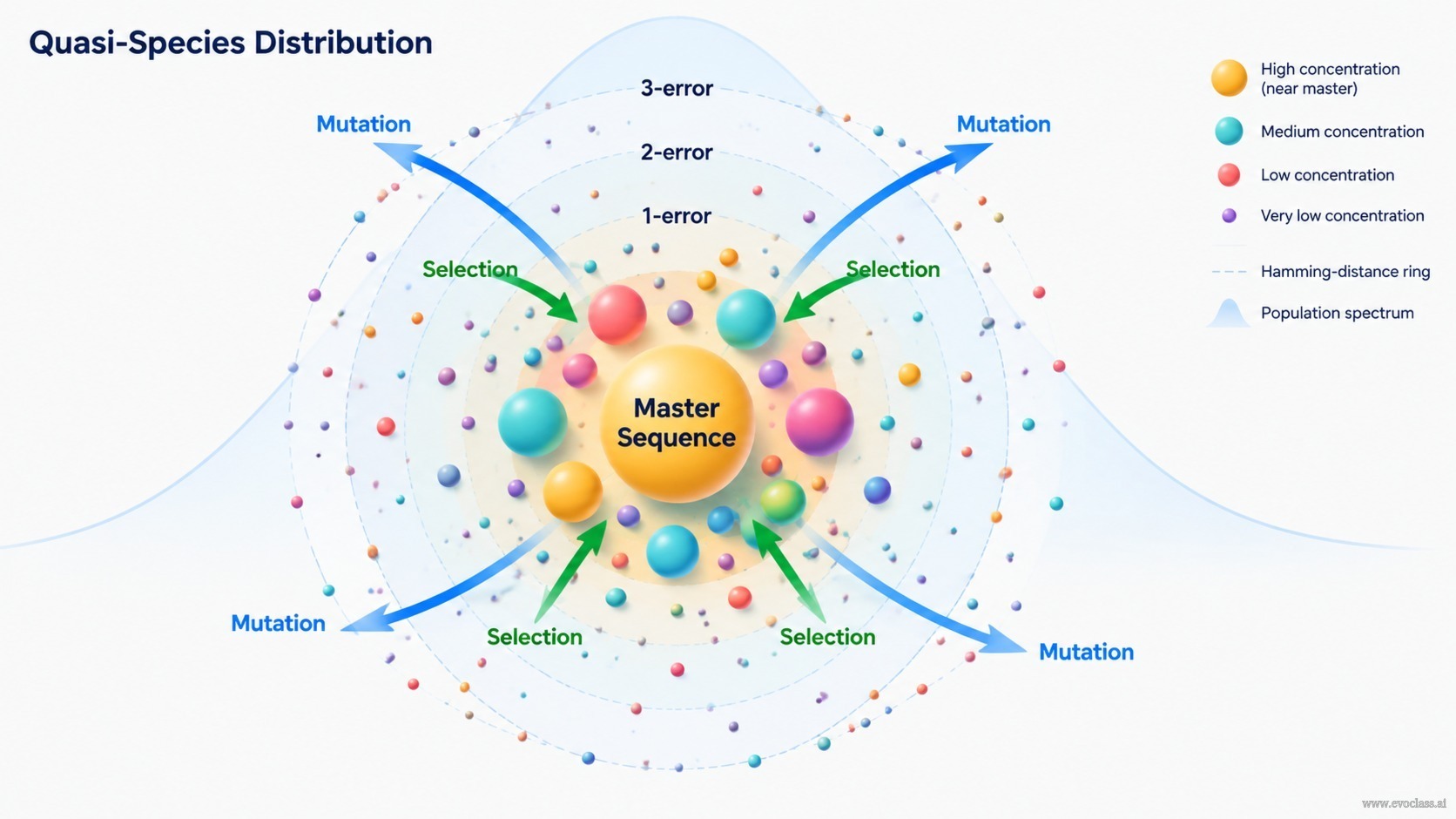
At the molecular level, the target of natural selection is not a single genotype but an organized distribution of related sequences called the quasi-species. This concept emerges from the balance between mutation and selection: mutation continuously generates variants around a master sequence, while selection favors better replicators. The steady state is a stable mutant spectrum—a cloud of sequences—rather than a single wild-type.
Learning Objective
Explain how mutation-selection balance produces a quasi-species and why the wild-type is an organized distribution rather than a single dominant sequence.
Key Points
- Mutation continuously generates mutant sequences around a master sequence.
- Mutation–selection balance produces a stable distribution of related sequences.
- The quasi-species is this organized distribution, not a single dominant sequence.
- The master sequence/wild-type is the most frequent variant, but the unit of selection is the whole mutant cloud.
- Under constant organization, each variant’s concentration balances its own replication against mutational influx/outflow from neighboring sequences.
- Distribution width depends on mutation rate, genome length, and selective differences; this sets up the error-threshold problem treated later.
- The quasi-species is not a taxonomic species; it is a dynamically maintained molecular ensemble.
Mathematical Representation
In the quasi-species model, the population is described by a vector of concentrations x for each sequence. The dynamics follow dxi/dt = Wii
Quasi-Species Distribution
A master sequence (wild-type) sits at the center of a sequence-space cloud, surrounded by a mutant spectrum. Point size and color encode variant concentration; Hamming-distance rings indicate mutational distance from the master. Arrows represent replication (selection) and mutation, showing how the population is maintained as a dynamic distribution rather than a single genotype.