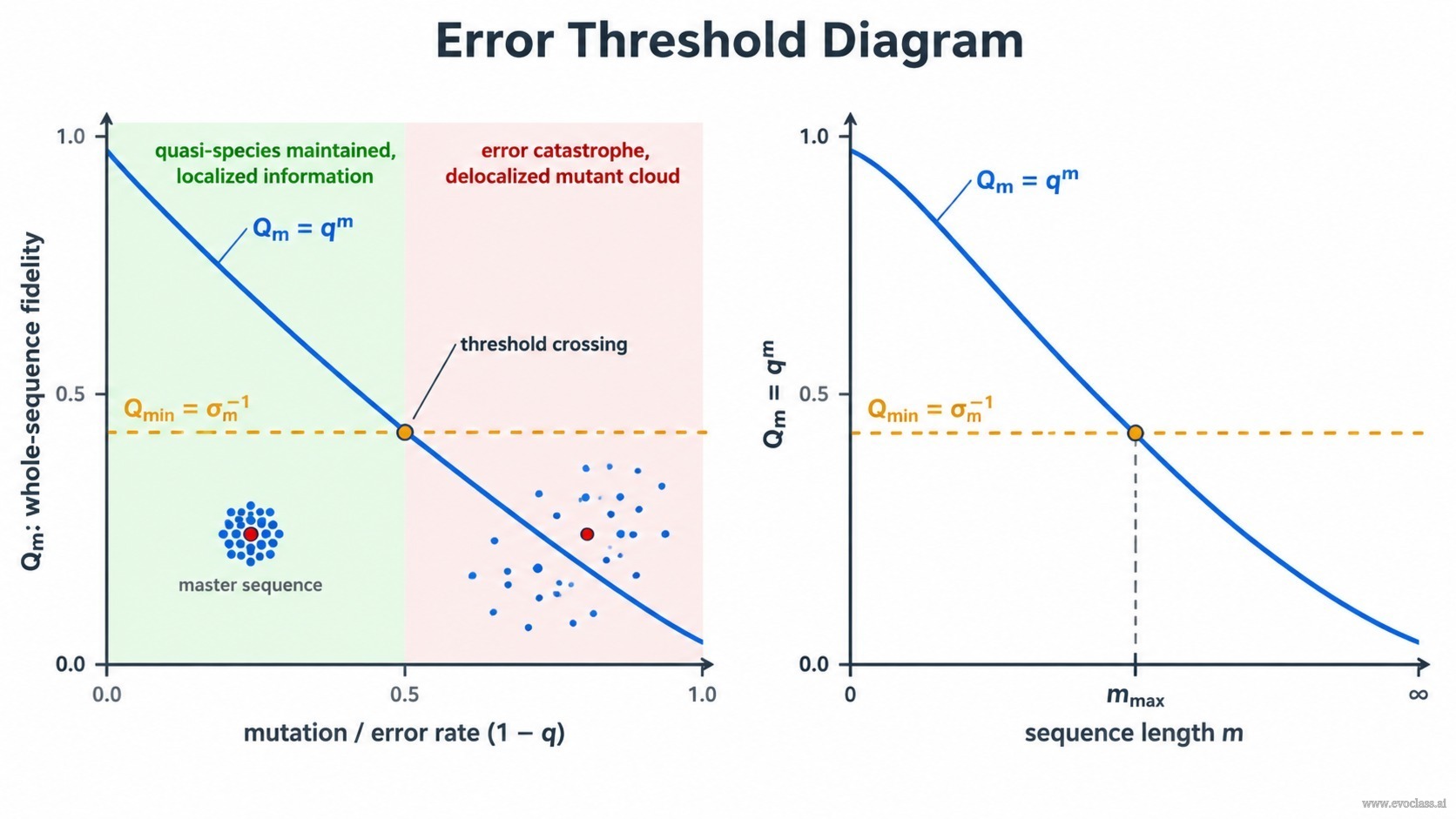
Selection can preserve a message only if replication copies that message accurately enough. The error threshold turns this intuition into a sharp criterion: it separates a regime in which a quasi-species stays localized around its master sequence from a regime in which mutational pressure delocalizes the stored information entirely.
Whole-Sequence Fidelity, Not Per-Base Fidelity
is the probability of correctly copying the entire sequence of length m in one replication round. Under independent-site errors it factorizes as , where q is the per-site fidelity. - Because fidelity multiplies across sites, it falls exponentially with length. That single fact is the origin of the information limit.
The Threshold Condition
- The master sequence is maintained only if
−1, where is the selective superiority of the master sequence relative to its mutant cloud. - At
the system is marginal; below it, selection can no longer hold the master sequence against mutational degradation. - A non-trivial threshold requires
. Higher selective superiority permits either lower fidelity or longer maintainable sequences.
Two Regimes
- Below the error threshold
: the quasi-species remains localized around the master sequence, and the information is retained. - Above the error threshold
: the mutant cloud delocalizes — the error catastrophe — and the information content is lost.
The Information Limit
Setting
Maintainable information therefore grows only logarithmically with selective advantage, while it responds inversely to the per-site error rate. Doubling
Worked Example
With
Error Threshold Diagram
Whole-sequence fidelity Qₘ = qᵐ is plotted against the mutation/error rate, together with the threshold line Qₘᵢ