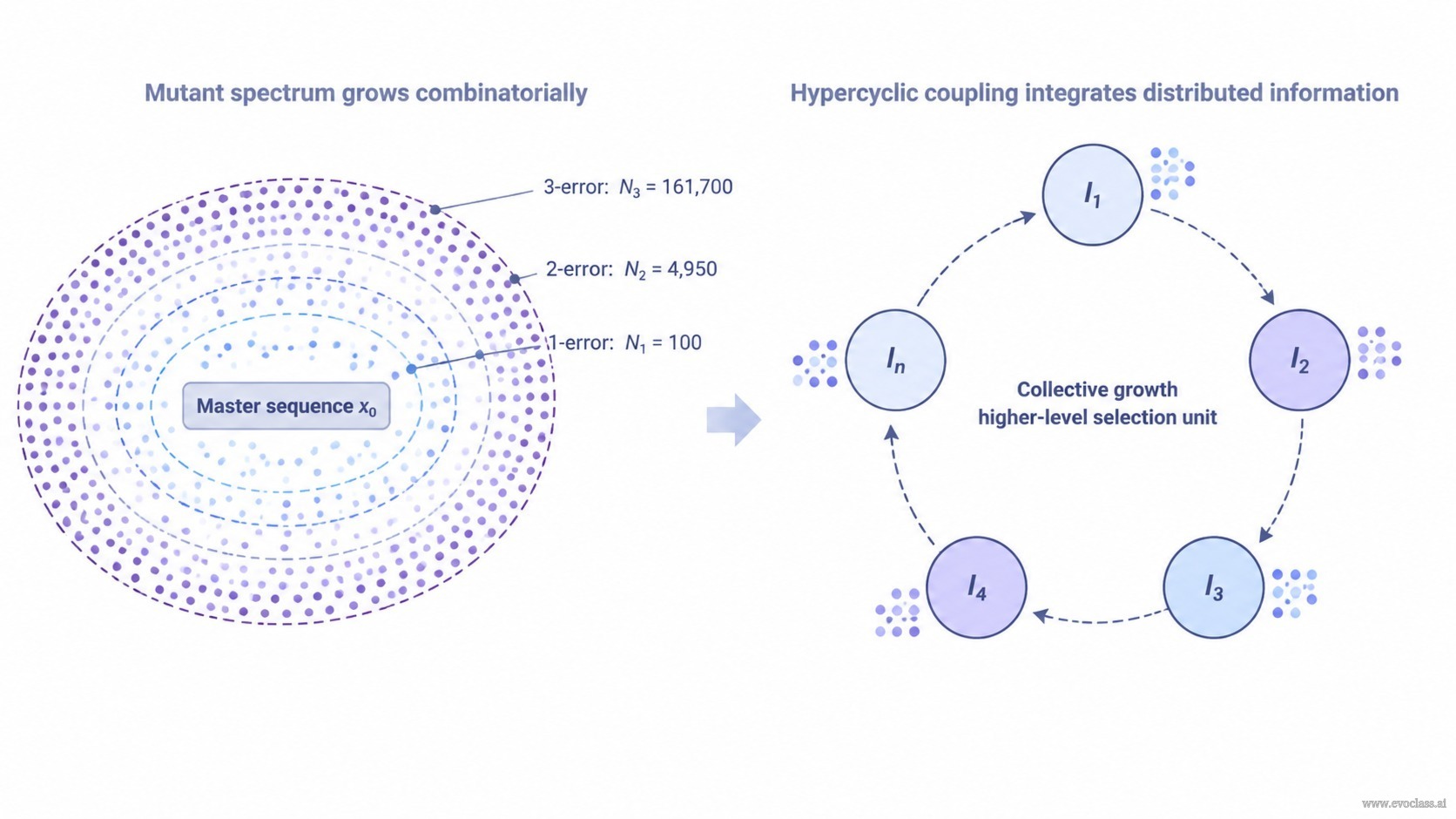
The error threshold bounds how much information a single steadily growing genome can maintain. Copying is never exact, so each round of replication surrounds the master sequence with a mutant spectrum of one-, two-, three-error and higher variants. Under mutation–selection balance this spectrum is not a marginal nuisance: selection acts on the whole organized distribution — the quasi-species — rather than on one privileged molecule.
What defeats a single genome is the arithmetic of that spectrum, which grows combinatorially with genome length. For a genome of 100 nucleotides:
General form:
Three consequences follow. First, the mutant cloud is vast compared with the master sequence itself: as genome length or mutation rate rises, the cloud overwhelms the master copy, the error threshold is crossed, and the encoded information is degraded. Second, a single steadily growing genome cannot integrate this diversity — its replicators compete, faster or shorter variants outcompete the master, and selection acting on individual molecules has no mechanism for holding the entire mutant set together as one stable unit.
What Hypercyclic Organization Adds
Hypercyclic organization answers the problem by linking different genes through catalytic mutual dependence. The product of each gene catalyses replication of the next member, closing the cycle I1 → I2 → … →
- Cyclic coupling: catalytic dependence converts independent competitors into one cooperative network, so no single fast variant can simply take over the population.
- Distributed function: information is spread across several members, so a degree of mutational variation can be absorbed without immediate collapse of the integrated information.
- Higher-level selection unit: the cycle — not the individual replicator — becomes the object whose growth and reproduction determine survival.
Limits of the Solution
Integration is not unlimited. Hypercycles themselves possess error thresholds, and they are vulnerable to parasitic members that exploit the cycle without contributing catalysis. Hypercyclic organization therefore relocates and partitions the information problem rather than abolishing it.
Why Hypercyclic Organization of Mutant Genes
On the left, a 100-nucleotide master sequence is surrounded by its mutant spectrum, whose size grows combinatorially: 100 one-error mutants, 4,950 two-error mutants and 161,700 three-error mutants. On the right, that same diversity is partitioned into genes coupled in a closed catalytic cycle I 1 → I 2 → … → I n → I 1, so the network grows and is selected collectively as a higher-level unit. The takeaway is that hypercyclic coupling integrates distributed information instead of relying on one steadily growing genome.