A hypercycle is a closed loop of catalytic support: each member assists the next, and the loop returns to its own start. That architecture makes the cycle self-reinforcing, but it also opens a door. Any element that receives catalytic help from the loop while returning nothing can multiply inside the same reactor, living off the very products the hypercycle generates. Such an element is a parasite.
What counts as a parasite
A parasite is a self-reproductive element that exploits the hypercycle without contributing to it. It is not an inert mutant that merely decays: it replicates on its own, drawing on catalytic support supplied by the cycle, yet it adds no catalysis of its own to the loop. Because the hypercycle must sustain that growth without receiving anything back, the parasite is a direct competitor for the same finite pool of material.
Constant organization and the T.13.8 system
The competition is analysed under constant total concentration,
- Parasite:
- Hypercycle component:
In both equations the first term is growth and the second term is the constant-organization dilution or outflow that holds the total fixed. The parasite grows quadratically in its own concentration, kAcA2, which is exactly what makes it self-reproductive, whereas the hypercycle component grows only through the cross term
Two corner fixed points and a concentration threshold
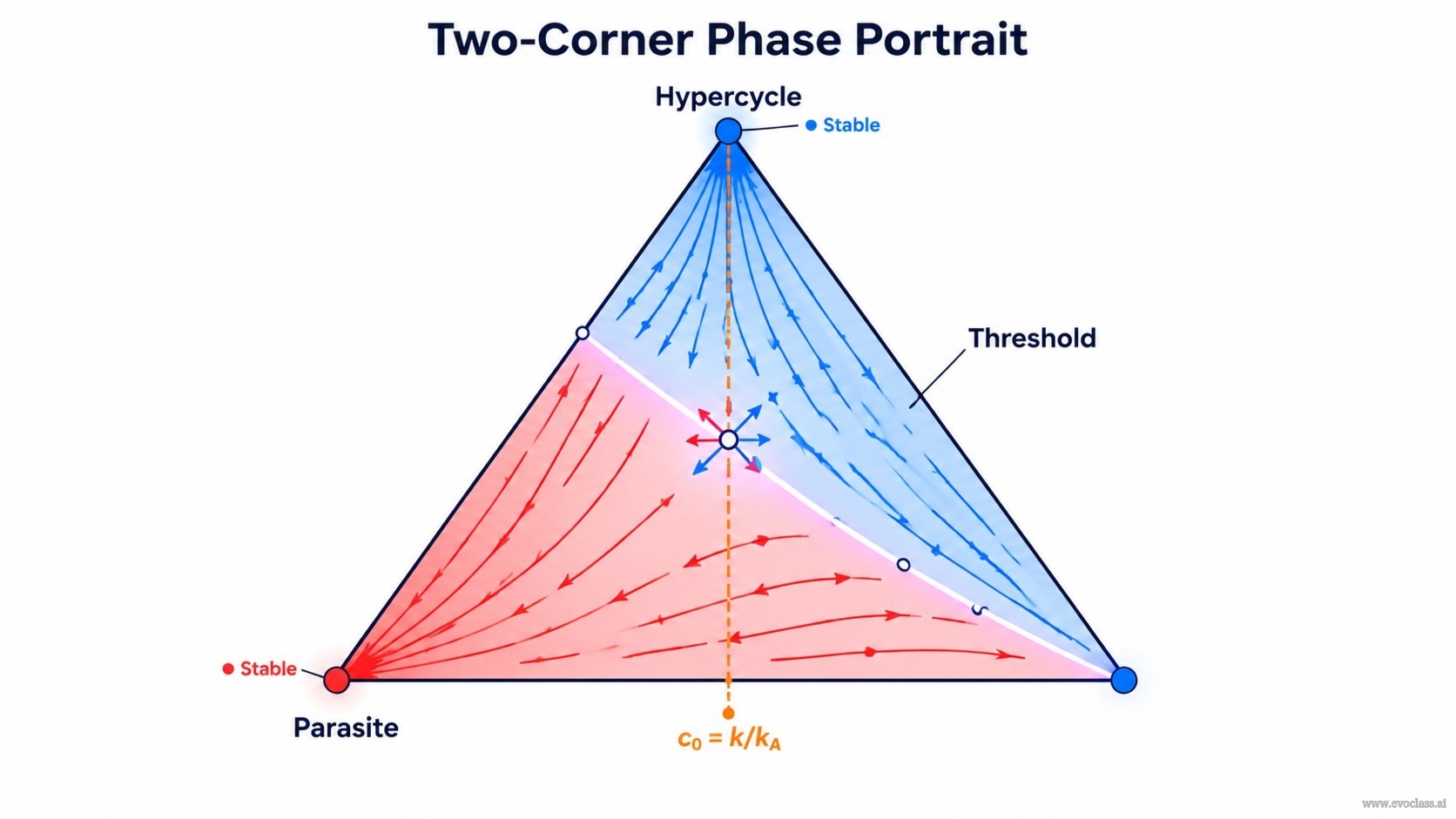
The system has two fixed points, and both sit at corners of the concentration simplex: a parasite-dominated state (
Below the threshold the hypercycle component still increases and the flow is driven towards the hypercycle corner; above it the component is diluted away faster than it is produced and the flow is driven towards the parasite corner. Crossing
Two-Corner Phase Portrait
On the concentration simplex the parasite-dominated and hypercycle-dominated states sit at opposite corners, with the total concentration c A + x held fixed by constant organization. Interior states flow to whichever corner wins: below the threshold c A the hypercycle component still grows , while above it the parasite displaces it .