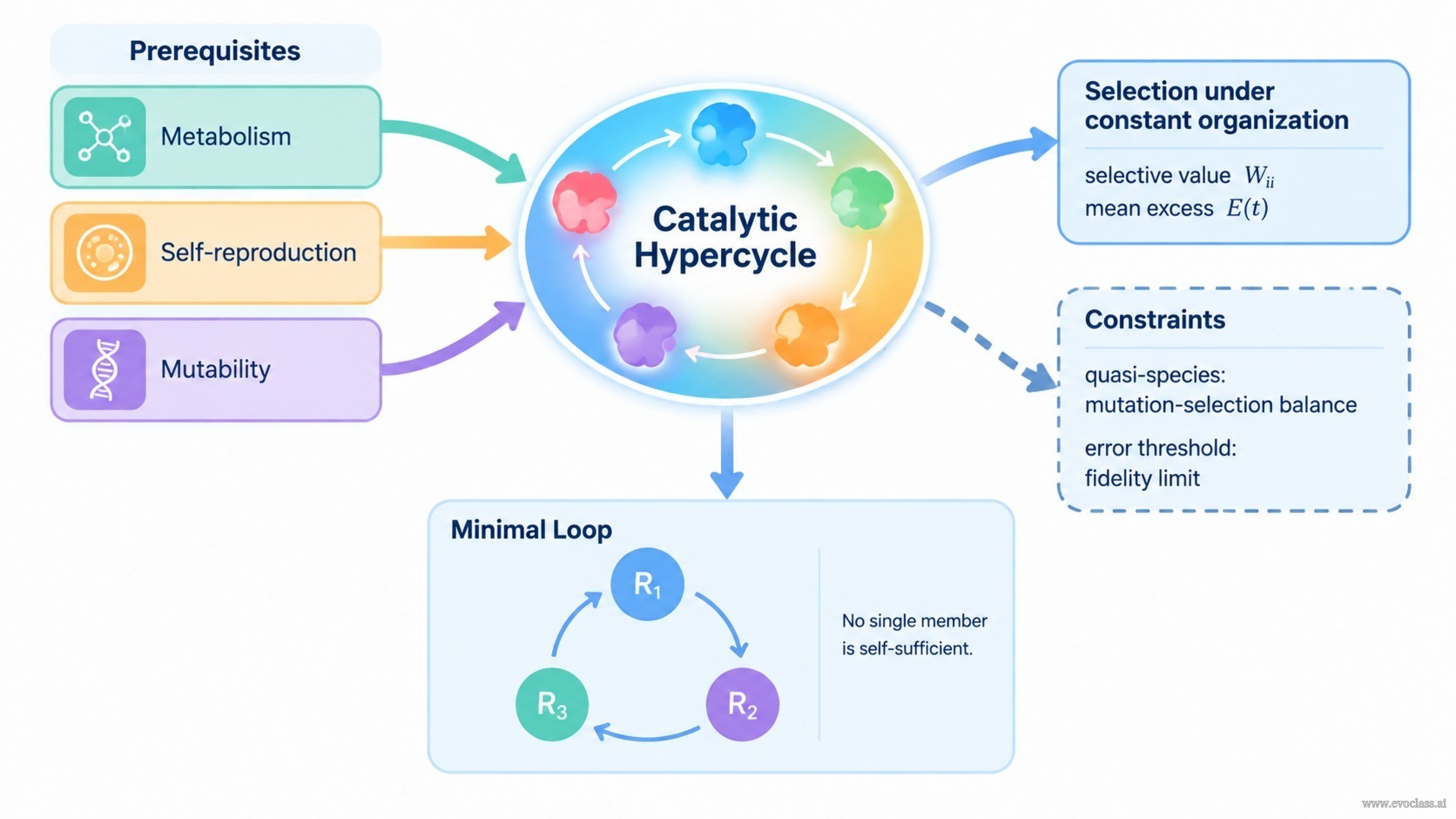
Catalytic hypercycles are the molecular realization of a Darwinian system: a closed cycle of self-replicative units in which each member catalytically accelerates the reproduction of the next. Because every unit depends on a partner downstream, the entity that reproduces is not any single molecule but the loop itself, which reproduces collectively and can therefore be treated as a higher-order replicator.
Why a cycle of replicators counts as a Darwinian system
Molecular evolution is not automatic. It requires three conditions to hold at the same time, and the hypercycle is interesting precisely because it supplies all three through one structural device, the closed catalytic loop.
- Metabolism: the system must harvest free energy and material to drive the synthesis of its own components. In a hypercycle each member's catalytic product feeds the synthetic work of another member, so the loop maintains an internal turnover of matter and energy.
- Self-reproduction: the system must produce copies of itself. Here the unit of reproduction is the cycle, not the isolated molecule: each member enhances replication of the next, so the loop as a whole is collectively self-reproducing while individual members are not self-sufficient.
- Mutability: the templates must be copied with occasional errors, generating heritable variation. Without sequence variation there is nothing for selection to act upon, and the cycle would be a chemical steady state rather than an evolving system.
A hypercycle therefore satisfies the prerequisites of metabolism, self-reproduction and mutability simultaneously and is, in that precise sense, a Darwinian system at the molecular level.
Selection under constant overall organization
To describe how such a system is selected, the cycle is placed in a regime of constant overall organization: the total concentration of replicators is held fixed, so competition is expressed as a redistribution of shares rather than as unbounded growth. Each variant i is then assigned a selective value Wii, its net replication advantage, and the dynamics take the familiar form
Two features of this pair of equations matter for the hypercycle. First, Wii is the net advantage of variant i, so a mutant with better catalytic support from its hypercyclic partner acquires a larger Wii without any change in the environment. Second, E(t) is the average excess productivity, the population mean of the selective values; it is subtracted from every variant alike and is exactly what keeps the total concentration constant. Because E(t) is a population average, it rises as the initially fittest variants spread, and the growth advantage of those variants is progressively eroded until the distribution becomes stationary.
The true target of selection is the quasi-species
Selection does not act on a single best sequence. Mutation continuously converts variants into one another, and mutation-selection balance produces a stable organized distribution of sequences centred on a dominant type: the quasi-species. Hypercyclic organization adds a further layer of collective coupling, because the units that are coupled are not individual sequences but whole quasi-species, each supplying catalytic support to the next. The account therefore scales from the quasi-species as the unit of molecular selection to the hypercycle as a selection unit of a second or higher degree.
The error threshold is not bypassed
Collective organization does not relax the fidelity requirement that constrains any replicator. Reproducible maintenance of information demands that copying fidelity be high relative to the amount of information stored: above a critical mutation rate the mutant cloud broadens without limit and the organized distribution dissolves. This same condition applies to every member of the cycle, and because the members depend on one another catalytically, their loss of information is cooperative. The hypercycle inherits the error threshold from its components; it does not escape it.
Hypercycle Concept Map
At the centre sits the catalytic hypercycle, a closed linkage of self-replicative units. Three prerequisite boxes (metabolism, self-reproduction, mutability) supply the conditions for Darwinian behaviour, a right-hand box collects the selection equations of constant overall organization — selective value Wᵢᵢ and mean excess productivity E(t) — and a dashed box marks the quasi-species and the error threshold that constrain how much information can be maintained. The lower panel shows the minimal loop R 1 → R 2 → R 3 → R 1, in which each unit catalyses the next and no single member is self-sufficient.