The Sentence-Evolution Game and the Error Threshold
HYC-1979Lesson 3: Error Threshold and Early Replicative Units
00:00
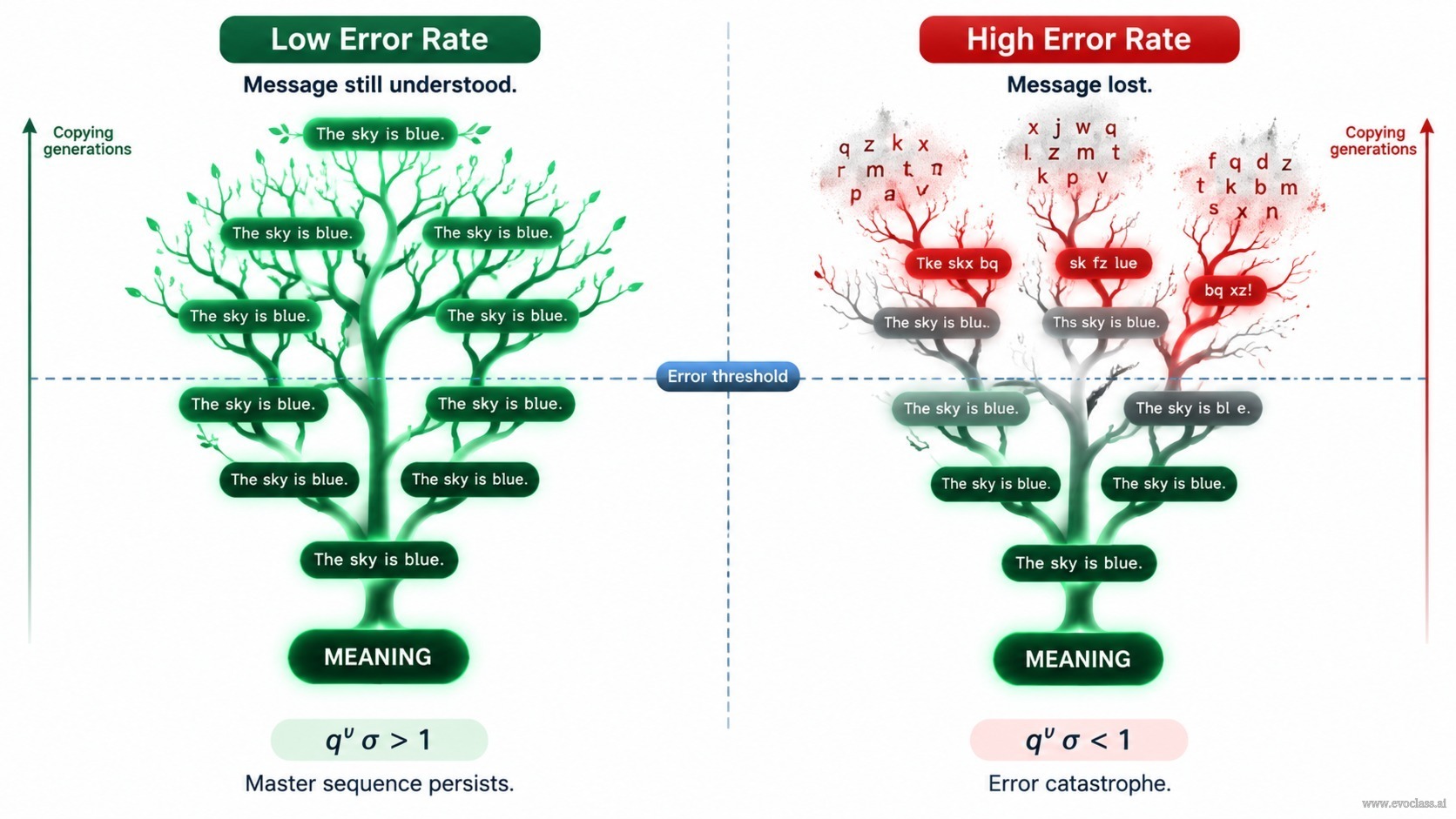
In the sentence-evolution game, a meaningful sentence stands in for a functional biopolymer. Its meaning depends on exact letter order, so copying errors act as mutations that usually destroy function. Let the sentence have length ν and let q be the per-letter copying fidelity. The probability that one whole copy is error-free is . Increasing length or lowering fidelity therefore makes accurate inheritance exponentially less likely.
Selection enters through the selective advantage σ: the fitness of the meaningful sentence relative to its mutant cloud. For molecules, σ is the higher replication, catalytic, or survival rate of the correct sequence compared with its mutants. The game asks whether selection can maintain the meaningful sequence across generations or whether the mutants take over.
The error-threshold condition for stable information is . For small per-letter error rates (1 − q), this is approximately . If the inequality fails, the population undergoes an error catastrophe: it delocalizes away from the functional sequence and dissolves into a mutant cloud.
Worked example
If a meaningful sentence has letters, , and , then . The message is below threshold and is lost. Shortening to gives , so the meaningful sentence can be maintained.
Assumptions and refinements
The basic game assumes independent uniform errors, a single master sequence, constant organization, and all-or-nothing meaning. Neutral networks, recombination, compartmentalization, and hypercyclic coupling can change the effective threshold. Increasing σ extends sustainable length only logarithmically, so high fidelity is essential for long genomes.
Learning objective
Explain how the sentence-evolution game tests the error threshold for stable information.
Supplementary note
The game links the abstract quasi-species error threshold to molecular information limits. It also provides a constraint that hypercyclic organization must respect or mitigate.
The Sentence-Evolution Game and the Error Threshold
A branching tree of copied sentences from an original meaningful sentence. Inner branches retain the message when , while outer branches accumulate letter errors and become meaningless mutant clouds; when , error catastrophe dissolves the original message.
QUESTION 1
In the sentence-evolution game, what does represent for a sentence of length ν?
The number of mutations that occur per generation
The probability that the meaningful sentence survives selection
The selective advantage of the meaningful sentence
The probability that a complete copy is error-free
✅ Correct!
q is per-letter fidelity, so is the probability that all ν letters are copied correctly.
❌ Incorrect
Focus on copying, not selection: q is the per-letter accuracy of replication.
QUESTION 2
What does the selective advantage σ compare in the sentence-evolution game?
The length of the meaningful sentence relative to a mutant sequence
The mutation rate of the environment relative to the sentence
The copying fidelity of the meaningful sentence relative to its mutants
The fitness of the meaningful sentence relative to its mutant cloud
✅ Correct!
σ is a relative fitness: higher replication, catalytic, or survival rate of the correct sequence compared with mutants.
❌ Incorrect
σ is not fidelity or length; it is the relative fitness of the master sequence against mutants.
QUESTION 3
What does selective advantage mean for a molecule?
A longer sequence that can carry more information
A larger population size of the correct sequence in the environment
A lower mutation rate per letter than the mutant sequences
A higher replication, catalytic, or survival rate of the correct sequence relative to its mutants
✅ Correct!
For molecules, σ measures the fitness advantage of the correct sequence over its mutant cloud, often through faster replication, better catalysis, or higher survival.
❌ Incorrect
Selective advantage is about relative fitness. It is not simply mutation rate, length, or population size.
QUESTION 4
If , , and , then . What does the error-threshold condition predict?
The meaningful sentence is above threshold and is maintained
The meaningful sentence is below threshold and is lost
The mutant cloud has no effect because σ is greater than 1
The meaningful sentence is exactly at the threshold and is neutral
✅ Correct!
Because , the message is below threshold and dissolves into error catastrophe.
❌ Incorrect
Check the inequality . Here , so the message is not maintained.
QUESTION 5
Under the error-threshold relation, which change most effectively extends the sustainable length of a functional sequence?
Increasing the mutation rate of the replicator
Reducing the selective advantage σ to zero
Increasing the per-letter copying fidelity q
Increasing the sequence length ν
✅ Correct!
Fidelity enters exponentially through , so increasing q extends sustainable length far more effectively than increasing σ alone, which acts only logarithmically.
❌ Incorrect
Longer ν or lower q worsens the threshold. High fidelity is the key requirement for long genomes.
Case Study: Maintaining a Functional RNA Sequence
Read the scenario and answer the questions.
A research team models an early RNA replicator as a 120-letter functional sequence. In strain A, per-letter fidelity is and selective advantage is . In strain B, and . Both strains are transferred repeatedly under the same conditions.
Q
Compare for the two strains and explain which strain is expected to maintain the functional sequence.
Answer: For strain A, , so . Strain A is below the error threshold and should lose the functional sequence. For strain B, , so . Strain B is above threshold and can maintain the functional sequence.
Q
Suppose the team cannot raise q further. Describe two molecular or organizational mechanisms that could mitigate the error threshold.
Answer: Compartmentalization can couple replication and selection at the level of individual compartments, reducing the effective mutant cloud. Recombination and neutral networks can allow exploration while preserving functional motifs. Hypercyclic coupling can provide nonlinear selection that favors cooperative functional sets, and shorter functional sequences can lower ν. These mechanisms do not abolish the threshold but can alter the effective conditions under which stable information persists.
XVI.2. What Does Selective Advantage Mean to a Molecule? 76