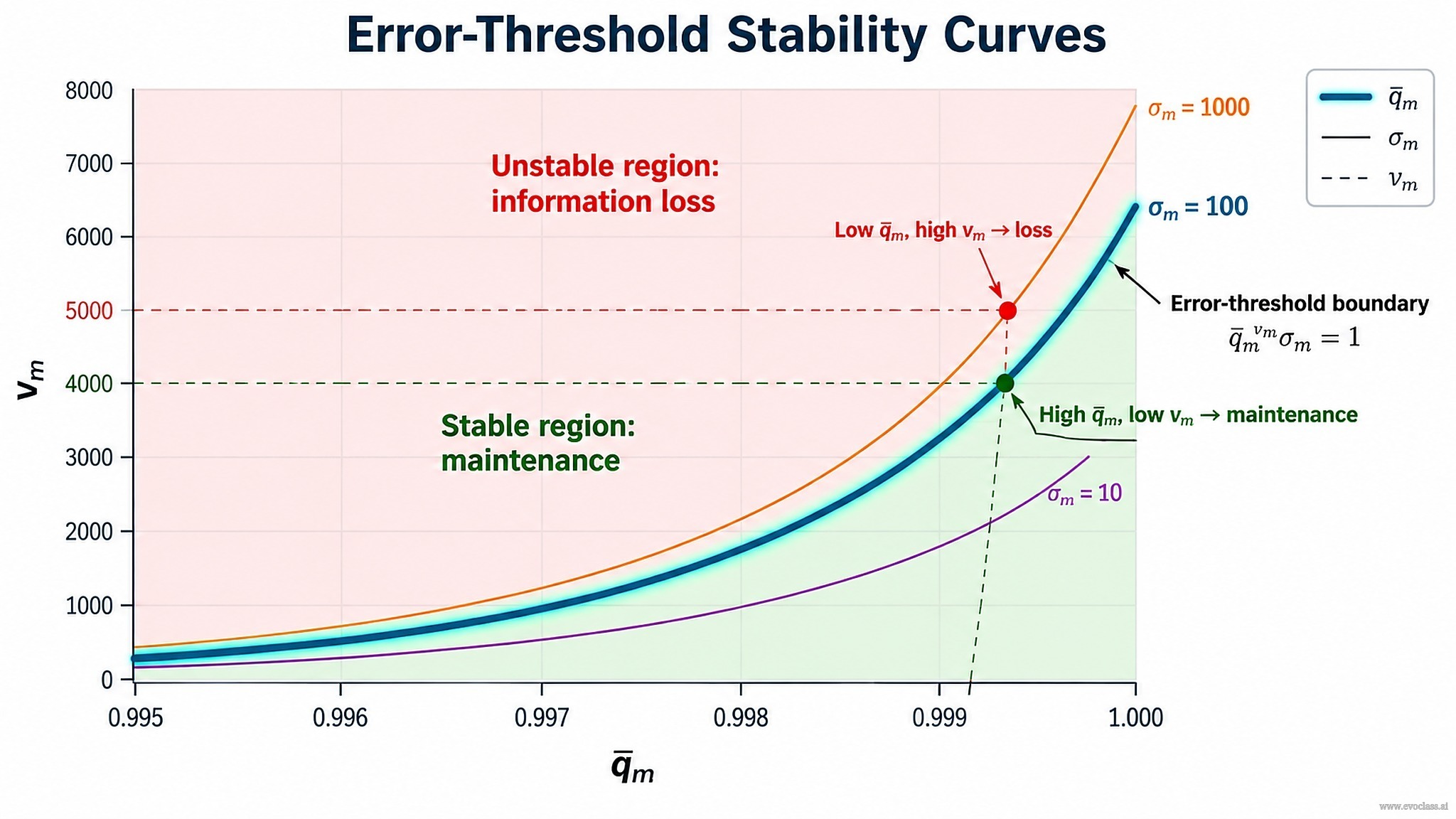
Within the quasispecies and constant-organization framework, the persistence of a meaningful sequence is predicted by the product q̄ₘvₘ σₘ. This single quantity combines copying fidelity, selective advantage, and sequence length into a decision rule for information maintenance.
Core Concepts
- q̄ₘ is the average copying accuracy per symbol or nucleotide. The probability of faithfully copying the whole vₘ-symbol sequence is q̄ₘvₘ, so fidelity penalties grow exponentially with sequence length.
- σₘ is the selective advantage of the meaningful sequence over its mutants. A larger σₘ raises the tolerated mutation load and permits longer maintainable sequences.
- vₘ is the sequence length or number of symbols that must be maintained. Longer vₘ increases the mutational target and lowers the maximum tolerable per-symbol error rate.
Decision Criterion
Maintain information if q̄ₘvₘ σₘ > 1. Lose information if q̄ₘvₘ σₘ < 1. Equality defines the error-threshold boundary. For q̄ₘ near 1, the maximum maintainable length is approximately vₘₐₓ ≈ ln σₘ / (1 − q̄ₘ), showing the trade-off among fidelity, selective advantage, and length.
Example
For σₘ = 100 and q̄ₘ = 0.999, vₘₐₓ ≈
Assumptions and Limits
This prediction applies to a dominant meaningful sequence under constant organization and without recombination or compartmentalization. It predicts quasispecies delocalization rather than physical degradation. Higher q̄ₘ, higher σₘ, or shorter vₘ favor maintenance; lower q̄ₘ, weaker selection, or longer vₘ favor loss.
Error-Threshold Stability Curves
Plot of maintainable sequence length vₘ against per-symbol copying accuracy q̄ₘ for selective advantages σₘ = 10, 100, and 1000. The region above each curve is unstable and loses information, while the region below is maintained.