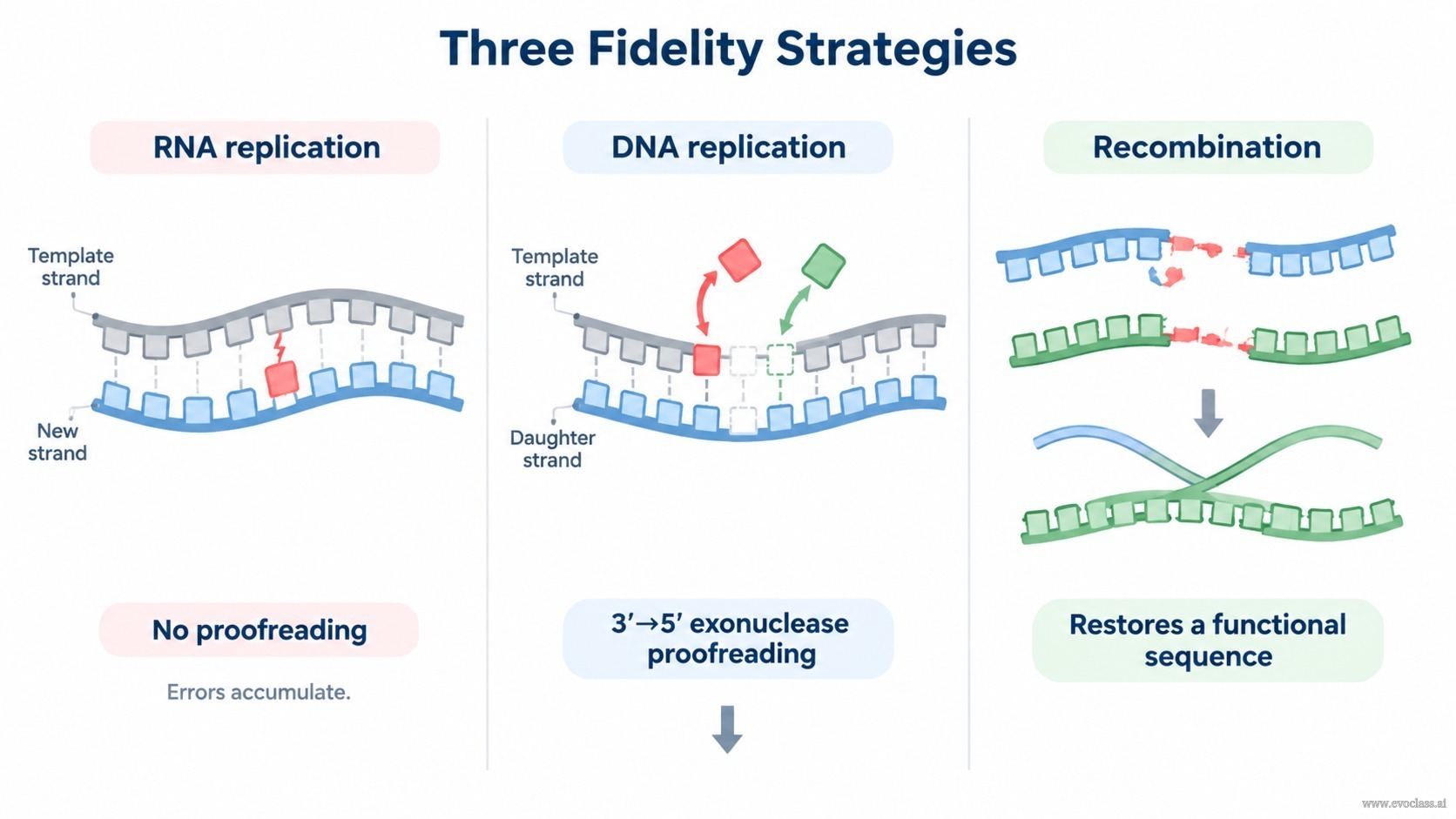
Three distinct strategies decide how much information a replicator can keep: the intrinsic fidelity of RNA replication, the exonuclease proofreading added by DNA replication, and recombination, which edits information at the level of templates and populations rather than of single base pairs. Together they set the effective mutation rate — and therefore where the error threshold falls and how stable a quasi-species can remain.
RNA replication: fast copying without proofreading
RNA replicases generally extend a growing strand without a 3′→5′ exonuclease domain. A misincorporated nucleotide is therefore neither recognised nor removed: replication is a single, non-editing synthesis step, and the error is carried into the daughter strand. The result is a high per-base error rate, on the order of one error per 10⁴ bases copied. Because the fraction of error-free progeny decays as genome length grows, long genomes cannot be maintained, so RNA genomes stay compact and sit close to the error threshold. The Qβ phage mutagenesis experiments illustrate this regime: instead of a single sharp wild-type sequence, the population appears as a broad mutant cloud distributed around a master sequence.
DNA replication: proofreading buys genome length
DNA polymerases usually carry a 3′→5′ exonuclease activity that inspects the newly added 3′ terminus. On detecting a mismatch, the enzyme reverses direction and hydrolyses the incorrect nucleotide before extension resumes, so the error is removed and the correct base is inserted. Proofreading layered on top of base-pairing selectivity lowers the error rate by two to three orders of magnitude. In error-threshold terms, a higher per-base accuracy q raises the largest genome that selection can maintain: with νmax ≈ ln σm ⁄ (1 − q), a smaller error rate (1 − q) relaxes the constraint and permits larger genomes with stable inheritance. DNA polymerase exonuclease mutants, which lose proofreading, show exactly the predicted increase in mutation rate and a reduced effective genome size.
Recombination: repair and reassortment at the template level
Recombination does not improve base pairing at the polymerase active site. It acts on templates and populations instead. Homologous recombination can reconstruct an intact sequence from two differently damaged templates; template switching can rescue a stalled or error-laden copy; and reassortment can combine beneficial variants into one background while purging deleterious ones. Its payoff depends on co-infection, available homology and the strength of selection, so from the quasi-species point of view recombination modifies the effective mutant load and the population-level mutation–selection balance rather than the per-base error rate itself.
Error threshold and quasi-species consequences
RNA's high error rate constrains νmax and keeps populations near the error threshold; DNA proofreading lowers the error rate and relaxes that constraint; recombination can reduce the effective mutant load or regenerate fit sequences, shifting the distribution of variants on which selection acts. The comparative principle follows directly: RNA fidelity favours rapid variation and compact information, DNA proofreading favours genome expansion and stable inheritance, and recombination favours population-level repair and modular innovation. These are complementary strategies, not mutually exclusive ones, and real replicators combine them to different degrees.
Comparative principle. RNA fidelity: rapid variation, compact genomes, high error load. DNA proofreading: order-of-magnitude lower error rate, νmax raised, large genomes inherited stably. Recombination: no change in base-pairing accuracy, but population-level repair, reassortment and purge of deleterious variants.
Three Fidelity Strategies
Left: RNA replication inserts a mismatched base and, lacking proofreading, leaves it in the daughter strand, so the per-base error rate stays high. Middle: a DNA polymerase's 3′→5′ exonuclease excises the mismatched 3′ nucleotide and inserts the correct one, lowering the error rate by orders of magnitude. Right: recombination joins two differently damaged templates to restore a functional sequence, repairing information at the population level rather than at a single base pair.