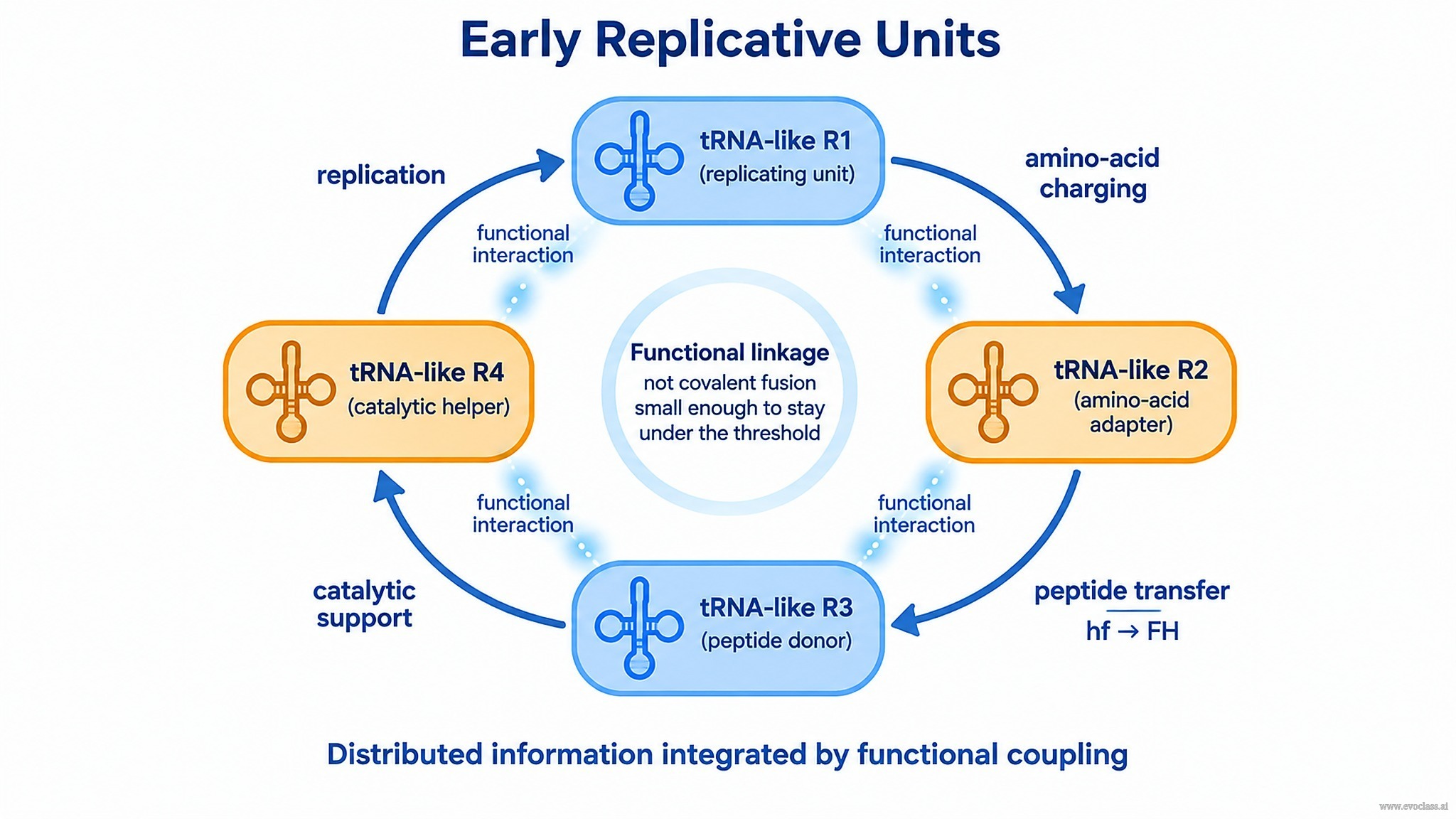
An early replicative unit faced a hard physical constraint. Copying is never perfect, and the error threshold ties the amount of information a replicator can carry to the accuracy of its replication: the longer the sequence, the more positions are exposed to mis-copying in every round, and the faster the encoded message erodes. Early replicators therefore had to stay small enough to be copied with usable fidelity, yet structured enough to carry a function that mattered. The molecules that satisfy both requirements at once are surprisingly modest in size — of the order of tRNA, roughly 70–90 nucleotides.
The size–fidelity trade-off
Write the condition for maintaining a meaningful sequence as q̄m ·
Why tRNA-like molecules fit the window
A tRNA-like RNA is small, but it is not formless. It folds reproducibly into a compact cloverleaf that further condenses into a stable L-shaped structure, and it can be charged with an amino acid at its 3′ end. Reproducibility of the fold is the decisive property: the same sequence always yields the same shape, so a single molecule can be simultaneously a template and a functional object. Small size keeps it below the error threshold; a stable fold lets it do chemistry — recognition, binding, amino-acid handling and catalytic assistance.
Integration without ligation
Splitting the total information across several small replicators solves the size problem but creates a new one: a set of independent replicators is a set of competitors, and the shortest or fastest one wins. The key argument of this slide is that integration does not require joining the molecules into one large genome. Integration can be functional: each molecule's product — an RNA, an amino acid, a peptide, a catalytic surface — becomes a resource for another molecule. When those dependencies close into a cycle, the set behaves as one cooperative unit, and this cyclic mutual support is the simplest realisation of hypercyclic organisation. Functional coupling, not covalent fusion, is what keeps distributed information intact.
tRNA-like molecules as adapters for primitive peptide chemistry
The same molecules provide the bridge to peptide synthesis. A tRNA-like RNA can act as an adapter or messenger: it carries a specific amino acid and can hand that amino acid over to a growing peptide chain without any sophisticated apparatus. Because only a limited number of sufficiently common amino acids has to be handled, and because specificity can reside in the RNA's own sequence, a primitive translation-like chemistry becomes conceivable using replicators that were already present for other reasons.
The hf → FH configuration switch
Whether a given tRNA is in the hf or the FH configuration depends on what it is attached to: an amino acid, or a peptide chain. Transferring the amino acid to the peptide chain flips the molecule from hf to FH. The model explains well how, in the absence of a sophisticated translation apparatus, a message can be read off — the state of the tRNA itself records whether the transfer step has occurred, giving the process a direction that a plain chemical equilibrium would not provide.
Take-away: small molecules, stable folds and cyclic functional coupling — not a large genome — are what allow early information to survive the error threshold.
Early Replicative Units
Four tRNA-like RNA replicators are arranged on a cycle and connected only by functional interactions — amino-acid charging, peptide transfer (during which the carrier flips from the hf to the FH configuration), catalytic support and replication. Because the dependencies close back on themselves, the set behaves as one integrated unit, so distributed information survives without being ligated into a single large genome.