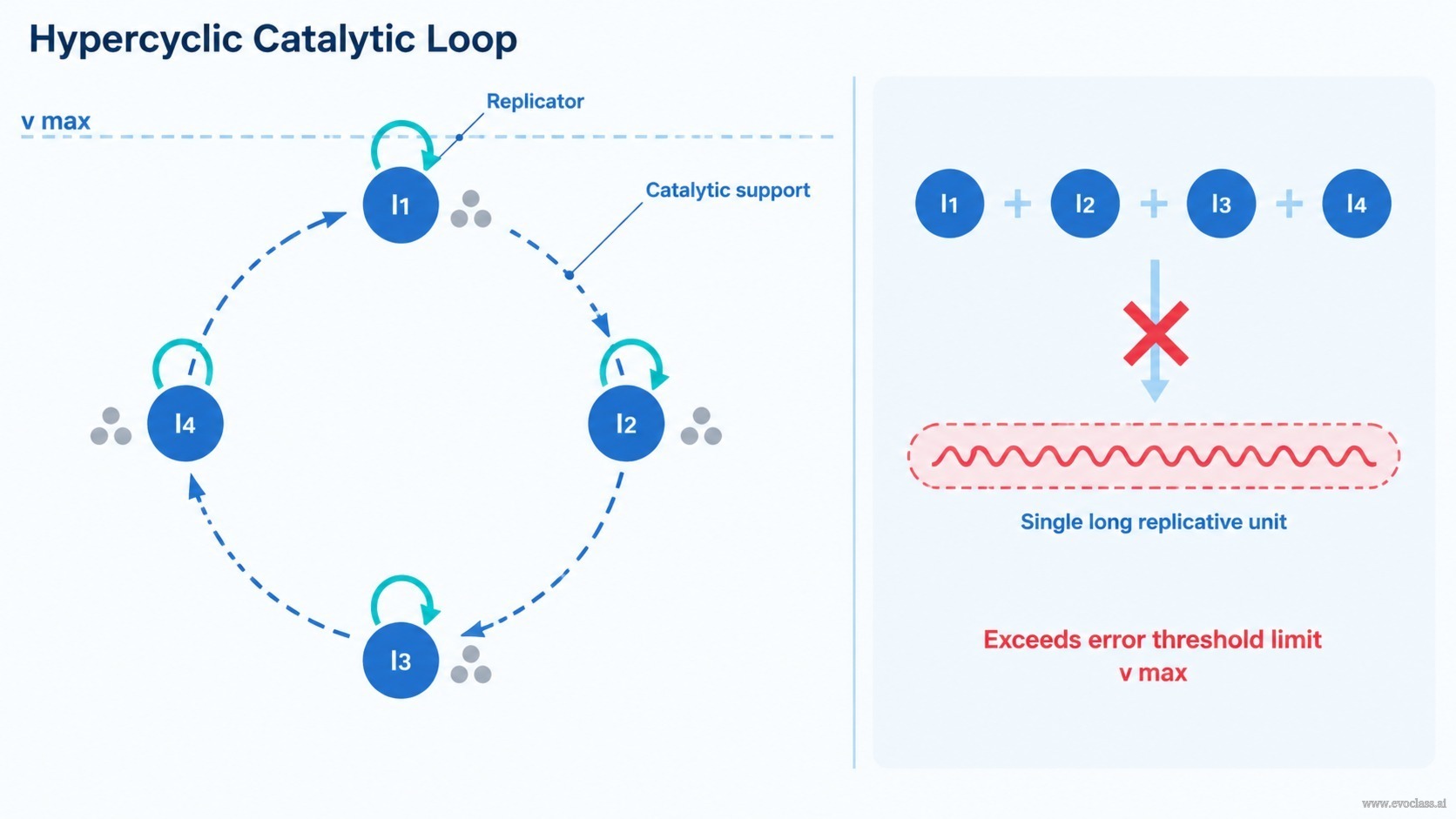
Earlier slides fixed a hard ceiling: for a given copying accuracy q̄ₘ and selective advantage σₘ, only sequences shorter than vₘₐₓ can be maintained as stable information. That ceiling is not a technical footnote — it decides how several early catalytic functions could ever be brought together into one evolving system.
The dead end of ligation. The obvious move is to join the required functions end to end into a single replicative unit. Ligation is ruled out by the threshold relation itself. A fused strand is roughly the sum of its parts in length, while the copying accuracy of the system stays the same, so the merged sequence overshoots vₘₐₓ and its master sequence delocalizes into the surrounding mutant distribution. The merged genome destroys exactly the information it was built to protect.
What integration has to preserve
A second condition is easy to overlook: every participating unit must remain competitive with respect to its own mutants. Selection is the only process that keeps specific information from drifting away into the mutant cloud. If a unit is buried inside a larger entity whose fitness is averaged over many functions, its own sequence is no longer under selective pressure and its information is lost. Integration therefore has to be functional rather than structural: it must couple units without diluting their individual selective advantages.
The hypercycle as the minimal solution
A hypercycle is a closed catalytic loop. Each replicator enhances the replication of the next, I1 → I2 → I3 → I4 → I1, and the enhancement returns to its starting point. Three consequences follow:
- Information stays distributed. Each function is carried by a short molecule, so no single unit has to exceed the error threshold.
- Competitive identity is retained. Every unit keeps its own replication and its own selection pressure against its mutant cloud, so its specific information can still be maintained and improved.
- The level of selection shifts. The reproducing and selectable entity is the cycle as a whole — a single integrated system that performs several functions at once, without any molecule carrying all of them.
Criteria for judging any proposed integration
Whatever mechanism is proposed, three conditions decide whether it can work: every unit must stay below the maximum stable length set by the error threshold; every unit must keep a selective advantage over its own mutants; and the coupling must be closed and cyclic, so that the coupled set reproduces itself as an integrated unit. Ligation fails the first condition. Loose, non-catalytic coexistence fails the third: independent replicators that merely share a compartment do not reproduce as one integrated system.
Why the solution is not the end of the story
Hypercyclic organization solves the integration problem, but it creates a new vulnerability. Because the loop supports its members catalytically, a replicator that accepts support without returning it — an internal parasite — can spread and erode the cycle. That is a later limitation of the mechanism, not an argument against it: the requirement is that integration must remain cyclic and controlled, not that it be parasite-proof from the outset.
Hypercyclic Catalytic Loop
A hypercycle links separate replicators in a closed catalytic loop (I 1 →I 2 →I 3 →I 4 →I 1), where each unit supports the replication of the next. Because every unit stays below the maximum stable length vₘₐₓ and keeps its own competition with its mutant cloud, several functions are integrated without the length penalty that makes ligation into one long strand unstable.