Limits of Hypercyclic Organization and Parasite Dynamics
HYC-1979Lesson 3: Error Threshold and Early Replicative Units
00:00
Hypercyclic organization can integrate several catalytic units into a single self-reproducing network, yet that integration is bounded. Under mass-action, constant-organization dynamics, a hypercycle faces two distinct pressures at once: self-reproductive parasites that collect catalysis without returning it, and the combinatorial mutant load that swells rapidly as the genome lengthens. Together these define a central limit of hypercyclic organization.
Parasites on the concentration simplex
Take a two-component system in which a parasite and a hypercycle member x share a total concentration . The parasite reproduces autocatalytically (rate constant ) and is sustained by catalysis that the cycle supplies, while the member x is reproduced through the coupling . The constant-organization dynamics (T.13.8) read:
The sign of ẋ separates two regimes at the threshold : for the member grows and the parasite is contained; for the member decays and the parasite invades. This is the quantitative statement of why a self-reproductive parasite can destabilize a hypercycle.
Corner versus interior states
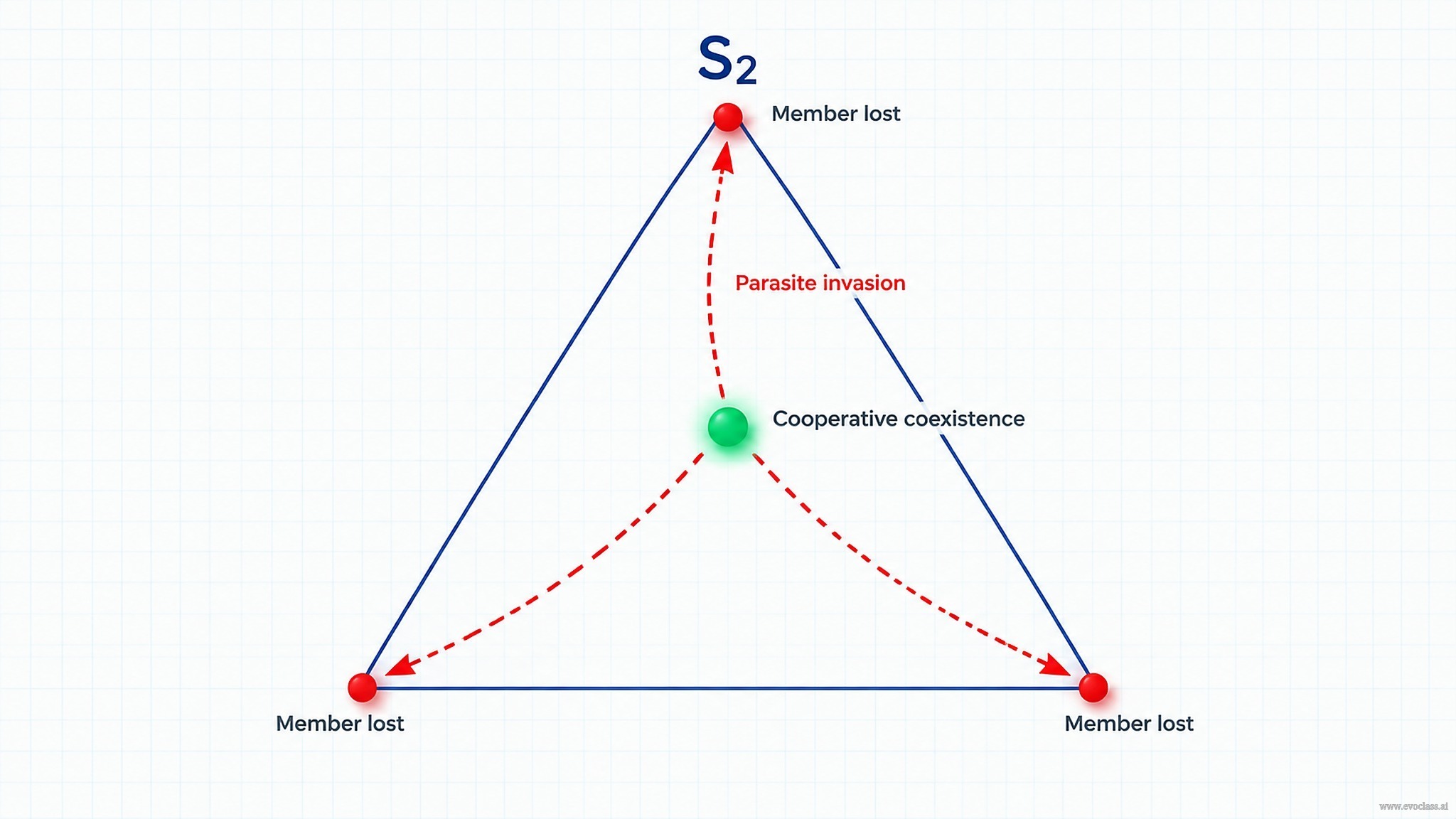
A hypercycle admits fixed points on the corners of the concentration simplex, each corresponding to the loss of one component, and an interior state representing cooperative coexistence of all members. The interior is productive but fragile: it is the region from which parasite invasion can drive the trajectory outward to the boundary, where a member is permanently lost.
Genome growth is combinatorially expensive
Lengthening the genome raises the mutation burden steeply. For a sequence of length 100 there are = (100 choose k) k-error mutants: 100 one-error mutants, 4,950 two-error mutants, 161,700 three-error mutants, and so on. When n such mutants are present with n ≪ , the number of their combinations grows as ( choose n) ≈ ⁿ / n!. This is why one steadily growing genome is disfavoured relative to hypercyclic organization of single mutant genes: cooperation spreads the catalytic function so that no single long sequence must absorb the whole mutant load.
Why structure matters
These limits are derived under the assumptions of well-mixed, constant-organization selection. Without additional spatial or compartmental structure, larger hypercycles face steadily increasing parasitic and mutational pressure, and the interior cooperative state cannot be maintained indefinitely.
Simplex with parasite invasion
A triangular concentration simplex S 2 whose red corner fixed points mark the loss of individual hypercycle members, while the green interior point marks cooperative coexistence. Dashed red arrows show a self-reproductive parasite driving the system from the vulnerable interior toward the boundary.
QUESTION 1
In the hypercycle model, what is the defining property of a self-reproductive parasite such as ?
It catalyzes the reproduction of every hypercycle member far more efficiently than they catalyze themselves.
It raises the overall replication rate of the cycle and therefore stabilizes it.
It receives catalytic support from the hypercycle but does not contribute catalysis back to the cycle.
It reproduces only when the total concentration c0 lies below .
✅ Correct!
A parasite reproduces and is catalytically supported by the cycle while giving nothing back, so it extracts the cycle's catalytic output without contributing to it.
❌ Incorrect
Focus on the asymmetry: the parasite takes catalysis but returns none, which is exactly what makes it destabilizing rather than supportive.
QUESTION 2
On the concentration simplex, what does a fixed point located at a corner represent?
Loss of one or more hypercycle members, so the system rests on the boundary rather than in the interior.
A balanced interior coexistence in which every member is present at equal concentration.
A hypercycle operating at its maximum possible replication rate.
A state in which parasite and member concentrations are exactly equal.
✅ Correct!
Corner fixed points correspond to the loss of a component; the interior, by contrast, is the cooperative state where all members coexist.
❌ Incorrect
Remember that simplex corners are extreme states where one component dominates and the others vanish — the opposite of balanced interior coexistence.
QUESTION 3
In the two-component model, holds for . What does this regime mean for the cycle?
The hypercycle member x still grows, so the parasite is contained at low total concentration.
The system jumps instantly to an interior equilibrium with no further change.
The parasite out-competes x and drives the member concentration to zero.
The total concentration c0 decays toward zero for every initial condition.
✅ Correct!
When c0 stays below the threshold the member retains positive growth, so the parasite does not yet dominate. Crossing above flips the sign to and the member is lost.
❌ Incorrect
Read the sign condition carefully: below the threshold means the member still grows there — invasion takes over only once c0 exceeds .
QUESTION 4
For a sequence of length 100, how many distinct two-error mutants exist?
100
10,000
4,950
161,700
✅ Correct!
The count is N2 = (100 choose 2) = ,950, the number of ways to place exactly two errors among 100 positions.
❌ Incorrect
Use the binomial count = (L choose k). For and this is ,950, not the single-error or three-error totals.
QUESTION 5
Which of the following best describes what is needed for larger hypercycles to withstand parasite and mutational pressure?
Additional spatial or compartmental structure that supports selection between groups.
Relying on well-mixed mass-action dynamics alone.
Simply increasing genome length without any change in organization.
✅ Correct!
The limits follow from well-mixed, constant-organization assumptions; added spatial or compartmental structure provides a further level of selection that can contain parasites and buffer mutation load.
❌ Incorrect
These limits arise specifically because the system is well mixed and of constant organization. What additional organization could relieve both pressures simultaneously?
Case Study: Taming a Self-Replicating RNA Hypercycle
Read the scenario below and answer the questions.
A laboratory models a self-replicating RNA hypercycle built from two catalytic members x and y, together with a parasitic RNA that is catalytically supported by the cycle but contributes no catalysis back. The system is treated as well mixed with constant total organization. The relevant parameters are the member-coupling constant k and the parasite self-reproduction constant , with total concentration . The team reports and considers running the cycle at two different total concentrations, and . They also plan to extend the catalytic genome length from 100 to 200 residues to add new functions.
Q
1. Using the sign condition on ẋ, determine what happens to the cycle at and at , and explain the long-run outcome in each case.
Answer: The threshold is . At , which is below the threshold, , so member x still grows and the parasite is initially contained. At , which is above the threshold, , so the member decays and the parasite invades. Because the dynamics are constant-organization, raising the total concentration is not a neutral choice: once the system crosses it is driven toward the boundary and settles at a corner fixed point where a member is lost.
Q
2. The team proposes lengthening the catalytic genome from 100 to 200 residues. Using combinatorial mutant counts, explain why this raises the error burden, and suggest one structural change that could help the hypercycle withstand both the mutational load and the parasite.
Answer: The number of k-error mutants is = (L choose k). Going from to roughly doubles the single-error count (100 to 200) and increases the two-error count sharply from 4,950 to about 19,900, with three-error counts rising even faster. Because the number of combinations of these mutants scales as ( choose n) ≈ ⁿ / n! for n ≪ , the combinatorial load grows super-linearly with genome length, so a single long genome becomes progressively harder to maintain. One structural remedy is compartmentalization or spatial structure — for example, encapsulating replicators in vesicles — which adds a level of selection between compartments, slows parasite spread, and buffers the mutation load, helping preserve the cooperative interior state.
XVI.3. Why Hypercyclic Organization of Single Mutant Genes Rather than One Steadily Growing Genome? 100 one-error mutants, 4950 two-error mutants 161 700 three-error mutants, etc., or = (100 over k) k-error mutants ( over n) ≈ ! (for n ≪ ), which leads to for and for . (2) The parasite is self-reproductive (Fig. 43b): ( x), ( x) (T.13.8) The system has two fixed points at the corners of :