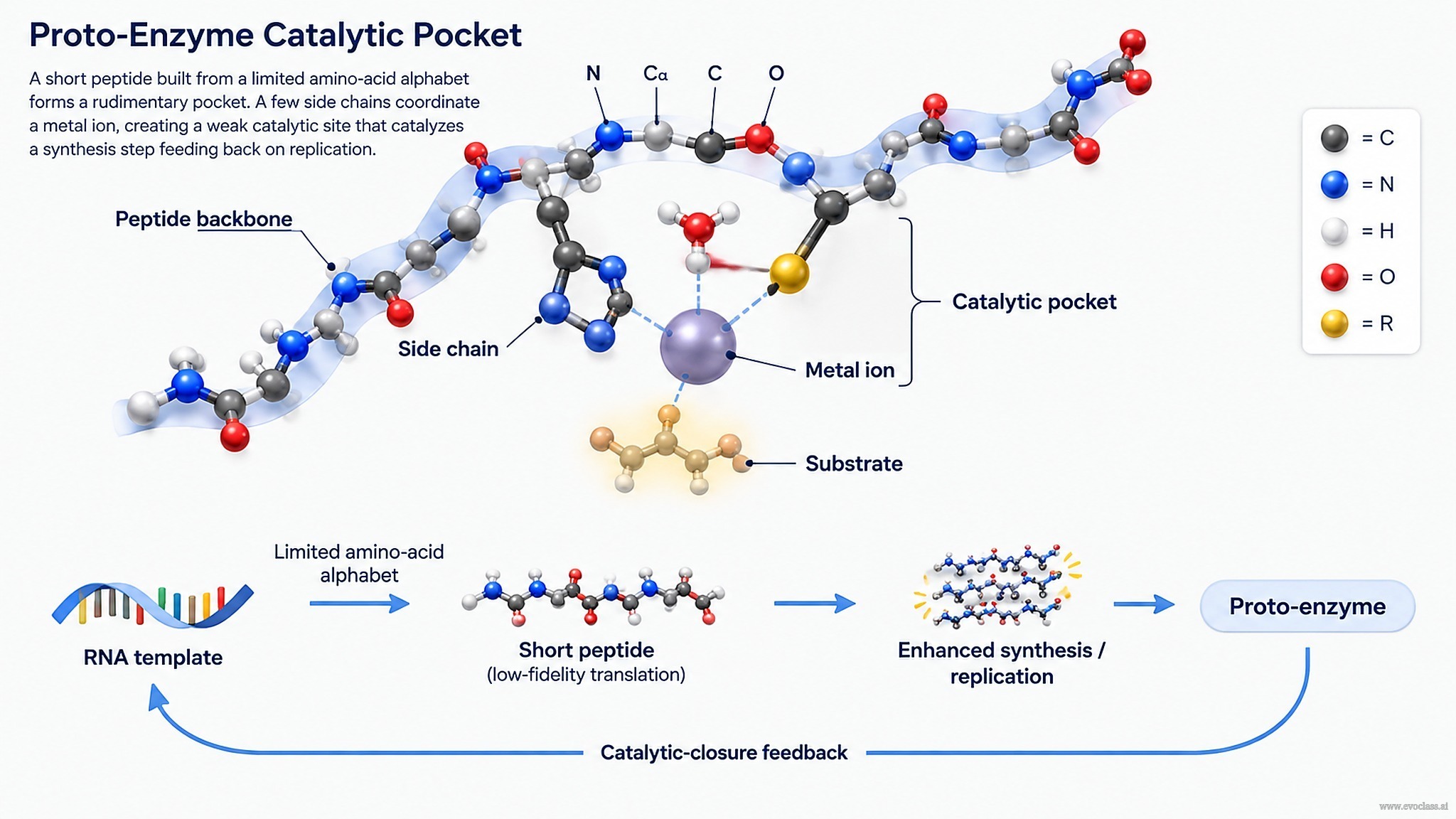
As early replicators approached the error threshold, a new class of molecules emerged that could link RNA-coded information to catalytic function: short, low-specificity peptides. These first functionally active proteins were not modern folded enzymes. They were built from a limited prebiotic amino-acid alphabet and relied on a few backbone and side-chain groups to form a rudimentary catalytic pocket.
What Made Them Functionally Active?
- Simple structures: Early proteins probably consisted of short peptides or small proteins, using a restricted set of amino acids. Their catalytic activity arose from a few backbone and side-chain groups that together created a primitive pocket.
- Selected role: Their likely function was to support replication by catalyzing synthetic reactions—such as nucleotide activation, polymerization, or peptide-bond formation—that fed back on the replication cycle.
- Catalytic closure: In a hypercyclic or translation-coupled setting, products encoded by one member could enhance synthesis or replication by other members, linking RNA information to protein catalysis.
- Transitional catalysts: Low-fidelity translation and replication restrict peptide length and catalytic precision. Only low-specificity proto-enzymes could be maintained before better proofreading and translation machinery evolved. These proteins represent a transition from RNA catalysis toward protein catalysis—not the sudden appearance of modern folded enzymes.
Example: Primitive Pocket
A short peptide with a few hydrophobic and polar side chains could form a primitive pocket that weakly catalyzes a synthesis step, feeding back on replication. Such a peptide would not be a precise enzyme; its activity would be marginal and error-prone, but sufficient to provide a selective advantage under the error threshold.
Proto-Enzyme Catalytic Pocket
A short peptide built from a limited amino-acid alphabet forms a rudimentary pocket. A few side chains coordinate a metal ion, creating a weak catalytic site that catalyzes a synthesis step feeding back on replication.
Proto-Enzyme Catalytic Pocket
A short peptide built from a limited amino-acid alphabet forms a rudimentary pocket. A few side chains coordinate a metal ion, creating a weak catalytic site that catalyzes a synthesis step feeding back on replication.