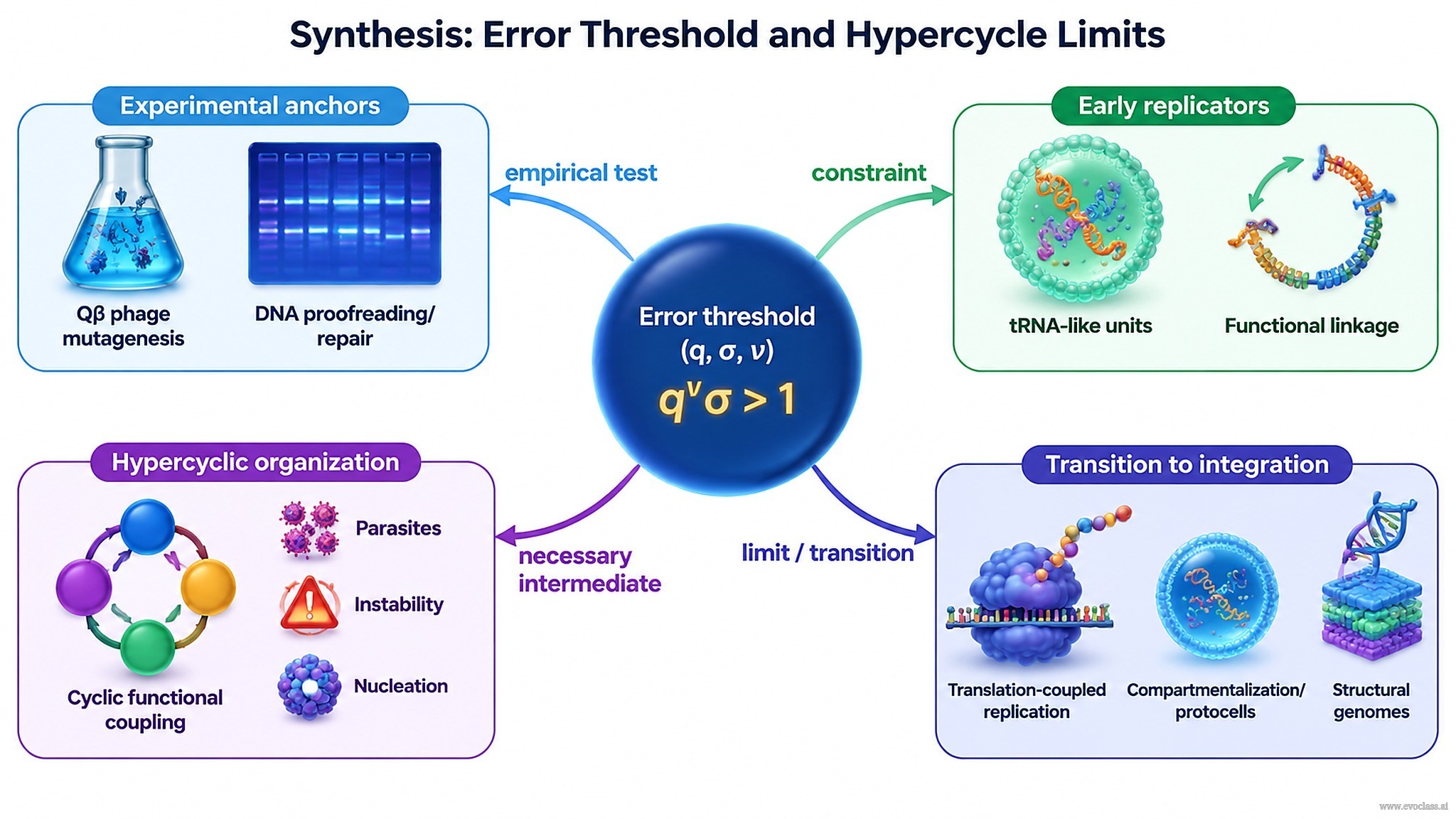
The error threshold sets the maximum stable information that a primitive replicator can maintain under a given replication fidelity and selective advantage. For sequence length ν and selective superiority σ, stable maintenance requires
The sentence-evolution game
The sentence-evolution game formalizes the same constraint with three variables: q̄m (copying accuracy), σm (selective advantage), and vm (sequence length). Together they predict whether a meaningful sequence is maintained or lost. Increasing vm without improving q̄m or σm pushes the system past the error threshold, so stable information survives only when fidelity, selection, and length are jointly balanced.
Experimental anchors: Qβ phage and DNA proofreading
Qβ phage mutagenesis experiments provide an empirical anchor: as mutation load increases, the mutant distribution broadens and wild-type dominance erodes, illustrating approach to the error threshold. In contrast, DNA proofreading and repair lower the effective mutation rate μ, shifting the boundary and making larger stable genomes possible. RNA replicators thus tend to approach the error threshold, while proofreading organisms can maintain more information.
Early replicators and functional coupling
Early replicative units likely remained short and tRNA-like. Their fidelity constrained both coding and catalytic capacity, so they could not carry large genomes. Instead of covalent ligation, they were linked by functional or catalytic coupling: each replicator supported the replication or activity of others, forming a cooperative network rather than a single integrated chromosome.
Hypercyclic organization: a necessary intermediate
Hypercyclic organization couples replicators cyclically, enabling collective selection, integration of more functions, and a route toward translation. It is therefore a necessary intermediate under low fidelity. Yet hypercycles have limits: they are vulnerable to parasitic or selfish mutant exploitation, depend on spatial or compartmental structure, suffer stability and nucleation problems, may show oscillatory or limit-cycle dynamics, and cannot integrate all genes structurally.
Beyond hypercycles: translation, compartments, and structural genomes
Improvements beyond hypercycles involve translation-coupled replication, compartmentalization or protocells, and structural integration into unified genomes. These changes align inheritance with the whole integrated unit, allowing selection to act on the entire set of genes rather than on loosely coupled replicators.
Error-Threshold Concept Map
The concept map centers on the error-threshold condition . It branches to experimental anchors such as Qβ phage mutagenesis and DNA proofreading, early tRNA-like replicators with functional linkage, hypercyclic organization with parasite and instability limits, and the transition to translation, compartmentalization, and structural genomes. Arrow labels mark 'empirical test', 'constraint', 'necessary intermediate', and 'limit / transition'.