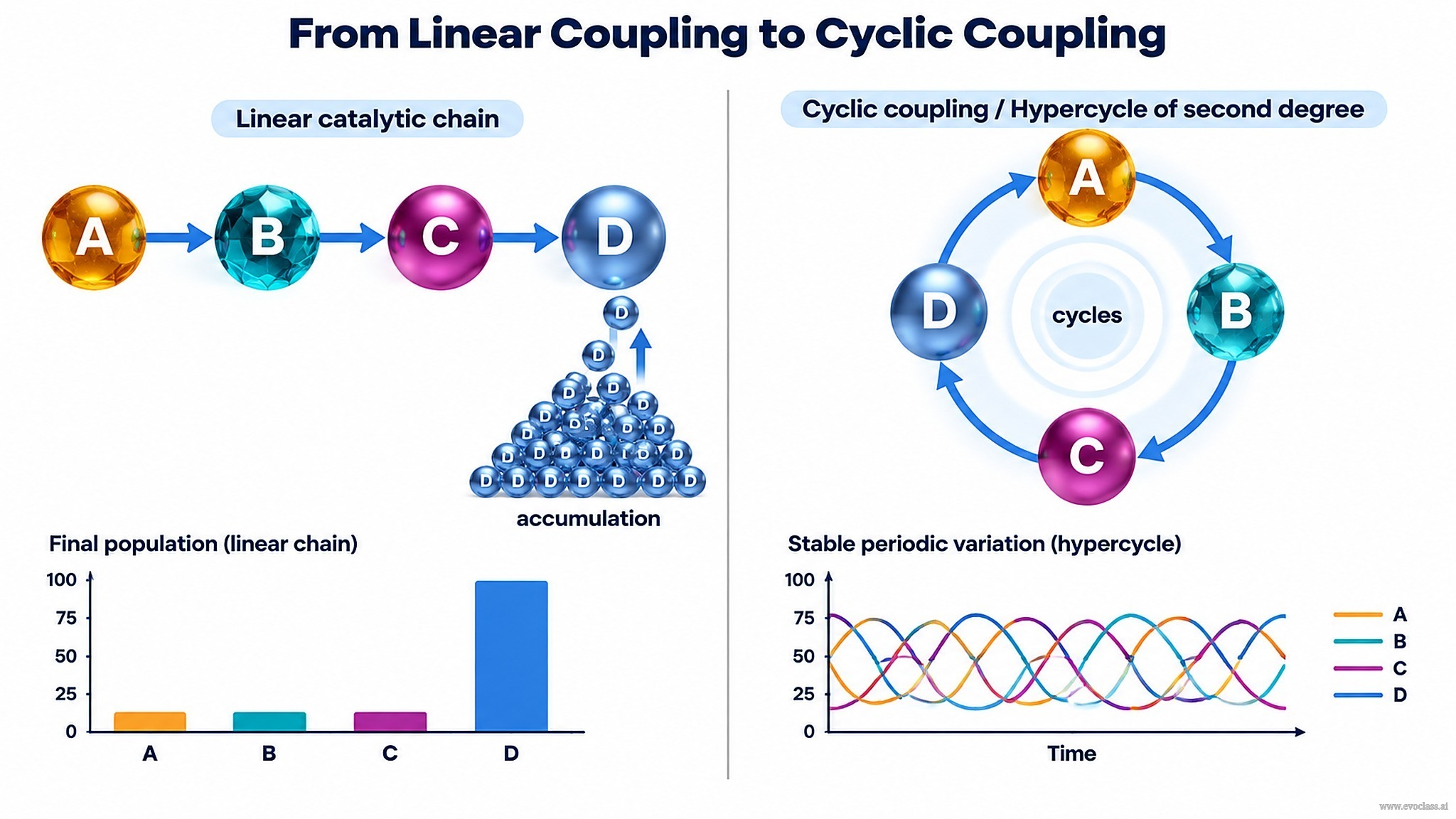
When replicative units feed catalytic advantage forward, the architecture of the coupling determines the selection outcome. In a linear chain A → B → C → D, each member accelerates the next, but no downstream member returns support to an earlier one. The advantage therefore travels in one direction and accumulates at the terminal node D, which acts as a growth sink.
Mathematically, if each component’s growth depends on itself and on the preceding catalyst, the linear case has a directed acyclic catalytic graph. D has incoming catalytic support but no outgoing catalytic obligation, so its relative concentration is favored under selection. Earlier members receive no returned catalytic benefit from downstream products.
Closing the chain
Adding the feedback link D → A removes the terminal sink. The catalytic graph becomes cyclic—strongly connected—so every member is both a product and a catalyst in a closed loop. The sentence is now a hypercycle of second degree: each member’s growth depends on its own concentration and on the catalytic contribution of the preceding member.
In the four-membered hypercycle, the four members hold stable, periodically varying population numbers. The outcome is collective maintenance rather than monopolization by a single terminal species. This transition changes the selection regime from a sink-dominated hierarchy to a self-sustaining cyclic organization, which is the foundation for later analysis of hypercycle stability, rate equations, and parasitic challenge.
From Linear Coupling to Cyclic Coupling
Side-by-side comparison of a linear catalytic chain A → B → C → D, where D acts as a terminal sink and accumulates advantage, versus a closed cyclic arrangement A → B → C → D → A, which forms a hypercycle of second degree and maintains all four members in stable, periodically varying population numbers.