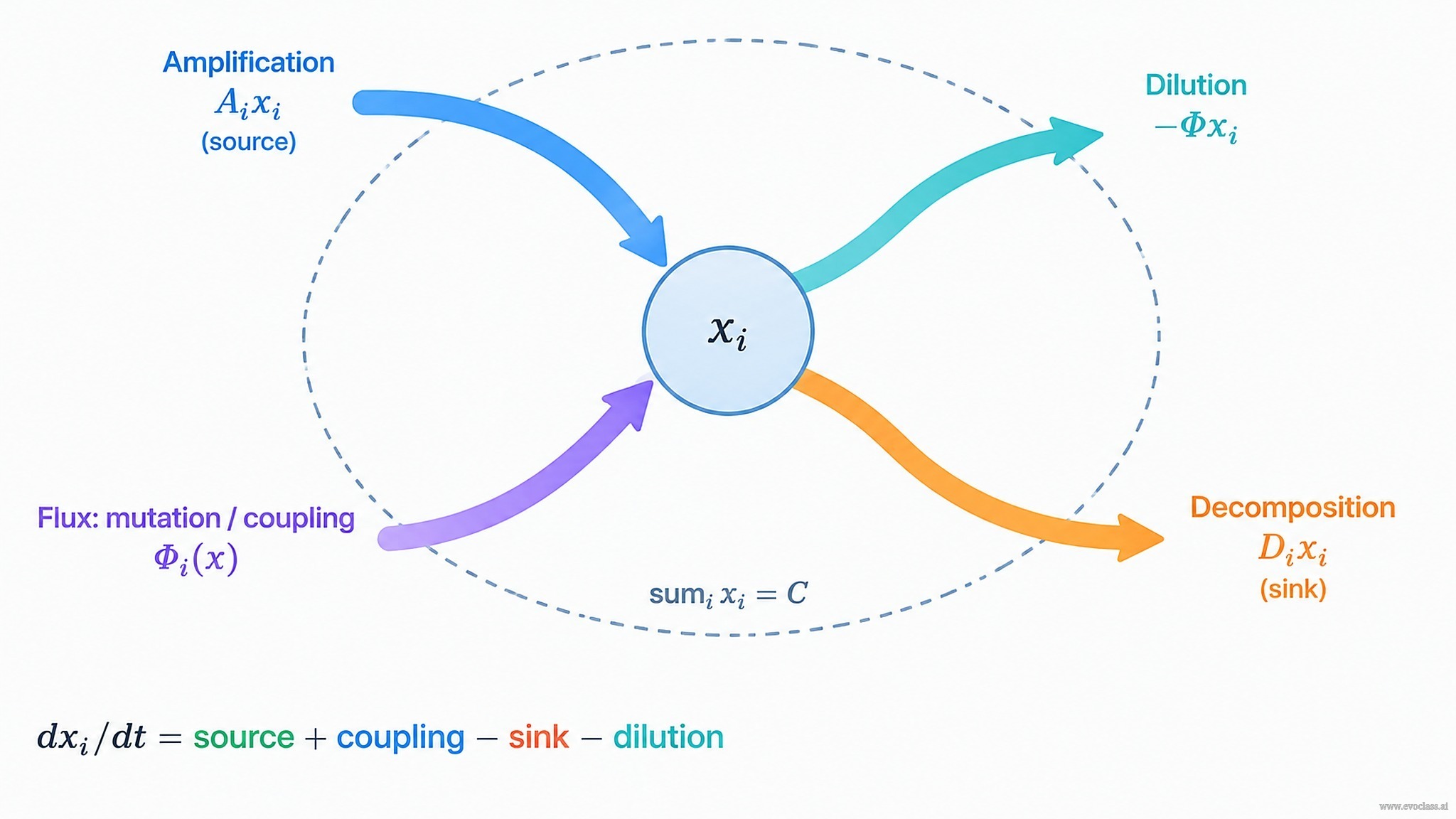
The general rate equation of a replicative unit
Here
Reading the three terms
- Amplification
is the positive source: self-reproduction of the unit or catalytic production of it by other units. How strongly depends on the other concentrations sets the growth degree and the hypercyclic coupling — for second-order catalysis the term is . - Decomposition
is the negative sink: decay, hydrolysis, inactivation, or any loss that removes the unit. Minimal models take it first order, , so that each unit disappears at a rate proportional to its own abundance. - Flux
covers redistribution among components by mutation or catalytic coupling. For an error-free, uncoupled set it vanishes. - Dilution flux −Φxi is the external outflow. Under constant organization it fixes the total concentration and turns absolute growth into relative selection.
Unlimited versus constrained growth
If no global constraint applies and amplification dominates,
Under constant organization,
so Φ is the average excess productivity of the whole set. A unit whose excess productivity exceeds the average grows in share while every unit is diluted proportionally. Decomposition together with dilution can then balance amplification, giving finite steady states, selection equilibria, or oscillations instead of unbounded growth.
Saturating generalizations
Bounded growth does not require an explicit dilution term. Replacing linear amplification by a hyperbolic (saturating) expression — rate ~
Worked example: a two-member cyclic hypercycle
For a two-member cyclic hypercycle with second-order catalysis and first-order decay,
with
Rate-Equation Flux Diagram
A flow-balance view of one replicative unit at the centre of the concentration simplex. Amplification (x) is the incoming source term, decomposition (x) is the outgoing sink term, the coupling flux Phi_i(x) redistributes material between units, and the dilution flux -Phi leaves the system. The dashed boundary marks the constant-organization constraint sum_i , which forces the four contributions to balance.