Under constant organization, the total concentration is fixed: . Growth functions are classified by the degree of the leading concentration-dependent production term in the rate equation
The dilution flux is a global balancing term, not an independent growth parameter. Summing the equations and imposing yields
Thus the exponent alone determines the qualitative selection regime.
Learning Objective
Classify growth functions by their degree and predict the resulting selection behaviour for and under constant organization.
: Concentration-Independent Growth
When , production is independent of concentration: . At equilibrium all species coexist with , so is proportional to . No competitive exclusion occurs; the dilution flux adjusts to keep the total constant.
: Linear Autocatalytic Growth and Darwinian Selection
When , the equation becomes . The species with the largest excludes all others: and all other . This is Darwinian selection of the fittest. The selectivity is in the rate constants, but the winner is the single fittest species.
: Quadratic and Hypercyclic Selection
When , production depends nonlinearly on concentration. For independent quadratic growth, , the system can show bistability or once-for-ever selection: whichever species first establishes a sufficient concentration excludes the others, and the winner can depend on initial conditions. If the quadratic terms are cyclically coupled, as in a hypercycle, the selected unit is a cooperative cycle of species rather than a single fittest species. Hypercyclic selection therefore changes both the winner and the stability of coexistence.
Worked Comparison
For two species with under constant organization, gives stable coexistence with ; drives and ; introduces nonlinear selection—bistability in uncoupled quadratic growth, or hypercyclic behaviour when the coupling is cyclic.
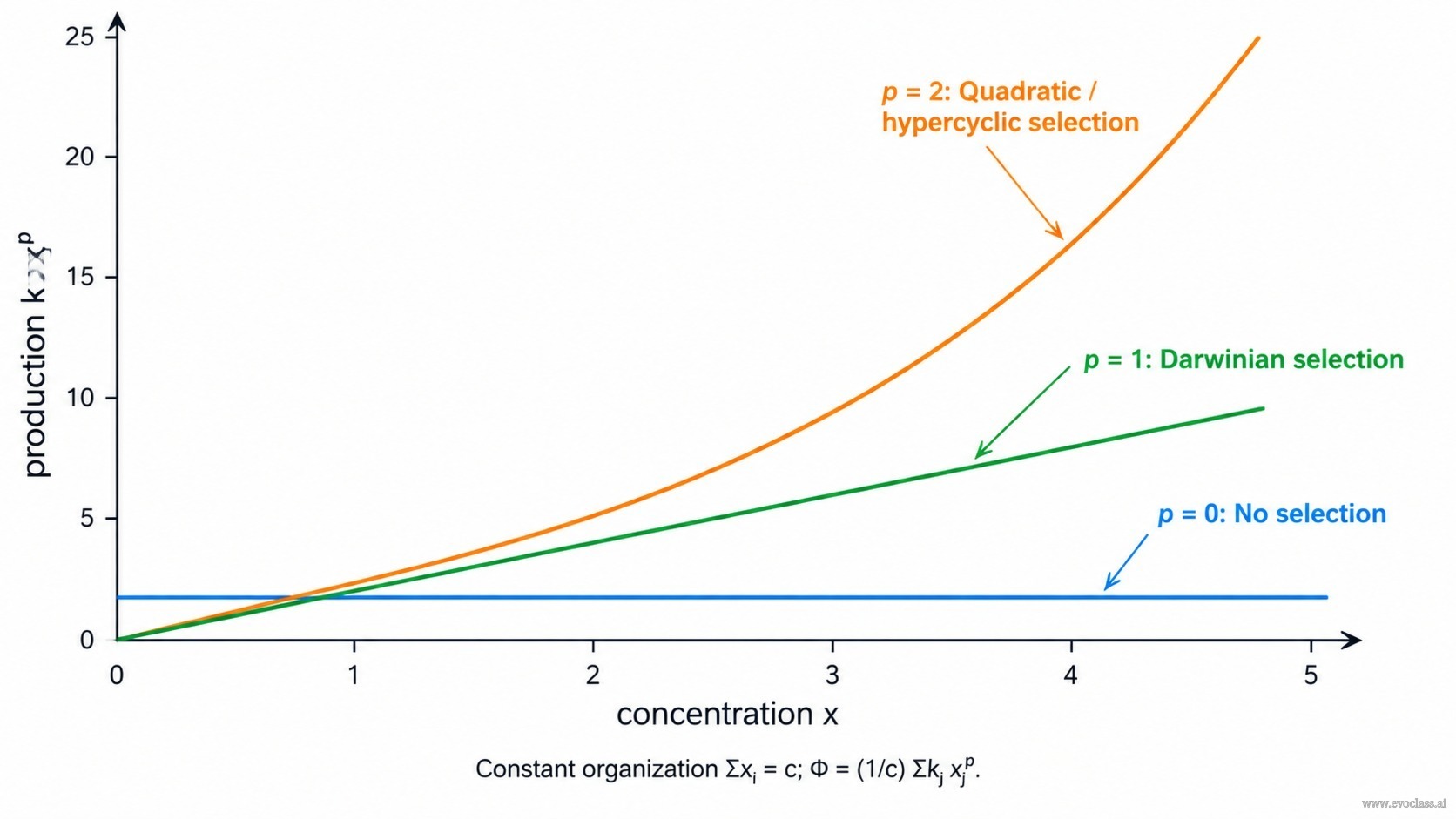
Growth Degrees and Selection Behavior
Plot of the production term k xᵖ versus concentration x for , 1 and 2 under constant organization. The horizontal line corresponds to no selection and coexistence proportional to kᵢ, the straight line through the origin corresponds to Darwinian selection of the largest kᵢ, and the upward parabola corresponds to quadratic or hypercyclic selection.
QUESTION 1
Under constant organization, what is the role of the dilution flux Φ in dx_i/dt = Φ?
It is a global balancing term that maintains Σx_i = c.
It is an independent growth parameter for species i.
It is the selection coefficient for the case .
It is the decomposition rate that removes species i.
✅ Correct!
Summing the rate equations under d(Σx_i)/dt = 0 forces Φ = (1/c)Σ , so Φ is determined globally rather than chosen independently.
❌ Incorrect
Φ is not a per-species parameter; it adjusts to keep Σx_i constant.
QUESTION 2
What value of p gives Darwinian selection of the fittest under constant organization?
✅ Correct!
For , dx_i/dt = (). The largest wins and all others decay.
❌ Incorrect
At all species coexist; is nonlinear/hypercyclic. Darwinian selection occurs at linear autocatalysis, .
QUESTION 3
For under constant organization, what is the equilibrium behaviour of species with different ?
The total concentration oscillates without a fixed point.
The winner depends on initial conditions, causing bistability.
All species coexist with proportional to .
Only the largest survives; all others go extinct.
✅ Correct!
gives dx_i/dt = k_i − x_iΦ. At equilibrium / Σk_j, so all species persist in proportion to their .
❌ Incorrect
is concentration-independent growth, which yields coexistence rather than competitive exclusion.
QUESTION 4
What distinguishes selection from selection?
is identical to apart from a rescaling of time.
is linear and always selects the single fittest species.
is nonlinear and can give bistability or hypercyclic selection.
removes selection and gives only neutral drift.
✅ Correct!
At the production term is quadratic. Independent quadratic growth can give once-for-ever selection, and cyclic coupling can give a hypercycle.
❌ Incorrect
The key difference is nonlinear concentration dependence. is linear; is quadratic.
QUESTION 5
In a second-degree hypercycle with cyclic coupling, what unit is selected?
Only the species that has the smallest rate constant .
A cooperative cycle of species, not a single fittest unit.
The single species that has the largest rate constant .
No single species, since all populations drift neutrally.
✅ Correct!
Cyclic quadratic coupling lets the hypercycle members hold stable, periodically varying populations, so the selected unit is the cycle.
❌ Incorrect
A hypercycle selects a cooperative set of species; single-species selection is the outcome.
Case Study: Two Competitors under Constant Organization
Analyze selection for , 1, and 2.
Two species A and B follow dx_i/dt = Φ under constant organization Σx_i = c, with . Their initial concentrations are (0) = .
Q
For , derive the equilibrium ratio and state whether the outcome is coexistence or competitive exclusion.
Answer: For , dx_i/dt = k_i − x_iΦ. At equilibrium , so . The total concentration gives , hence and . Both species coexist stably, with because . No competitive exclusion occurs.
Q
For and , compare the predicted selection outcome for independent growth. What changes if the species are cyclically coupled into a hypercycle instead of growing independently?
Answer: For , dx_i/dt = (); species A has larger , so → c and → 0: Darwinian selection of the fittest. For independent growth, dx_i/dt = (); once one species establishes a higher concentration, it excludes the other, but the winner can depend on initial conditions (bistability/once-for-ever selection). If the species are cyclically coupled, the quadratic term involves the previous species, forming a hypercycle. Then the selected unit is the cooperative cycle, and all members can coexist with stable or periodically varying concentrations rather than one species excluding the rest.