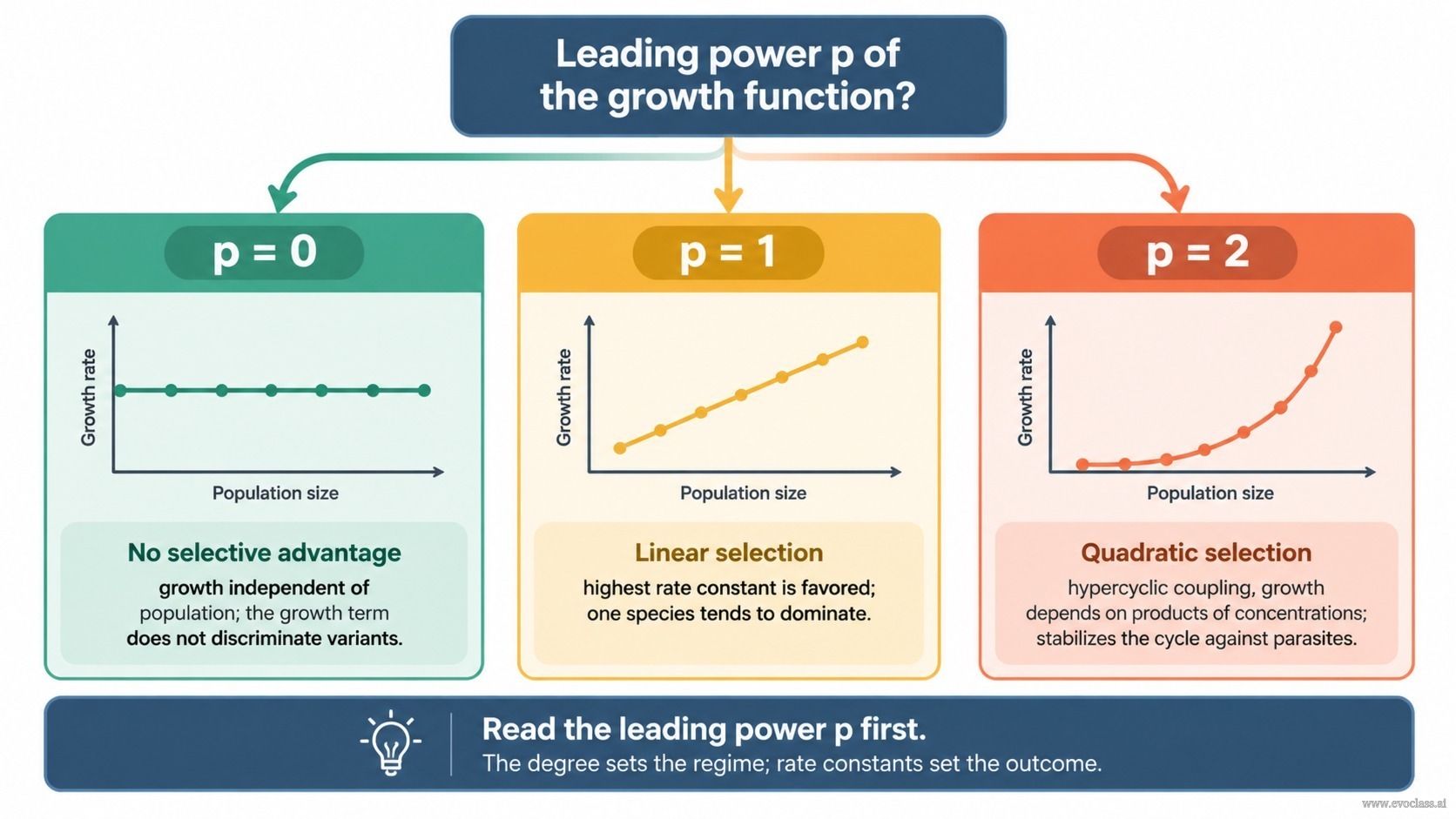
Growth degree classification identifies the leading power p of the population-dependent growth term in the selection equations. Under constant organization, p determines whether selection is neutral, linear, or quadratic, and thus the qualitative outcome for species or hypercycle stability.
Reading the leading power
: no selective advantage between species; growth is independent of population, so the growth term does not discriminate variants. : linear selection; the species with the highest rate constant is favored. : quadratic selection; hypercyclic coupling can stabilize a hypercycle against parasites because growth depends on products of concentrations.
Interpretive check
The check requires reading the leading power of the growth function before interpreting selection behavior. The degree classifies the regime, while rate constants set the quantitative outcome. For example, a growth term constant in x gives
Quick check
Before predicting winner or coexistence, identify p:
Growth-Degree Decision Tree
The leading power p of the population-dependent growth term classifies selection regimes: gives population-independent neutral growth, gives linear selection favoring the largest rate constant, and gives quadratic hypercyclic coupling that can stabilize a cycle against parasites.
Growth-Degree Decision Tree
The leading power p of the population-dependent growth term classifies selection regimes: gives population-independent neutral growth, gives linear selection favoring the largest rate constant, and gives quadratic hypercyclic coupling that can stabilize a cycle against parasites.