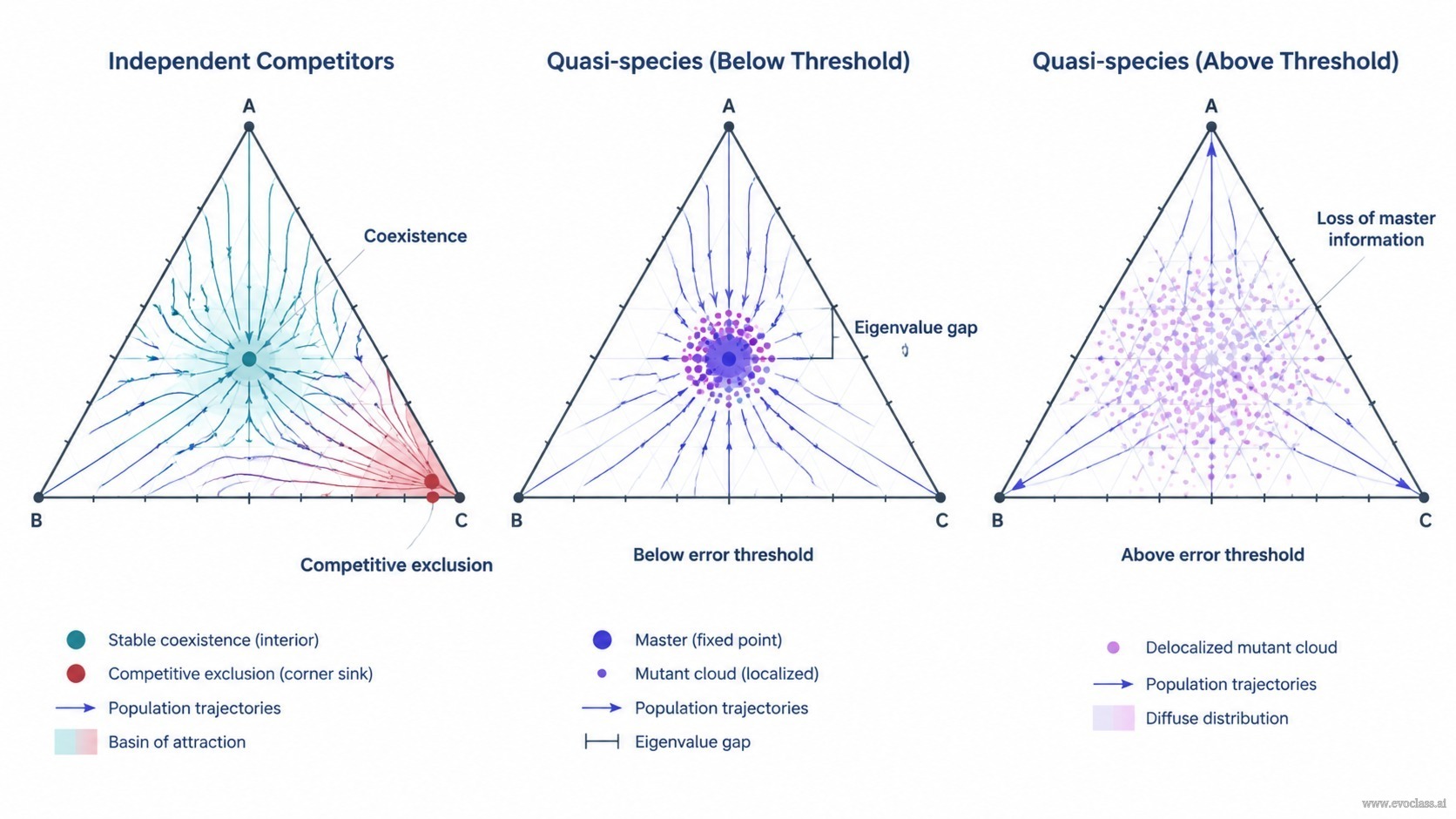
A fixed point of mutation–selection dynamics is a concentration vector x* that the flow leaves unchanged. On the concentration simplex, where normalized concentrations sum to one, fixed-point analysis separates three selective outcomes: stable coexistence, Darwinian selection of a localized master sequence, and once-for-ever selection of an integrated unit.
The general mutation–selection equation is
Here Qij is the probability that template j produces mutant i,
In matrix form this is the eigenproblem M x* = Ā x*, with
Independent competitors:
When mutation is switched off,
Quasi-species: mutation–selection balance
A quasi-species is a distribution of closely related mutants centered on a master sequence. It is not a single genotype but the stable fixed point of mutation–selection balance. The eigenvector of M determines the stationary distribution. Local stability is governed by the Jacobian normal modes about x*: a positive eigenvalue gap favors a localized, master-dominated quasi-species. If the mutation rate exceeds the error threshold, the localized fixed point loses stability and the stable quasi-species delocalizes over many mutants. This is information loss, not ordinary Darwinian selection.
Fixed-point taxonomy on the simplex
- Stable coexistence: an interior fixed point with multiple surviving types.
- Darwinian selection: a stable corner or a localized master sequence under competitive exclusion.
- Once-for-ever selection: irreversible fixation of an integrated unit that cannot be invaded by internal variants.
Assumptions and limits: constant organization, well-mixed mass action, deterministic large populations, and constant rate parameters. Finite populations, spatial compartments, recombination, and frequency-dependent catalysis can shift basins or introduce stochastic switching between localized and delocalized states.
Simplex Phase Portraits
Three-panel phase portrait on the concentration simplex: independent competitors can flow to a corner sink for competitive exclusion or to an interior point for stable coexistence; a quasi-species flows to a master-centered fixed point below the error threshold and delocalizes above it.