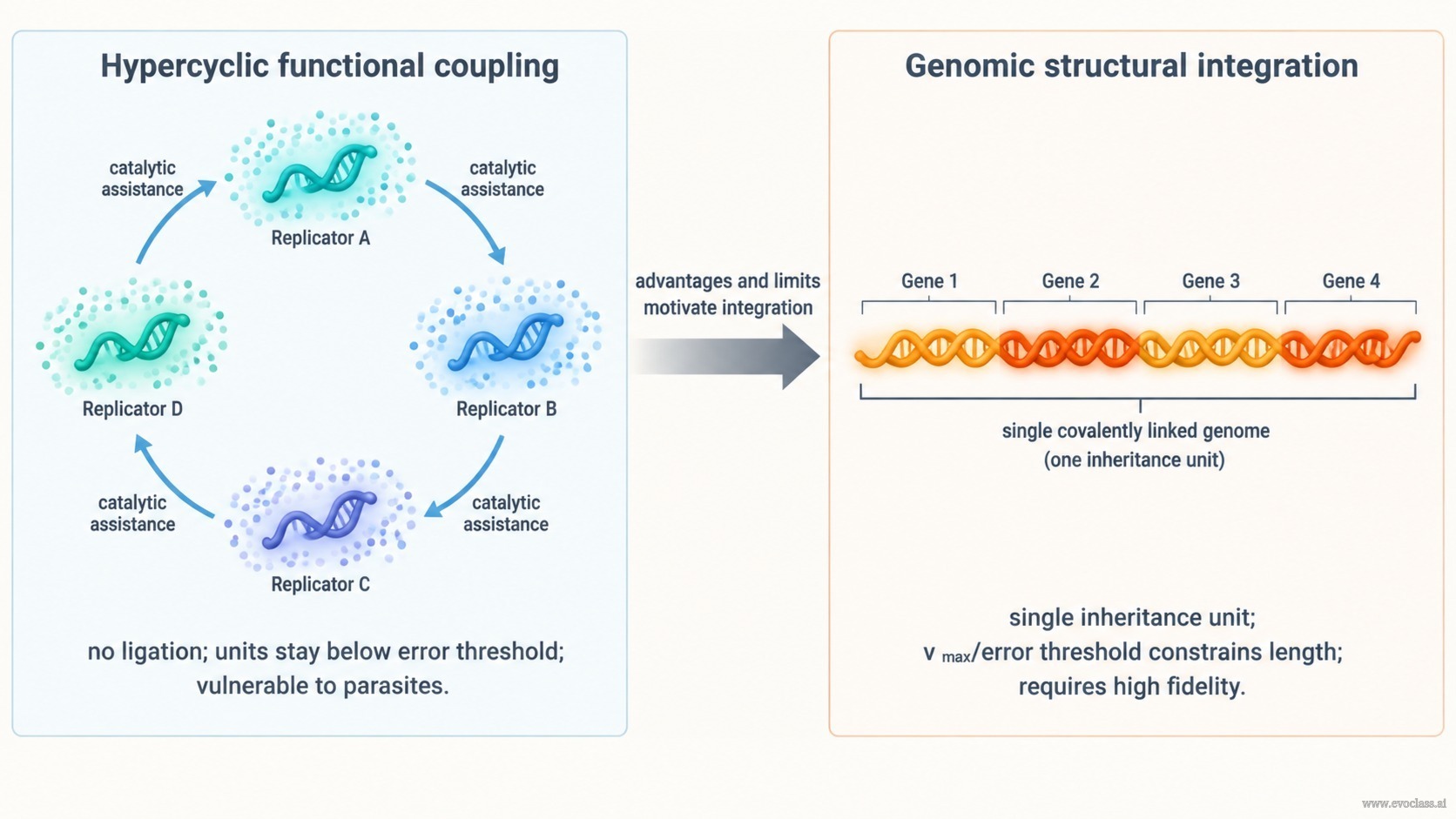
Hypercyclic integration is the functional, non-covalent cooperation among independently replicating molecules. It couples competitive units into a higher-level replicative system without ligating them into one large genome. That distinction matters because a single long genome faces the error threshold: at low replication fidelity, the mutation load grows combinatorially. For a 100-site sequence, there are 100 one-error mutants, 4,950 two-error mutants, and 161,700 three-error mutants; such numbers illustrate why one steadily growing genome is costly and why coupled small units can be favored early.
In a hypercycle, each unit assists the next catalytically, forming a closed loop. Because each unit remains short, it can stay below the error threshold and can continue evolving relative to its own mutants. Mutations remain distributed among separate units, while catalytic interdependence supplies collective function. The units therefore remain competitive with respect to their mutant clouds, preserving specific information rather than submerging it in a single long genome.
Yet hypercyclic organization has limits. First, it is vulnerable to parasites: selfish replicators that receive catalytic support but do not contribute. Cooperative integration is not automatically stable. Second, functional coupling is not complete structural integration; separate units must be coordinately replicated and inherited, creating problems of stoichiometry, segregation, and joint function. These limitations motivate the later transition to integrated genomes and cellular organization.
Advantages and Limits
- Non-covalent integration: couples competitive molecules without ligation; avoids or postpones the threshold relation for
that makes one steadily growing genome prohibitive at low fidelity. - Preserved evolvability: each unit remains competitive with respect to its mutants and can evolve further; mutations stay distributed among separate units.
- Collective function: catalytic interdependence coordinates many small quasi-species/mutant clouds.
- Parasite vulnerability: selfish replicators can receive support without contributing, so cooperation is not automatically stable.
- Incomplete structural unity: separate units require coordinated replication and inheritance, raising stoichiometry, segregation, and joint-function problems.
Thus hypercycle integration is advantageous as an evolutionary intermediate but limited as a long-term solution. Later integration must preserve competitiveness while overcoming fidelity and
Hypercycle Integration
A two-panel comparison. Left: a cycle of short catalytic replicator units coupled functionally, each with its own mutant cloud; labels note no ligation, units staying below the error threshold, and vulnerability to parasites. Right: one covalently linked genome as a single inheritance unit, constrained by the error threshold and requiring high fidelity. The central arrow shows that the advantages and limits of hypercyclic organization motivate structural integration.