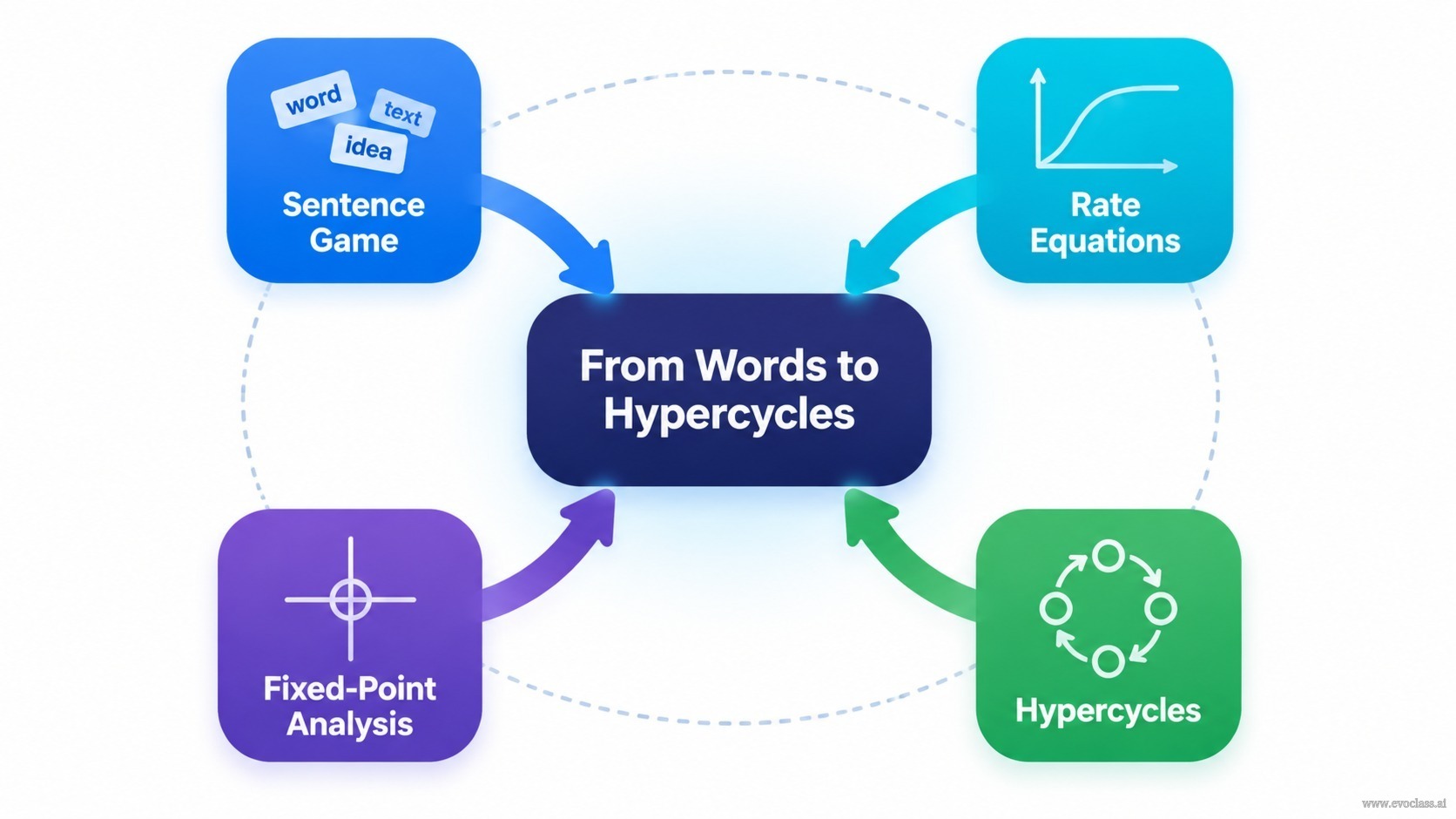
This closing page assembles the lesson into a single argument. Four strands — the sentence game, the general rate equation, the classification of growth by its degree, and fixed-point stability analysis — are not separate topics: each answers the same question at a different level of description, namely when does a collection of replicators become one selectable unit?
From Words to an Unstable Sentence
In the game built on TAKE ADVANTAGE OF MISTAKE, the four words are selectively equivalent replicators. Mutation and selection operate on each word on its own, so nothing couples word replication to sentence meaning: no sentence-level replicative unit emerges, one word wins by chance, and its error copies fluctuate roughly as a Poisson distribution. This is the molecular lesson in miniature — independent informational units do not automatically aggregate into a higher-level unit.
The Same Limit in Quasi-Species Terms
The quasi-species picture states the same point quantitatively. Without functional coupling, the amount of information a population can maintain is bounded by the error threshold: as mutation pressure rises, the master sequence dissolves into a broad mutant cloud and integrated organisation is lost. Independent words are the linguistic analogue of that cloud.
Coupling Advantage: Chains and Loops
Feeding a coupling advantage forward along a linear chain does not repair the situation — growth concentrates in the last member, and the chain behaves functionally as a single winner. Closing the coupling into a loop changes the outcome qualitatively: each member supports the next, the advantage returns to every participant, and the four-member sentence becomes a hypercycle of second degree with stable, periodically varying population numbers.
Rate Equations and Growth Degrees
A general rate equation separates amplification, decomposition and flux, so that the change of each concentration is amplification minus decomposition plus flux. Under constant organization a dilution flux keeps the total concentration fixed, and the leading power p of the growth term classifies the resulting selection behaviour:
— no self-amplification; growth is independent of concentration, so there is no selection and all species coexist. — linear autocatalysis; Darwinian selection of the fittest, with one survivor. — second-order, hypercyclic growth; cyclic coupling, coexistence of all members, and once-for-ever selection.
Fixed Points, Jacobian and Normal Modes
Which of these behaviours actually appears is decided by fixed-point analysis in the concentration simplex of normalised variables. Each fixed point is classified as a sink, a source or a saddle by linearising around it through the Jacobian; the eigenvalues give the normal modes with their growth or decay rates, and the separatrices between basins determine which attractor the system reaches. Applied to independent competitors the method yields stable coexistence or Darwinian selection of the fittest, and applied to quasi-species it reproduces the error-threshold result.
The Synthesis
"From words to hypercycles" is therefore a shift from independent informational units to cyclically coupled catalytic networks. When individual functions are linked so that each product supports the replication of the next, the collective organisation — not the isolated molecule — becomes the entity on which selection acts. Hypercycles are the mechanism that converts a set of competing replicators into an integrated, higher-order unit of molecular selection.
Synthesis Concept Map
The sentence game shows that words selected only for their own replication never stabilise into a sentence-level unit, which mirrors the error-threshold limit on uncoupled information. The rate-equation framework and fixed-point analysis supply the formal vocabulary for that limit, while closing the catalytic loop converts the same four members into a second-degree hypercycle whose collective organisation, not the isolated word, becomes the selectable unit.