Learning Objective: Analyze catalytic chains under constant organization and derive the six (and generally 2n) fixed points of the three-membered and n-membered systems.
Constant Organization and the Concentration Simplex
Under constant organization the total concentration c0 is held fixed. It is therefore natural to use normalized concentrations
Why Open Chains Have No Interior Fixed Point
Fixed points are found by setting the normalized rate equations to zero while enforcing
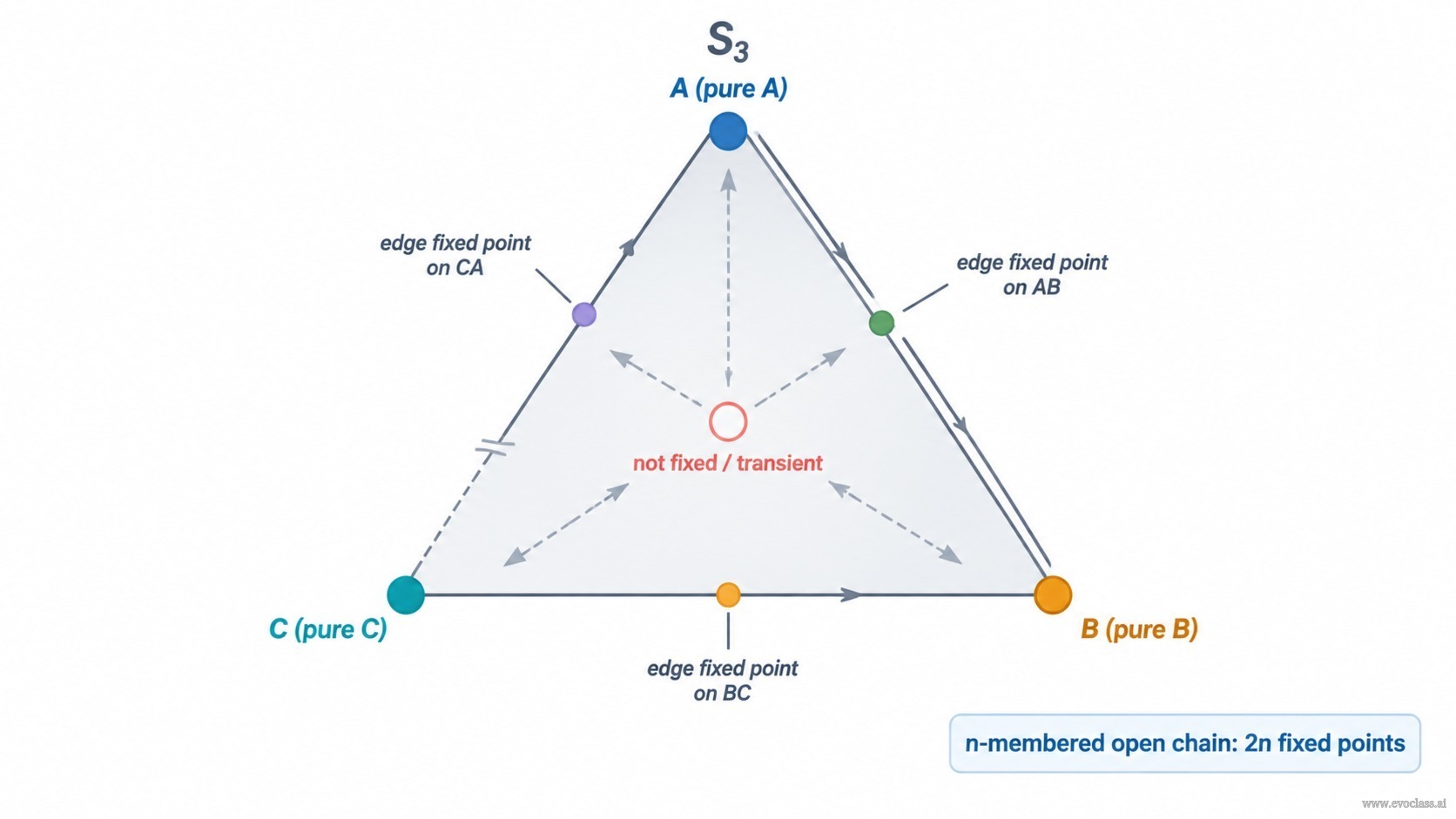
Counting the Fixed Points:
- For
, there are six fixed points: three pure corner states (A, B, C) and three two-species edge equilibria (AB, BC, CA). - For general n, the structural count is 2n fixed points, corresponding to corner and mixed boundary states.
- The 2n count is a fixed-point enumeration result. Stability and dynamical character are treated separately; a boundary fixed point need not be stable.
Worked Example: A → B → C
Consider a three-membered open chain A → B → C with no C → A closure. Solving the normalized fixed-point conditions under constant organization gives the six boundary fixed points: the three corners A, B, and C, plus the three two-species edge equilibria on AB, BC, and CA. The central interior state with A, B, and C all present is not a fixed point for the open chain. Under the chain dynamics, trajectories migrate toward the boundary, and the last member of the chain can eventually dominate in a once-for-ever selection.
Fixed Points of Open Catalytic Chains
For a three-membered open chain A → B → C, the six fixed points lie on the boundary of the concentration simplex S 3: three corners (pure A, B, C) and three edge equilibria on AB, BC, and CA. The central interior point with all three species present is not a fixed point because the chain lacks the closing C → A link.