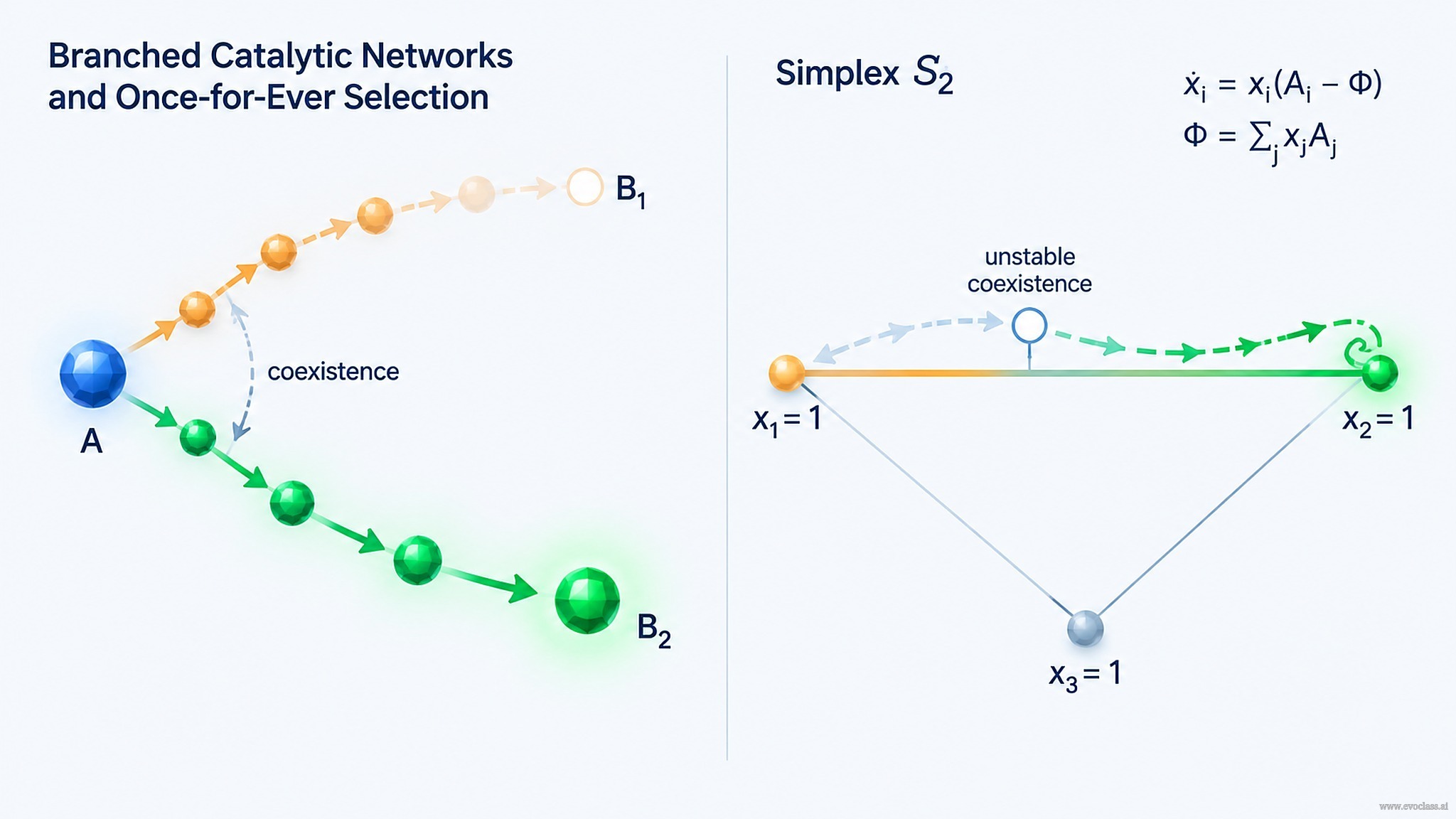
In a branched catalytic network, one catalyst or catalytic unit supports multiple competing replicators. Unlike a cyclic hypercycle, the coupling is open: there is no ring closure and no mutual dependence among all members. Under constant organization, the total concentration is fixed, and the dynamics of branch concentrations follow the standard selection equation:
Here
Fixed Points and Corner Selection
The concentration simplex
- If one branch has a larger
, it drives toward 1 while the other branches decline toward 0. - Fluctuations or small rate differences can tip the system, but once a branch gains an advantage, the fixed point migrates to its corner.
- Losing competitors go extinct; the system does not settle at an interior cooperative state.
Once-for-Ever Selection
This outcome is called once-for-ever selection: a winner-take-all commitment rather than cooperative integration. The stable fixed point migrates to one of the competing corners, and the system remains there. Branched couplings lack the closure and mutual dependence needed for a hypercycle, so they fail to integrate multiple functions into a joint catalytic organization.
Branched Catalytic Networks and Once-for-Ever Selection
One catalyst feeds two competing branches, while the concentration simplex S 2 shows the stable fixed point migrating from unstable interior coexistence to a pure-state corner. The winning branch attracts the system, and the losing branch goes extinct.