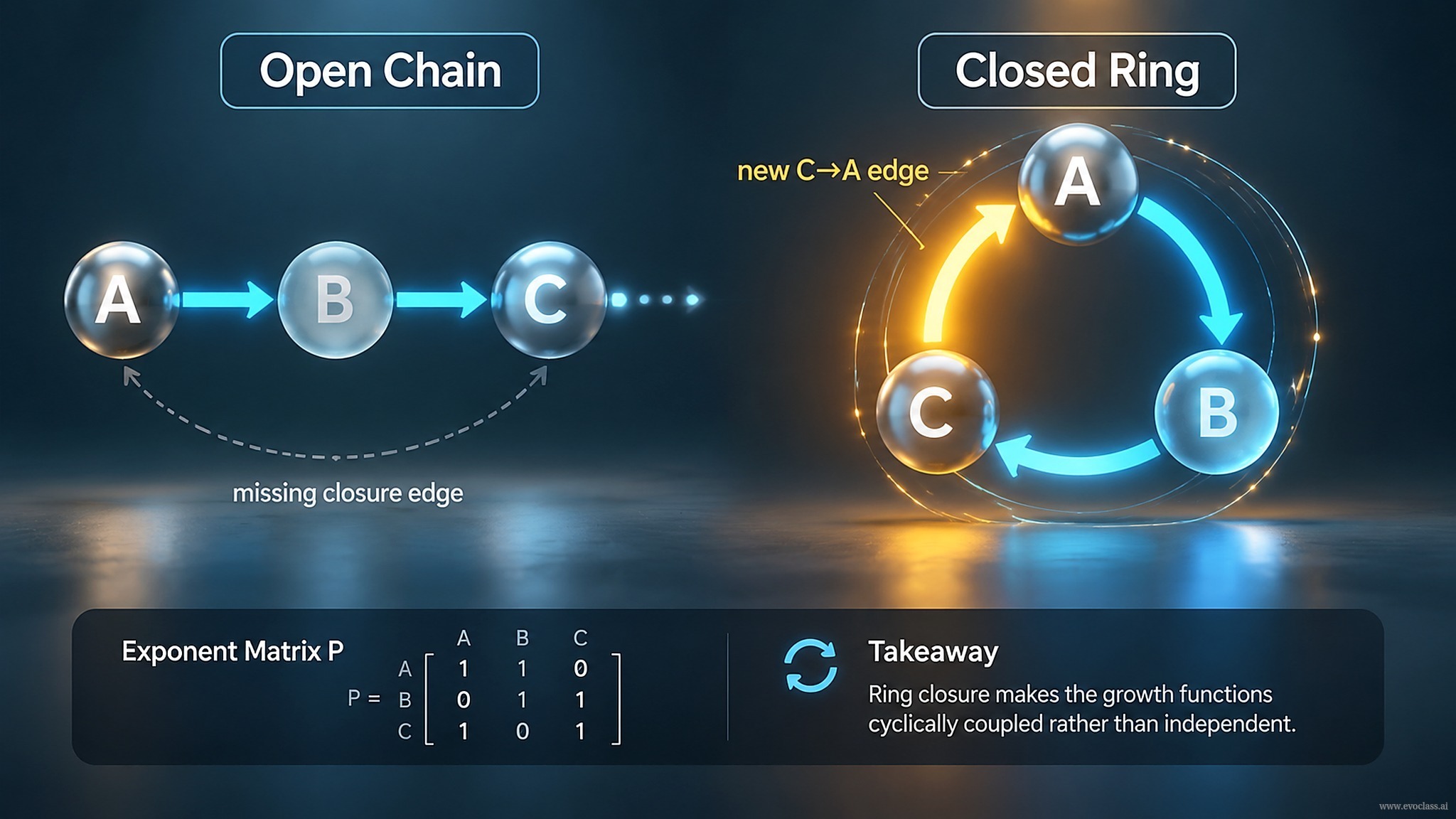
An open catalytic chain supports only a one-way flow of catalytic influence: if A catalyzes B and B catalyzes C, information can propagate forward but never feed back. Under constant organization such a chain has no interior attracting state — its fixed points migrate to the corners of the concentration simplex, so the last member finally dominates. The system performs a once-for-ever selection instead of sustaining a joint, cooperative function.
Ring closure: from cascade to hypercycle
Ring closure adds the single missing feedback edge — the edge from the terminal member back to the initial one. Closing the chain A → B → C supplies the C → A catalytic link and produces the cycle A → B → C → A. Every species now sits simultaneously upstream and downstream of the others, and the topology is no longer a directed line but a hypercycle: a cyclic catalytic arrangement whose members are cooperatively coupled and which can therefore integrate information rather than merely pass it along. An open chain stays a linear cascade; a closed ring becomes a hypercycle.
Growth functions on the ring
In a simple n-membered hypercycle the growth of species i is catalyzed by species i − 1 with indices taken modulo n, so the first species is catalyzed by the last and the loop is closed. The resulting growth terms are non-linear and second order, of the form xixi−1. Under constant organization these terms are balanced against a dilution/flux term Φ that keeps the total concentration fixed, so the relative concentrations evolve on the simplex.
Formally, hypercyclic growth functions are encoded by the exponent matrix P: row i records which concentrations appear in the growth function of species i and with what powers. Ring closure is exactly the cyclic entry P1,n = 1 (the wrap-around member of the cyclic i, i − 1 block), and this entry is what distinguishes a hypercycle from an open or branched catalytic network. Hypercyclic growth functions satisfy the homogeneity condition Σk pik = p and are classified by that exponent into elementary
Because the loop is closed, the qualitative behaviour of the system becomes cooperative and information-integrating rather than a collection of independently selected units: the coupled ring can sustain coherent, wave-like growth of all members instead of driving a single corner of the simplex to dominance.
Open Chain vs. Closed Hypercycle
Left: an open catalytic chain A → B → C in which catalysis runs one way, and the dashed missing C → A edge leaves the cascade without closure. Right: the same three members closed into the ring A → B → C → A; the solid C → A edge, labelled 'ring closure', converts the cascade into a hypercycle. The accompanying exponent matrix P records that each species is catalyzed by its predecessor (mod n), with diagonal 1s for self-replication and the cyclic P1,