Hypercyclic growth functions are not arbitrary; their catalytic architecture is encoded in a single compact object: the exponent matrix P = (pik). For a hypercycle with n species, P is an n × n matrix of nonnegative integers. The entry pik specifies the exponent—or molecularity—with which species k contributes to the growth function of species i. A zero entry pik = 0 means that species k has no catalytic influence on species i; a positive entry gives the order of that influence.
The matrix is subject to two structural constraints that make it a hypercycle rather than a general catalytic network. First, the homogeneity condition requires that every row of P sum to the same integer p:
∑k pik = p for all i.
This means every species shares a common total growth degree p. If one row summed to a different value, the species would have different molecularities, and the growth functions would not be homogeneous of a single degree. Second, the cyclic symmetry condition requires that P be invariant under a simultaneous cyclic relabeling of indices: i → i+1 and k → k+1 (mod n). Consequently pik = pi+1,k+1 (mod n). This makes P a circulant matrix (or block-circulant in compound cases), so the catalytic pattern is identical for every member up to rotation.
Elementary versus compound hypercycles
The exponent matrix classifies hypercycles into two broad types.
- Elementary hypercycle. The simplest closed cyclic case usually has
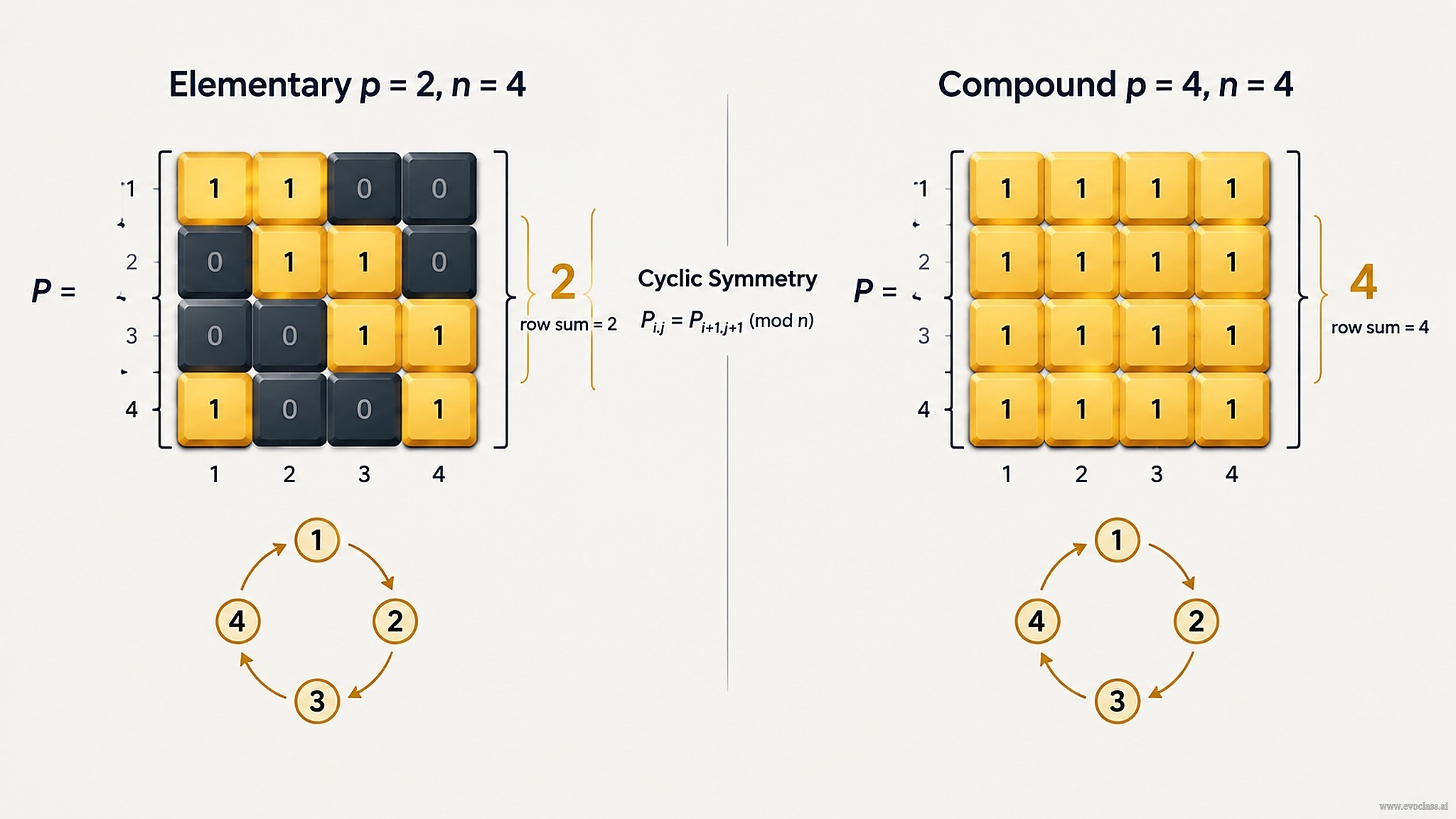
. Each growth function depends on the species itself and its immediate cyclic predecessor. For , the matrix has pii = 1 and pi,i-1 = 1 (indices mod 4), so every row sums to 2. The matrix is sparse: exactly two 1s per row, with all other entries zero. - Compound hypercycle. A higher-order cyclic organization, for example
or multiple nonzero cyclic contributions per row. For and , each row can contain four unit cyclic contributions, giving quartic homogeneous growth functions while retaining cyclic symmetry. The matrix is denser (or has higher-order entries) but remains circulant.
Classification criterion: elementary versus compound is read from the value of p and the sparsity or pattern of P, not merely from the number of species. A four-membered cycle can be elementary
The figure below contrasts the two matrix types. In both panels, row sums are annotated, and the circular index key marks the cyclic relabeling that leaves P invariant.
Exponent Matrix and Hypercycle Classification
Side-by-side 4×4 exponent matrices P for an elementary hypercycle and a compound hypercycle. In the elementary matrix, each row has two positive unit entries (self and cyclic predecessor), so every row sums to 2. In the compound matrix, every entry is 1, so each row sums to 4 and the growth functions are quartic. Both matrices are circulant, reflecting cyclic symmetry under i → i+1 (mod n).