Under constant organization the total concentration of the hypercycle is held at the fixed value c0, so every admissible state lies on the concentration simplex
Imposing this condition on an n-membered hypercycle produces a remarkably simple fixed-point set. The central fixed point is x̄0 = (c0/n)(1, …, 1)ᵀ, so every one of the n species carries the identical concentration c0/n and the n shares sum exactly to c0. Because all coordinates are equal, this point lies in the interior of the simplex and is permutation-symmetric: relabelling the species of the cycle leaves it unchanged. It is the equilibrium of full cooperation — no member is favoured over any other.
One Central Point and n Corner Points
- Central fixed point: x̄0 = (c0/n)(1, …, 1)ᵀ — an equal-concentration, permutation-symmetric equilibrium in the interior of the simplex, where every member coexists.
- n corner fixed points: one for each member, with that species at concentration c0 and all remaining species at zero. Each species can, in principle, be the sole survivor.
- Corners are pure states: they sit at the vertices of the simplex, so they describe a single dominating species rather than an integrated, cooperating community.
Worked Example:
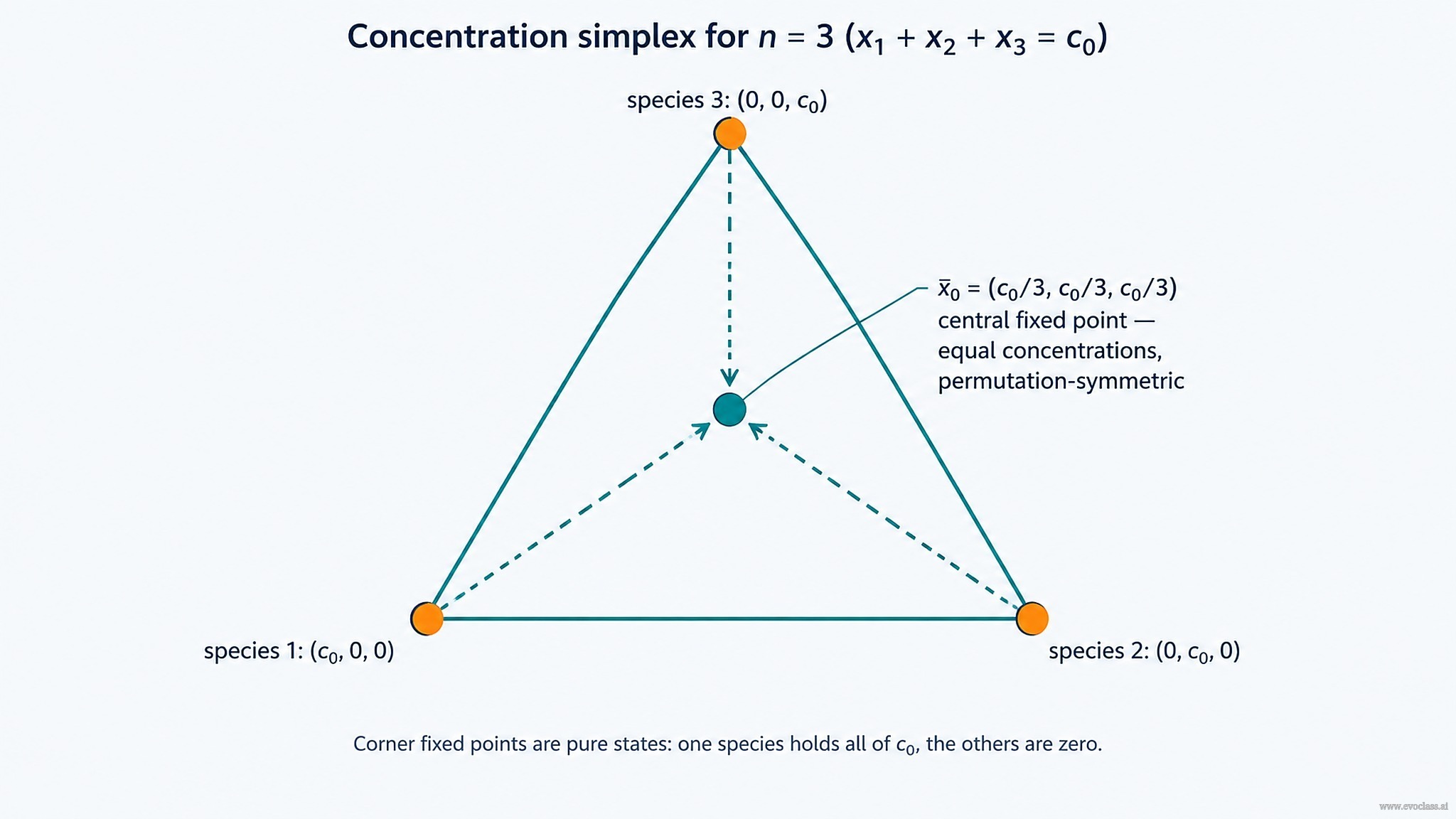
For a three-membered hypercycle the concentration simplex is a triangle. The central fixed point is (c0/3, c0/3, c0/3), and the three corner fixed points are (c0, 0, 0), (0, c0, 0) and (0, 0, c0). The fixed-point set relevant to this step therefore contains one central equal-concentration equilibrium plus n pure-state corner equilibria — 1 + n points in total, four in this example. Note that the existence of the corners is immediate from the symmetry of the system; whether the interior point actually attracts trajectories depends on n and on the normal modes of the system, which is analysed as a separate step.
Central and Corner Fixed Points of the Hypercycle
A triangular concentration simplex for a three-membered hypercycle, with one permutation-symmetric central fixed point at (c 0 /3, c 0 /3, c 0 /3) in the interior and three pure-state corner fixed points at (c 0, 0, 0), (0, c 0, 0) and (0, 0, c 0) on the vertices. Schematic inward trajectories indicate that the centre is the equal-concentration equilibrium reached cooperatively, while each corner represents collapse onto a single species.