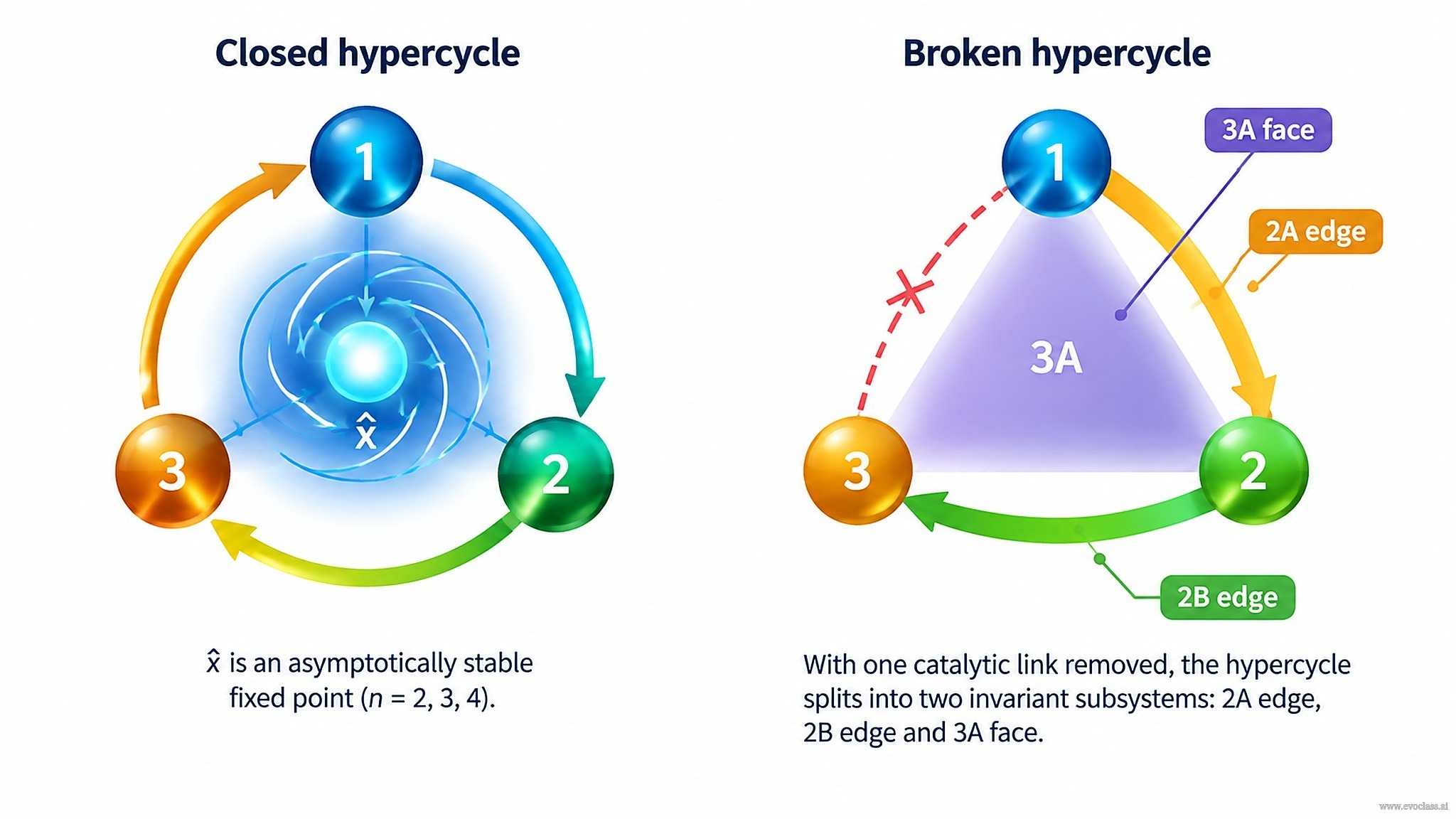
A hypercycle's central fixed point can be certified as asymptotically stable without solving the full nonlinear system, by exhibiting a Lyapunov function V(x) that vanishes at the equilibrium, stays strictly positive everywhere else, and decreases steadily along every trajectory the system can follow.
The Lyapunov Criterion
A function V(x) qualifies as a Lyapunov function for the central fixed point x̂ when V(x̂) = 0 and V(x) > 0 for all
Stability for
For small hypercycles of dimension
Broken Hypercycles and Invariant Subsystems
If a single catalytic link is broken, the network no longer closes into one self-reinforcing cycle. Instead it partitions into globally invariant subsystems: sets of species whose dynamics never leak into the rest of the system. Because orbits are trapped inside them, each subsystem can be analysed on its own.
- 2A edge — a flowing edge that transmits catalytic influence.
- 2B edge — a fixed-point edge that settles to rest.
- 3A face — a two-dimensional subsystem spanning the remaining members.
Studying these lower-dimensional objects recovers the stability and selection behaviour of the broken cycle piece by piece, and links the Lyapunov analysis of intact hypercycles to the dynamical decomposition of broken ones.
Broken Hypercycle Subsystems
A hypercycle with one catalytic link removed no longer forms a single closed loop; its remaining architecture appears as globally invariant subsystems — the 2A edge, the 2B edge and the 3A face — each analysable for stability on its own. On the left, the intact three-membered cycle carries a central fixed point x̂ that a Lyapunov function certifies as asymptotically stable for