10
Limit Cycles and Coherent Growth
HYC-1979 Lesson 5: Selection, Species, Will
00:00

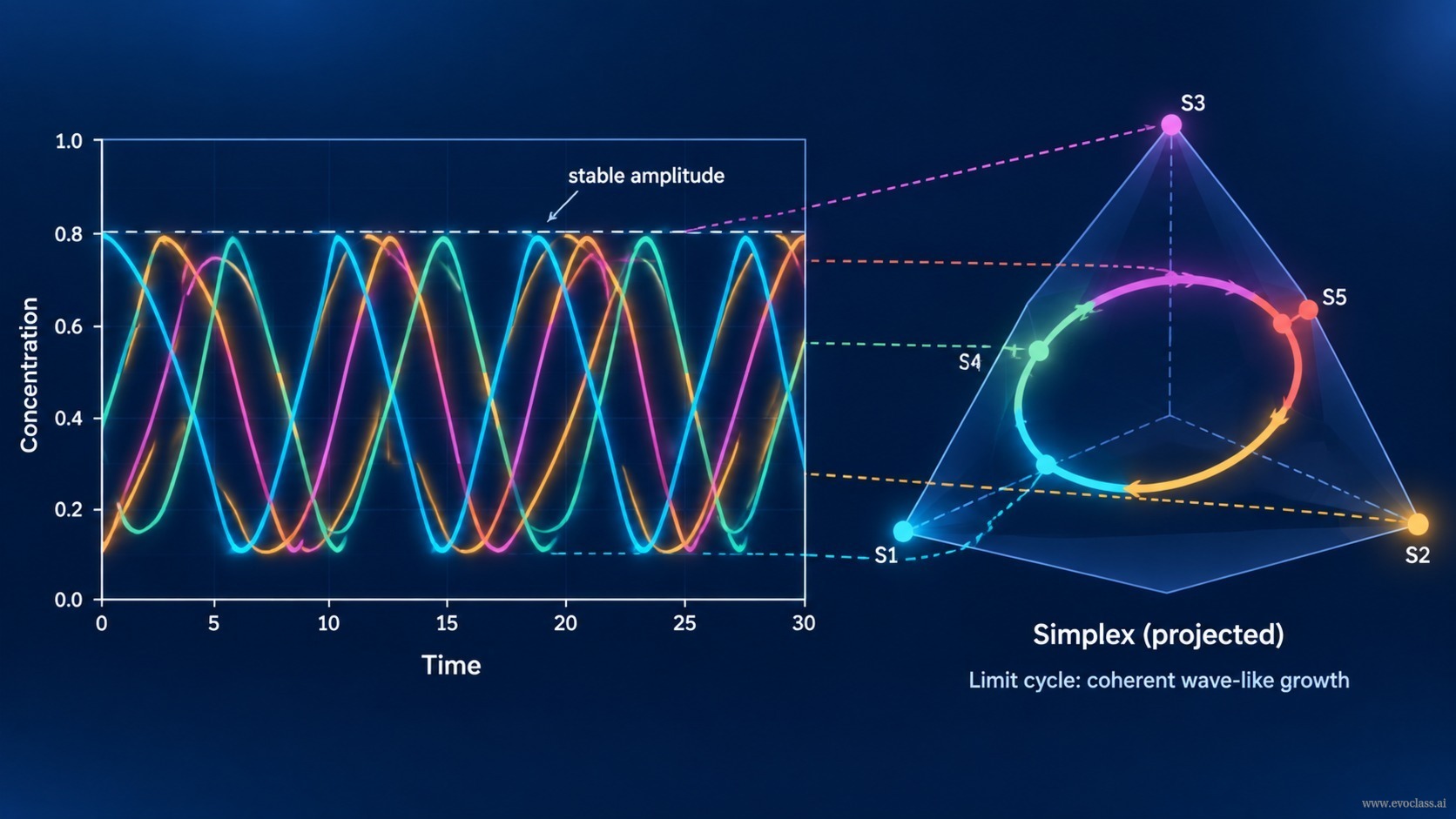
For hypercycles of dimension , the central cooperative fixed point is no longer the stable attractor. The system does not settle at that stationary state or at any single member; instead it sustains a stable limit cycle in the concentration simplex, in which all members persist with phase-shifted oscillations—coherent, wave-like growth of the whole cycle rather than settlement to a pure state or a single corner.

Normal-mode analysis establishes how the central fixed point changes character with dimension: it is a focus for , a spiral sink for , a center for , and a saddle with spiral components for . Lyapunov stability arguments prove that the central fixed point is asymptotically stable for , 3, and 4; for this stationary central cooperation is left behind, and numerical integration provides evidence for a stable limit cycle.

Limit Cycles and Coherent Growth Numerical integration: for n ≥ 5 the central fixed point is left behind and the trajectory winds onto a stable limit cycle. Concentration time series (n = 5) concentration time x1 x2 x3 x4 x5 Dashed line: central level c₀ / n Phase-shifted oscillations persist after the transients die out. Limit cycle in the concentration simplex x̄0 n ≥ 5 closed orbit (limit cycle) central fixed point x̄0 corner fixed points

The limit cycle corresponds to wave-like coherent growth: replication is temporally ordered and phase-shifted, so the entire cycle is sustained as an integrated unit and no single member wins by competitive exclusion. This contrasts with broken hypercycles, whose dynamics can be confined to invariant edge or face subsystems and produce partial competition or once-for-ever selection.

Distinguish the fixed point from the cycle
For the trajectory approaches the stationary central point x̄0 = (c0/n)(1, …, 1)ᵀ. For that point is no longer attracting, and the trajectory winds onto a closed orbit—plotting each concentration xᵢ(t) shows sustained phase-shifted oscillations after the transients die out.