2
Limit Cycles for Hypercycles of Dimension Five and Higher
HYC-1979 Lesson 6: Concentration, Hypercycles, Fixed
00:00

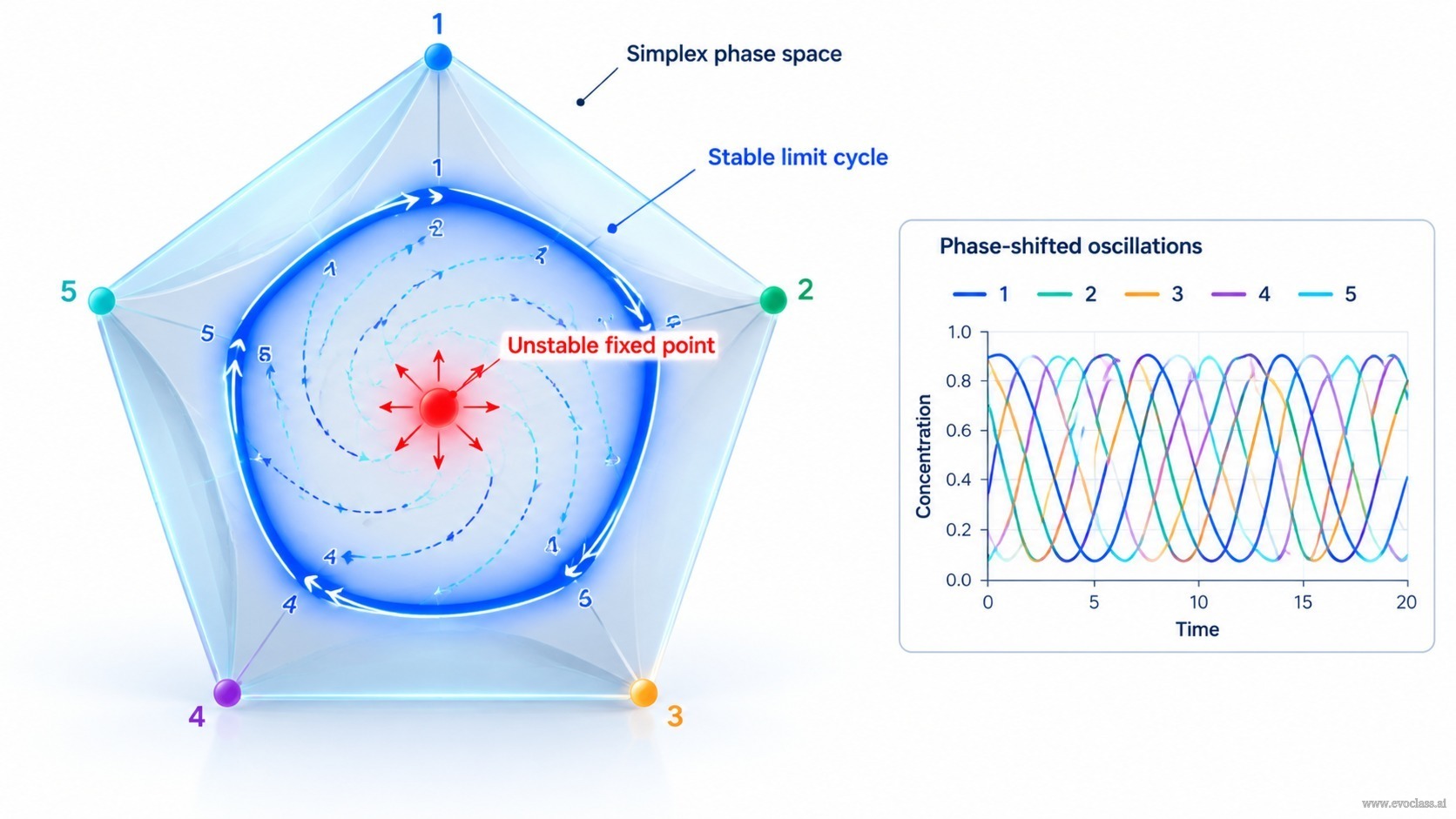
For an elementary hypercycle with members, the interior fixed point is unstable. Linear stability analysis of the cyclic catalytic coupling shows that the stationary coexistence solution loses stability, typically through a Hopf bifurcation. Under constant organization, the long-term attractor is therefore not a stationary point but a stable limit cycle in the concentration simplex. The hypercycle persists as a coherent periodic oscillation rather than as a static balance of concentrations.

Limit cycle in an elementary hypercycle for n ≥ 5 The interior fixed point is unstable — the long-term attractor is a closed orbit in the simplex Projected concentration simplex (n = 5) 1 2 3 4 5 Unstable interior fixed point Stable limit cycle (closed orbit) Trajectory spiraling onto the orbit Time series: phase-shifted maxima 1 2 3 4 5 concentration time Maxima follow the catalytic order 1 → 2 → 3 → 4 → 5 → 1 Total concentration is fixed: the oscillation stays bounded

What the limit cycle means dynamically

After a perturbation, trajectories do not relax back to the interior fixed point. Instead they spiral outward or inward onto a closed orbit that encircles the unstable interior point. The interior fixed point remains a stationary solution of the rate equations, but it is dynamically unstable: any small displacement grows into the oscillation. On the limit cycle, each hypercycle member has a periodically changing concentration. The peaks are phase-shifted around the cycle: maxima propagate in catalytic order 1 → 2 → 3 → 4 → 5 → 1. This reflects the cyclic topology of the hypercycle coupling.

Boundedness and coherent organization

Constant organization confines the dynamics to the simplex, so the oscillation is bounded. Total concentration is conserved or externally fixed, and the system undergoes a periodic redistribution among members rather than unbounded growth or extinction under ideal assumptions. The limit cycle therefore represents a self-sustained, coherent mode of hypercyclic organization for , distinct from stationary coexistence in lower-dimensional cases. In a projected phase portrait, you see the unstable interior point at the center and an attracting closed curve around it; in a time plot, you see successive periodic maxima following the catalytic cycle.

Supplementary Notes
Interpret limit-cycle behavior and concentration oscillations in elementary hypercycles of dimension . The key qualitative signature is an attracting closed orbit in the concentration simplex, not a stable interior equilibrium. The oscillation is coherent, phase-locked to the catalytic cycle, and bounded by constant organization. Unequal rate constants can further shape pulse sizes and time-averaged concentrations, but the qualitative limit-cycle organization persists.