In a hypercycle of dimension n ≥ 5 under constant organization, the concentrations evolve according to the elementary hypercycle equations. The parameter is the catalytic rate constant for production of species by its predecessor xi−1 in the cyclic order → → … → → .
(ki xi−1 − Φ), j kj xj xj−1, , indices modulo n.
Rotational symmetry and its breaking
When all catalytic rate constants are equal, = … = , the hypercycle possesses a symmetric rotating-wave limit cycle. Every species shows an identical pulse, and the pulses are equally spaced in phase. The whole pattern rotates around the catalytic cycle without changing shape.
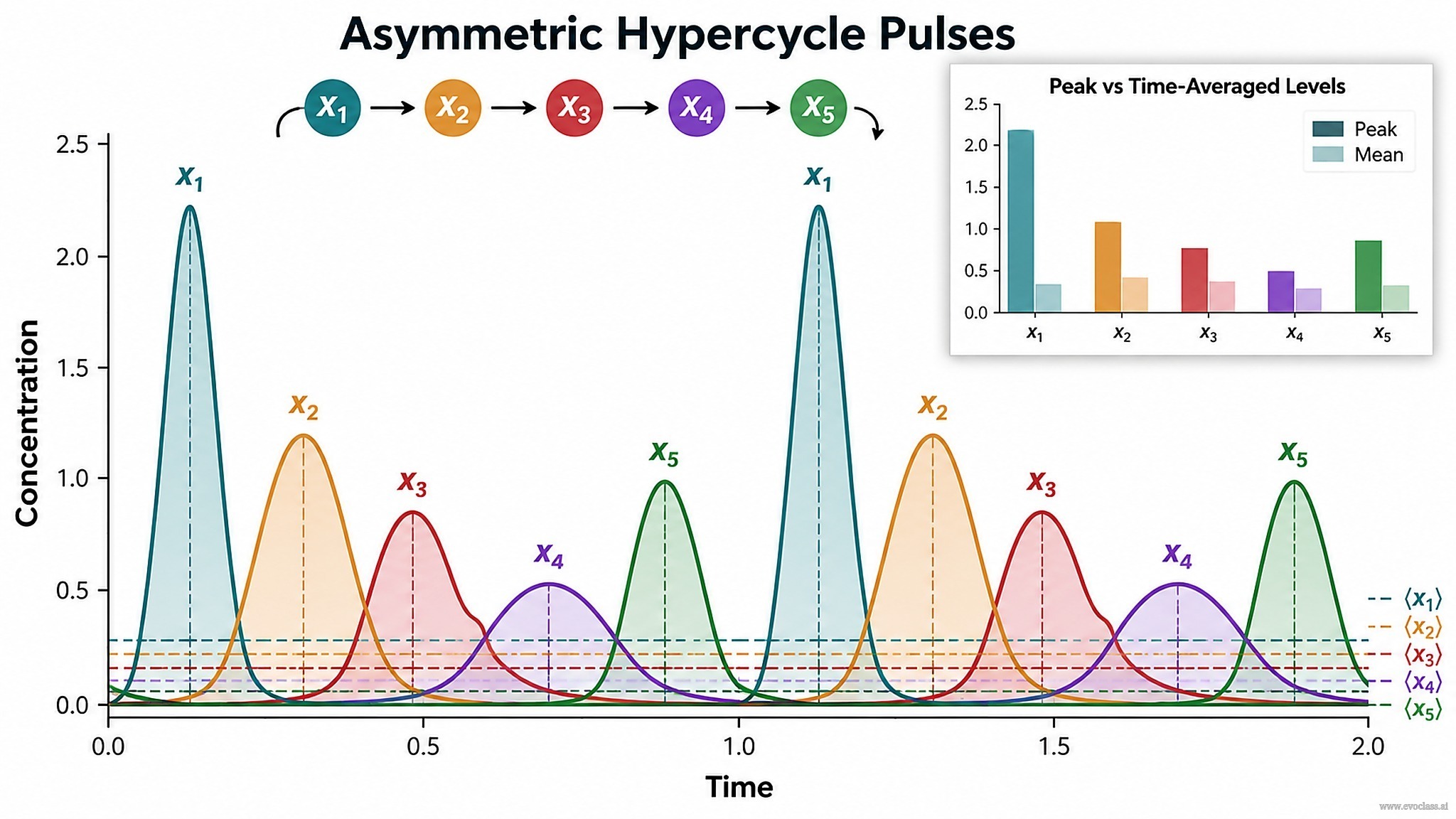
Unequal rate constants break this rotational symmetry. The cyclic order of pulses remains → → … → → , but pulse height, width, and phase lag become species-specific. A species with a larger catalytic advantage reaches a higher peak concentration. Peak order still follows the catalytic cycle.
Phase lags encode rate-limiting steps
Phase differences need not be uniform. A fast step shortens the delay between the predecessor pulse and the product pulse; a slow step lengthens it. Thus pulse timing encodes which catalytic step is relatively rate-limiting. For example, if is large, the pulse follows with a shorter lag than in the symmetric case.
Time-averaged concentrations
Time-averaged concentrations obey ⟨⟩ = ⟨Φ⟩ / ki+1. A species' mean level therefore depends on the downstream rate constant, not simply on its own peak height. A tall pulse can coexist with a modest time average if the next catalytic step is fast.
Common misconception. A large raises the peak of but does not by itself raise ⟨⟩. The average is governed by ki+1 and the global selection flux Φ.
Example: five-membered hypercycle
Consider with . The pulse tends to peak higher and follow with a shorter lag. Its average is not simply proportional to its peak. The relation ⟨⟩ = ⟨Φ⟩ / shows that the mean level of is coupled to the downstream rate driving .
The pulses remain coupled through Φ and constant organization. Unequal constants modulate hypercyclic organization without destroying its cyclic topology.
Asymmetric Hypercycle Pulses
Time series of concentration pulses for a five-membered hypercycle with unequal catalytic constants kᵢ. The cyclic order x 1 → x 2 → … → x 5 → x 1 is preserved, but each species shows a pulse of different height, width, and phase lag; dashed lines mark the time-averaged concentrations ⟨xᵢ⟩. The inset compares peak heights with time-averaged levels, showing that a tall pulse can have a modest mean.
QUESTION 1
In the hypercycle model (kixi−1 − Φ), what is the role of the global selection flux Φ?
It is the total catalytic production that enforces constant organization, j kjxjxj−1.
It is the average concentration of the hypercycle.
It is an external dilution rate that is independent of concentrations.
It is the time derivative of the total concentration.
✅ Correct!
Φ couples all species and maintains Σxi = 1; it is not an external parameter.
❌ Incorrect
Constant organization requires a global term built from the same catalytic reactions, not an independent dilution rate.
QUESTION 2
If all rate constants are equal in an hypercycle, what is the form of the limit cycle?
A steady state with no oscillations.
A chaotic attractor with no repeating order.
A single-species dominance cycle.
A symmetric rotating-wave cycle with identical, equally phase-shifted pulses.
✅ Correct!
Equal preserves full rotational symmetry, so pulse shapes and spacings are identical.
❌ Incorrect
Unequal is what breaks symmetry; equal gives the symmetric limit cycle.
QUESTION 3
With unequal , which statement about peak order and phase lags is correct?
A slow step shortens the lag between predecessor and product pulses.
Peak order is randomized; phase lags are always uniform.
Peak order follows → → … → → ; a fast step shortens the lag between predecessor and product pulses.
Peaks occur simultaneously for all species because Φ synchronizes them.
✅ Correct!
The catalytic cycle fixes the order; local rate constants modulate the timing.
❌ Incorrect
The cyclic topology is preserved. Fast steps shorten lags; slow steps lengthen them.
QUESTION 4
Which relation correctly gives the time-averaged concentration ⟨⟩ in an oscillating hypercycle?
⟨⟩ is independent of Φ and .
⟨⟩ = / ⟨Φ⟩
⟨⟩ = ⟨Φ⟩ / ki+1
⟨⟩ = ⟨Φ⟩
✅ Correct!
The mean of is set by the downstream rate constant ki+1 and the mean global flux.
❌ Incorrect
Average concentrations are not given by the species' own ; they depend on the next catalytic step.
QUESTION 5
A species has a large but a relatively low time-averaged concentration. What is the most consistent explanation?
The global flux Φ must be zero.
Its peak and average must be equal, so the data are impossible.
Its average depends on the downstream ki+1; a fast downstream step can keep ⟨⟩ low despite a tall peak.
A large always maximizes the time average.
✅ Correct!
Peak height and time average are distinct; the average is controlled by the next rate constant.
❌ Incorrect
A large raises the peak, but ⟨⟩ = ⟨Φ⟩/ki+1 can still be small.
Case Study: Unequal Rate Constants in a Five-Membered Hypercycle
Interpret time-series and time-averaged data from a perturbed hypercycle.
A constant-organization hypercycle with has reference rate constants that produce a symmetric limit cycle. Experimentally, is doubled while , , , and remain at reference values. The time series shows that the pulse peaks higher and follows with a shorter lag. Dashed time-averaged levels reveal that ⟨⟩ falls below its symmetric-reference value, while ⟨⟩ changes only modestly.
Q
Explain why the pulse rises and why the – phase lag shortens when is doubled.
Answer:
Doubling increases the local catalytic production of from , so the pulse reaches a higher peak. A faster step also shortens the delay between the precursor pulse and the product pulse, because is produced more rapidly once is present. The cyclic order → → … is preserved.
Q
Use ⟨⟩ = ⟨Φ⟩/ki+1 to explain why ⟨⟩ can fall even though is unchanged.
Answer:
The average of is ⟨⟩ = ⟨Φ⟩/k2. Doubling raises the denominator, and although ⟨Φ⟩ may adjust, the result is a lower ⟨⟩. Thus x1's time-averaged concentration is controlled by the downstream rate constant , not by its own or by its peak height.