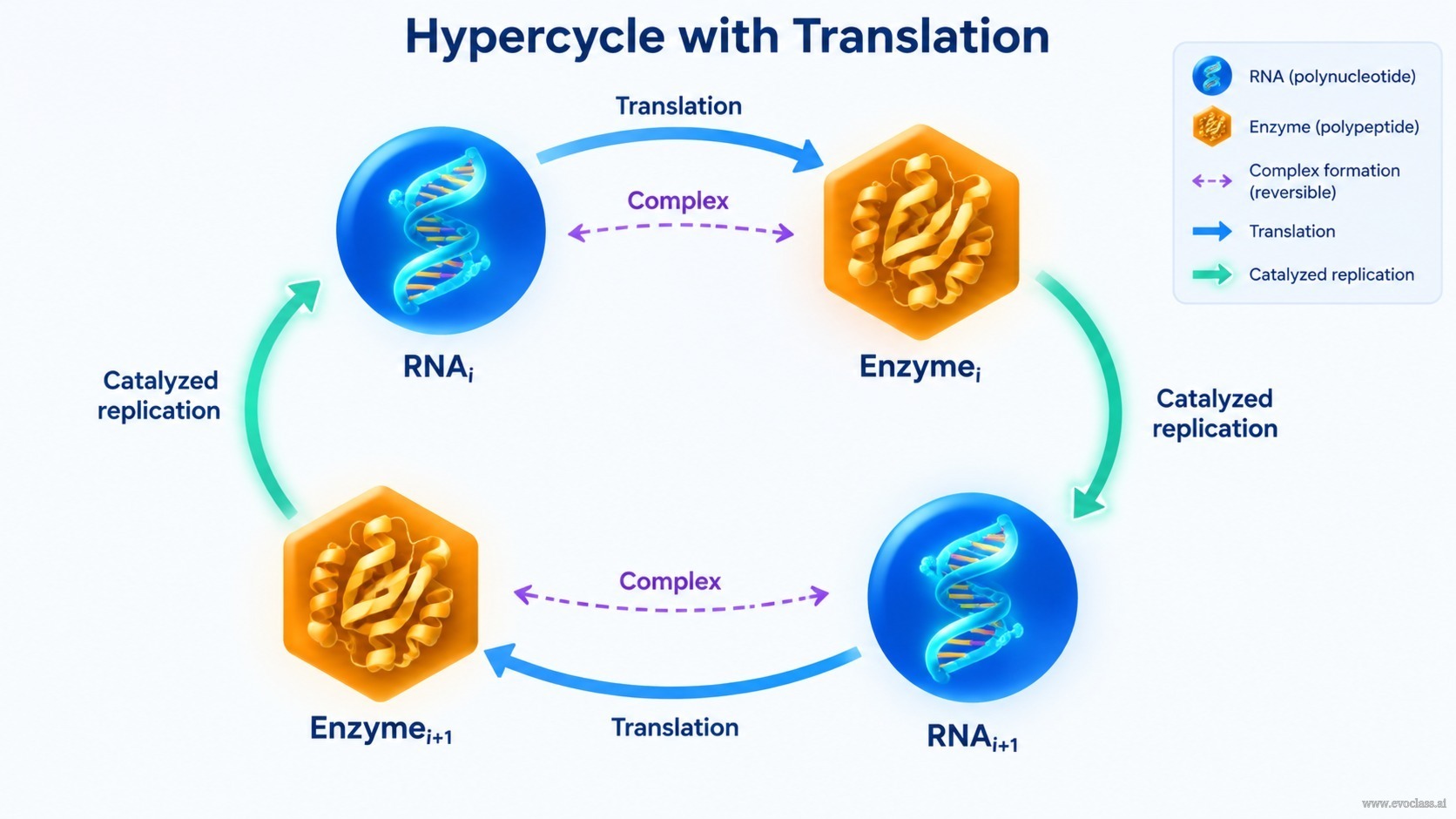
Translation-coupled hypercycles extend the elementary hypercycle by making every polynucleotide both a replication template and a translation template. The same RNA molecule can be copied by a replicase and read by a ribosome, so replication and translation compete for the template.
Molecular and kinetic architecture
- Dual template role. For member i, RNAi is copied to produce more RNAi and translated to produce polypeptide
. The two processes draw on the same pool of free RNAi. - Cycle closure. The polypeptide translated from member i catalyzes replication of a different member, typically i+1. The organization is hypercyclic rather than purely autocatalytic because
does not catalyze its own template RNAi. - Coupled species. The kinetic state explicitly contains free polynucleotides, free polypeptides, and polynucleotide–polypeptide complexes. Complexes may be the catalytically active or replication-active forms, for example RNAi+1·
. - Kinetic architecture. Template-directed replication and translation are interlocked with catalytic feedback. Polypeptide information is maintained only through the polynucleotide templates that encode it; the polypeptides are not independently replicated.
- System-level consequence. The translation-coupled hypercycle cannot be reduced to a simple catalytic hypercycle because it adds translation and complex-formation steps to the replication cycle. These extra steps set up later analysis of concentration limits and stability.
Elementary kinetic steps
For cycle member i, a compact scheme is:
- Translation: RNAi → RNAi +
. - Complex formation:
+ RNAi+1 ⇌ (RNAi+1· ). - Catalyzed replication: (RNAi+1·
) → 2 RNAi+1 + , or + RNAi+1 → 2 RNAi+1 + if the complex is not shown explicitly.
Replication of RNAi is catalyzed by Ei−1. Iterating over i closes the translation-coupled hypercycle. Because replication and translation share the same RNA template, their relative rates determine how much RNA is used for copying versus how much polypeptide is made available as catalyst. This coupling is the key structural difference from an elementary hypercycle.
Learning objective
Describe the structure and kinetic assumptions of a hypercycle with translation, including polynucleotide–polypeptide coupling and complex formation.
Translation-Coupled Hypercycle
Alternating RNA and polypeptide nodes show translation of RNA_i into
Translation-Coupled Hypercycle
Alternating RNA and polypeptide nodes show translation of RNA_i into