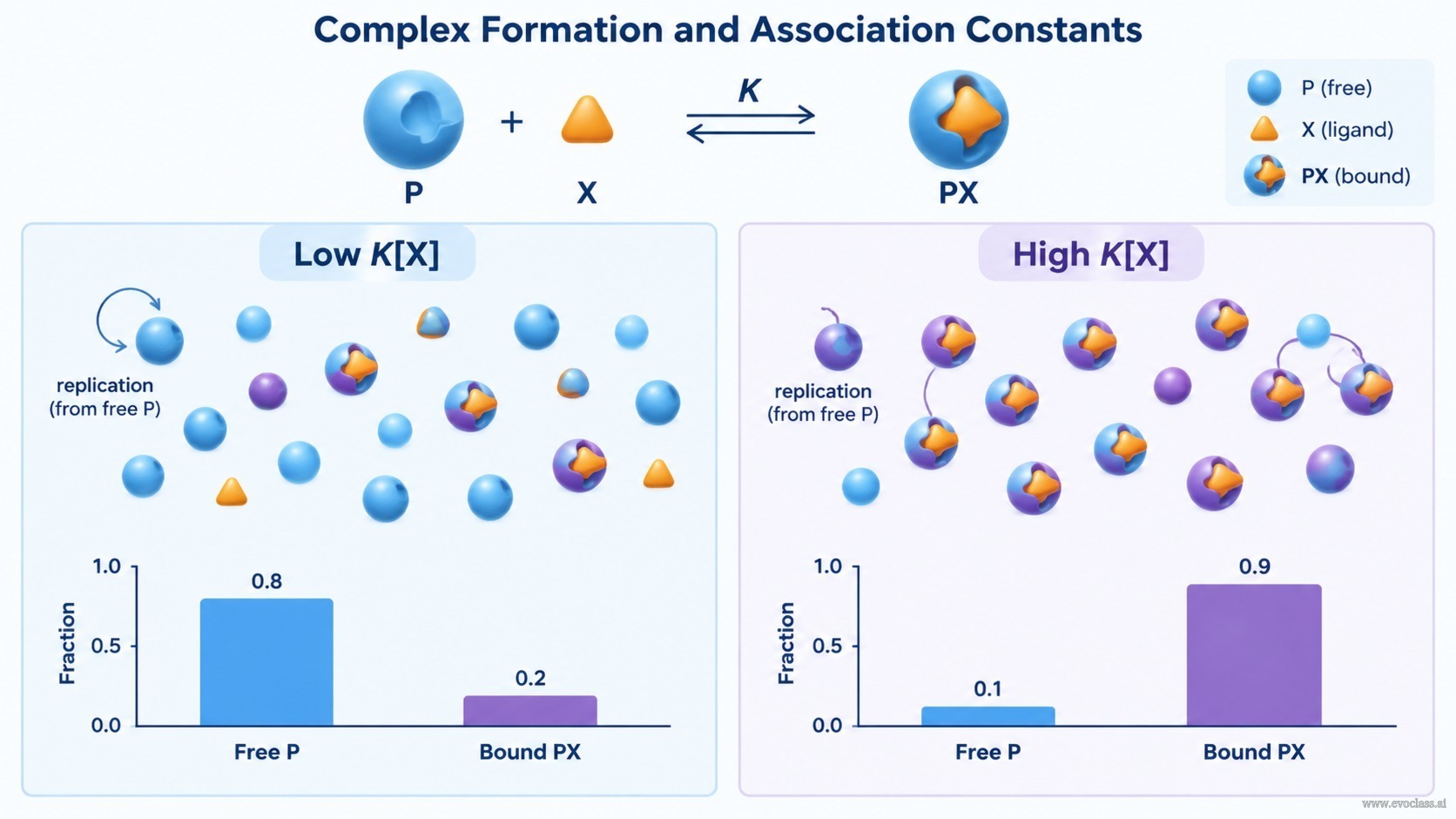
In translation-coupled hypercycles, the polynucleotide template P is not only replicated but also translated into a polypeptide product X. These two species can bind reversibly to form a complex PX. The association constant K fixes the equilibrium partitioning between complexed and free species, and therefore controls how much free template remains available for replication.
The binding reaction is reversible: P + X ⇌ PX. By convention, the equilibrium association constant is K = [PX] / ([P][X]). A larger K favors the bound complex PX, while a smaller K favors the free components. At equilibrium, [PX]/[P] = K[X] and [PX]/[X] = K[P], so K and the free partner concentrations jointly set the complex-to-free ratio.
Mass conservation and free template
Mass conservation requires that total concentrations partition into free and bound forms: [P]tot = [P]free + [PX] and [X]tot = [X]free + [PX]. The replication step depends on the free template concentration [P]free, not on the total template concentration. Complexation therefore reduces free template and can lower the effective replication flux.
- Bound fraction increases with K and with free X. Low K[X] leaves most template free, whereas high K[X] saturates complex formation.
- Because X is produced by translation, complex formation couples polypeptide synthesis to template availability and thus to hypercyclic replication dynamics.
In the broader hypercycle picture, this reversible sequestration shifts the system between regimes. When K[X] is small, most template is free and the translation-coupled hypercycle can behave like an elementary hypercycle or a simple catalytic cycle. When K[X] is large, complexation removes free template from replication and can damp oscillations, alter limit-cycle amplitudes, or push the system toward a low-concentration regime. Near a Hopf bifurcation, such changes in effective feedback can also modify critical slowing down and the stability of the oscillatory state.
Complex Formation and Association Constants
The reaction P + X ⇌ PX with association constant K partitions total template into free P and bound PX. The bar chart shows that increasing K[X] shifts the bound fraction from low to near saturation, leaving less free P for replication.