In a translation-coupled hypercycle, each RNA template is not only replicated but also translated into a polypeptide that binds back to the RNA through reversible complex formation. That binding step, characterized by a dissociation constant
Why low total concentration simplifies the kinetics
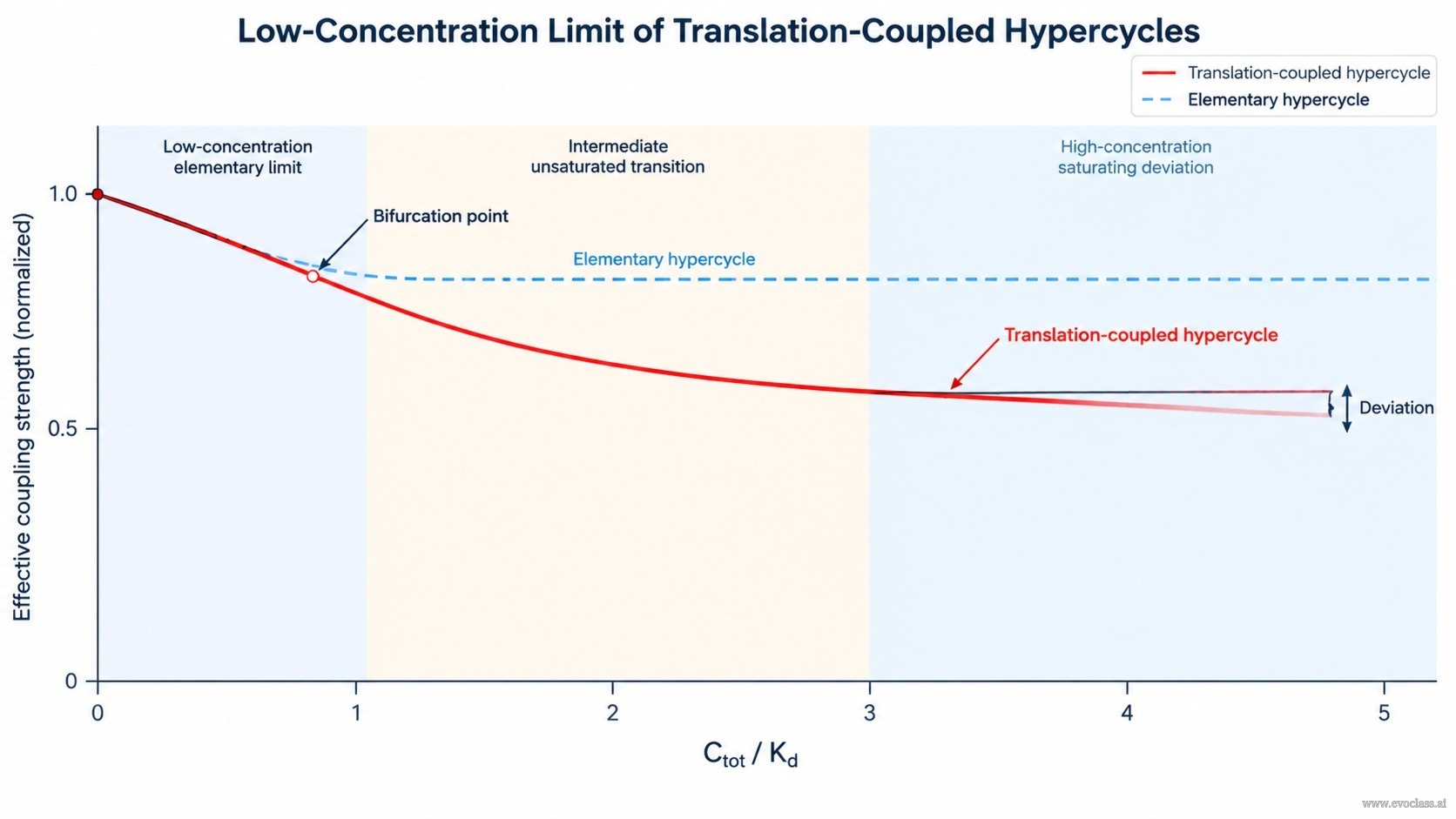
When the total concentration of RNA and polypeptide is much smaller than
- Free species dominate. [complex] is much smaller than [RNA] and [polypeptide], so the dynamics is carried by the free species rather than by bound material.
- Bilinear complex concentration. [complex] ≈ [RNA][polypeptide]/Kd, i.e. proportional to the product of the two free concentrations instead of to either one alone.
- Second-order catalytic flux. Because the complex is the catalyst, the mediated flux kcat[RNA][polypeptide]/Kd ≈ (kcat/Kd)[RNA][polypeptide] is a second-order mass-action term — exactly the coupling form used by an elementary hypercycle.
Effective rate constants and preserved topology
The association constant and the catalytic constant enter only through their combination, so they can be absorbed into a single effective rate constant keff = kcat/Kd. The result is an elementary hypercycle with renormalized coefficients. Crucially, the cyclic coupling topology is preserved: each member still catalyzes the replication of the next member around the loop, and translation introduces no independent dynamical coupling at this limit — it merely rescales the rates. This is why fixed-point, stability, limit-cycle and error-threshold analyses developed for elementary hypercycles carry over directly to translation-coupled hypercycles whenever the dilute condition holds, which is precisely what makes the reduction so useful for selection and error-threshold reasoning.
Where the reduction breaks down
The reduction is asymptotic, not an identity. It remains valid only while complex formation is unsaturated. As total concentration rises toward
Low-Concentration Limit of Translation-Coupled Hypercycles
Effective coupling strength of a translation-coupled hypercycle plotted against the dimensionless total concentration C_tot/K_d. At low values the solid translation-coupled curve merges with the dashed elementary hypercycle reference, because sparse, unsaturated RNA-polypeptide complexes give a bilinear catalytic flux with effective constant k_cat/K_d; as concentration grows, complexes saturate and the two curves separate.