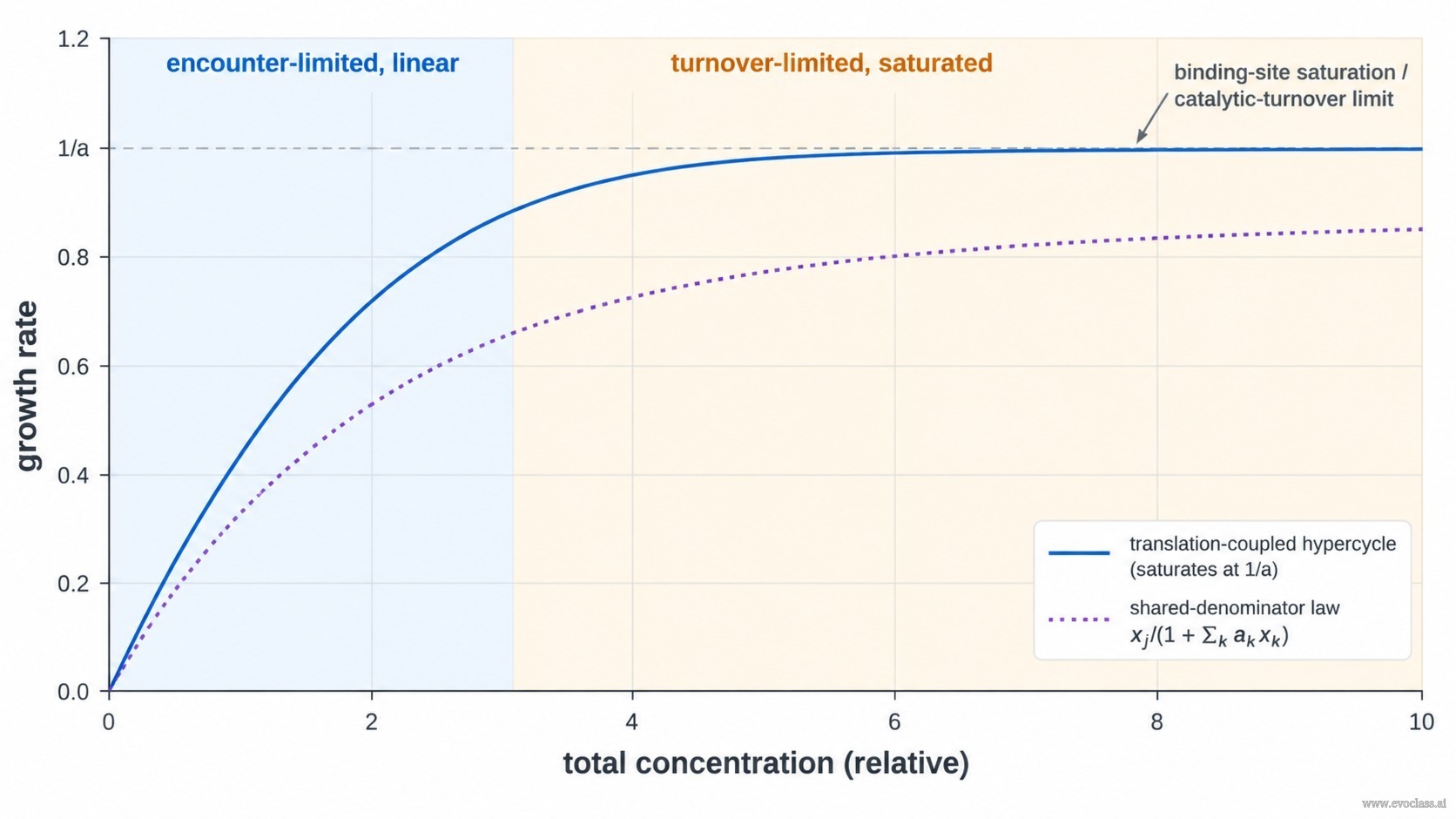
When the total concentration of a translation-coupled hypercycle becomes large, the encounter problem disappears. Free polynucleotides and polypeptides are so abundant that binding sites are almost permanently occupied, and the concentration of polynucleotide–polypeptide complexes approaches a ceiling fixed by the amount of the available binding partners rather than by the frequency of collisions.
Saturation and the Turnover Limit
In this regime the complex concentration approaches a maximum set by the available binding partners: whichever component is scarce caps how much complex can exist, so adding more of the abundant species creates no new catalytic units. Growth is then limited by catalytic turnover — how quickly each saturated complex can produce its product — instead of by encounter frequency. The same total amount of material therefore supports a nearly constant rate of replication.
Generalized Saturating Rate Laws
The kinetics are captured by generalized saturating rate laws. For a single saturable species, rate ≈
Justifying the Approximation
Neglecting the weak coupling terms between different complexes is valid as long as wkm ≪ Wmm − Wkk (cf. Table 2): the off-diagonal coupling is small compared with the dominant diagonal difference, so the leading-order saturating law is accurate. Higher approximations could be obtained using
Saturating Growth Curve
Growth rate plotted against total concentration for a translation-coupled hypercycle. The solid curve rises almost linearly at low concentration (encounter-limited) and flattens into a horizontal plateau at high concentration, where binding sites are saturated and the rate is set by catalytic turnover; the dashed asymptote marks the plateau value 1/a. A second dotted curve shows the shared-denominator law /( ), which saturates more gradually because all species draw on the same binding capacity.