8
Hopf Bifurcation and Critical Slowing Down
HYC-1979 Lesson 6: Concentration, Hypercycles, Fixed
00:00

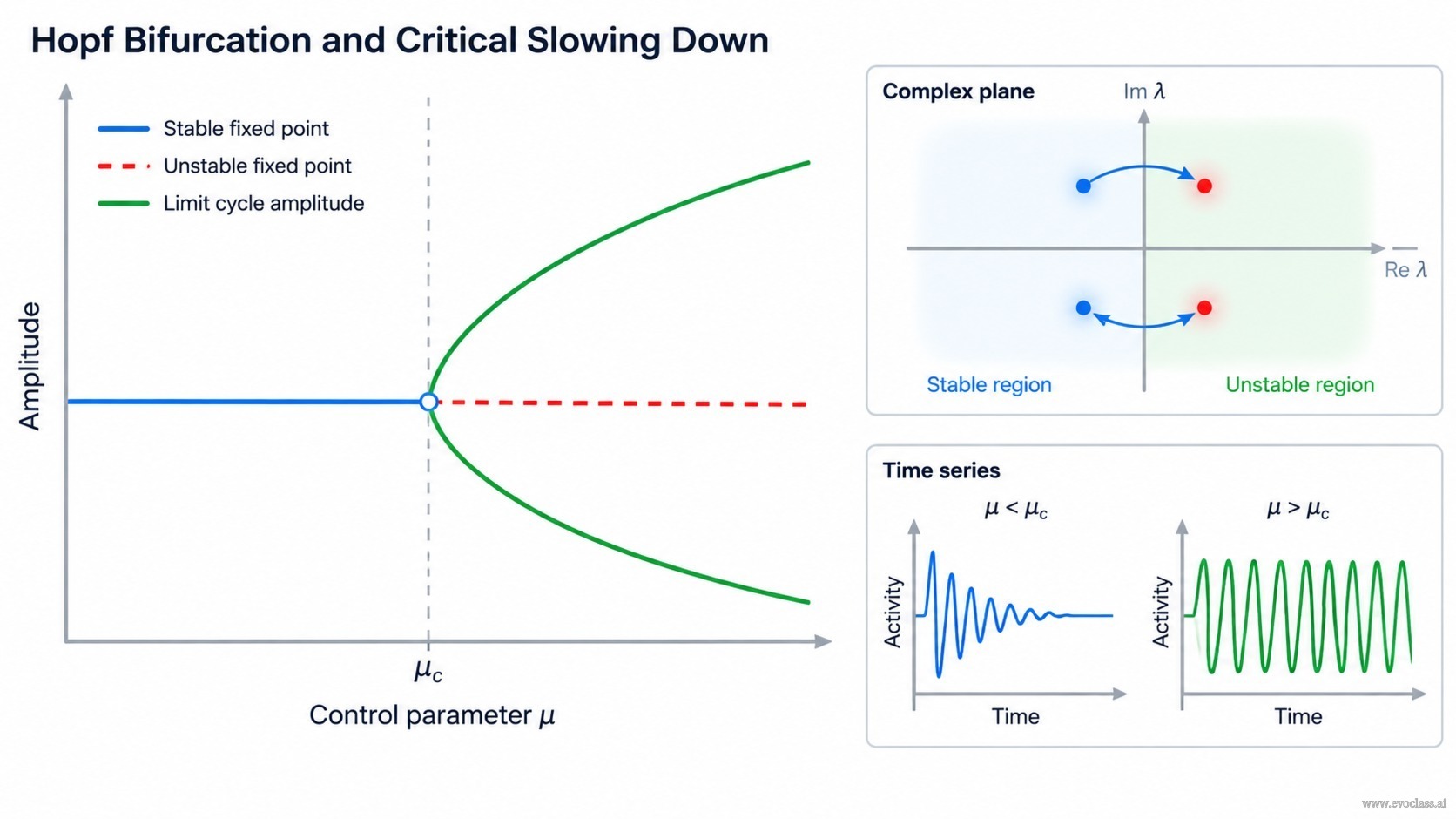
In the hypercycle framework, a Hopf bifurcation marks the transition from a stable stationary concentration distribution to sustained coherent oscillation. Linearizing the hypercycle dynamics around a fixed point gives eigenvalues ± iω. A Hopf bifurcation occurs when the real part α changes sign through zero, so a complex-conjugate pair crosses the imaginary axis. At that point the fixed point becomes nonhyperbolic; for a supercritical Hopf bifurcation, the stationary state loses stability and a stable limit cycle emerges.

Hopf Bifurcation and Critical Slowing Down A bifurcation diagram shows a stable fixed-point branch going dashed and unstable at the Hopf point, where a green limit-cycle branch emerges. An inset shows a complex-conjugate eigenvalue pair crossing the imaginary axis, and time-series insets compare damped, critically slowed and sustained oscillations. Hopf Bifurcation and Critical Slowing Down From a stable fixed point to a stable limit cycle — and the warning signs as the threshold nears Bifurcation diagram control parameter μ against oscillation amplitude |z| amplitude |z| control parameter μ Hopf point μc stable fixed point unstable fixed point stable limit cycle amplitude grows from zero μc Complex eigenvalue plane conjugate pair crosses the imaginary axis Re λ Im λ α < 0 α = 0 α > 0 Time series near the Hopf point μ < μc — damped oscillations μ just below μc — critical slowing down μ > μc — sustained oscillation stable fixed point unstable fixed point limit-cycle amplitude Hopf point μc Critical slowing down: as μ approaches μc, damping vanishes and the return time 1/|α| diverges — rising variance and lag-1 autocorrelation.

Eigenvalues and the Hopf Condition

The imaginary part ω = Im sets the frequency of the nascent oscillation, so the period near onset is approximately 2π/ω. The real part α controls stability: gives a stable focus with damped oscillations; is the Hopf point; makes the fixed point unstable and nonlinear saturation yields a limit cycle. In hypercycle models, control parameters such as rate-constant asymmetry, coupling strength, or saturation level can tune the system through this bifurcation.

Critical Slowing Down as an Early Warning

As α → 0−, the slowest mode's damping rate vanishes. Small perturbations then return to the fixed point over increasingly long times, producing long transients and enhanced noise sensitivity. In stochastic or noisy hypercycle concentrations, this appears as rising variance and autocorrelation, which can act as early-warning indicators of the transition to limit-cycle behavior.

Example
For a reduced two-variable or high-dimensional hypercycle model, let the Jacobian at the central fixed point have (μ) ± iω(μ). Then defines the Hopf point. Below , a small perturbation gives damped oscillations; near , the decay is very slow; above , the oscillation grows until nonlinear saturation produces a limit cycle.