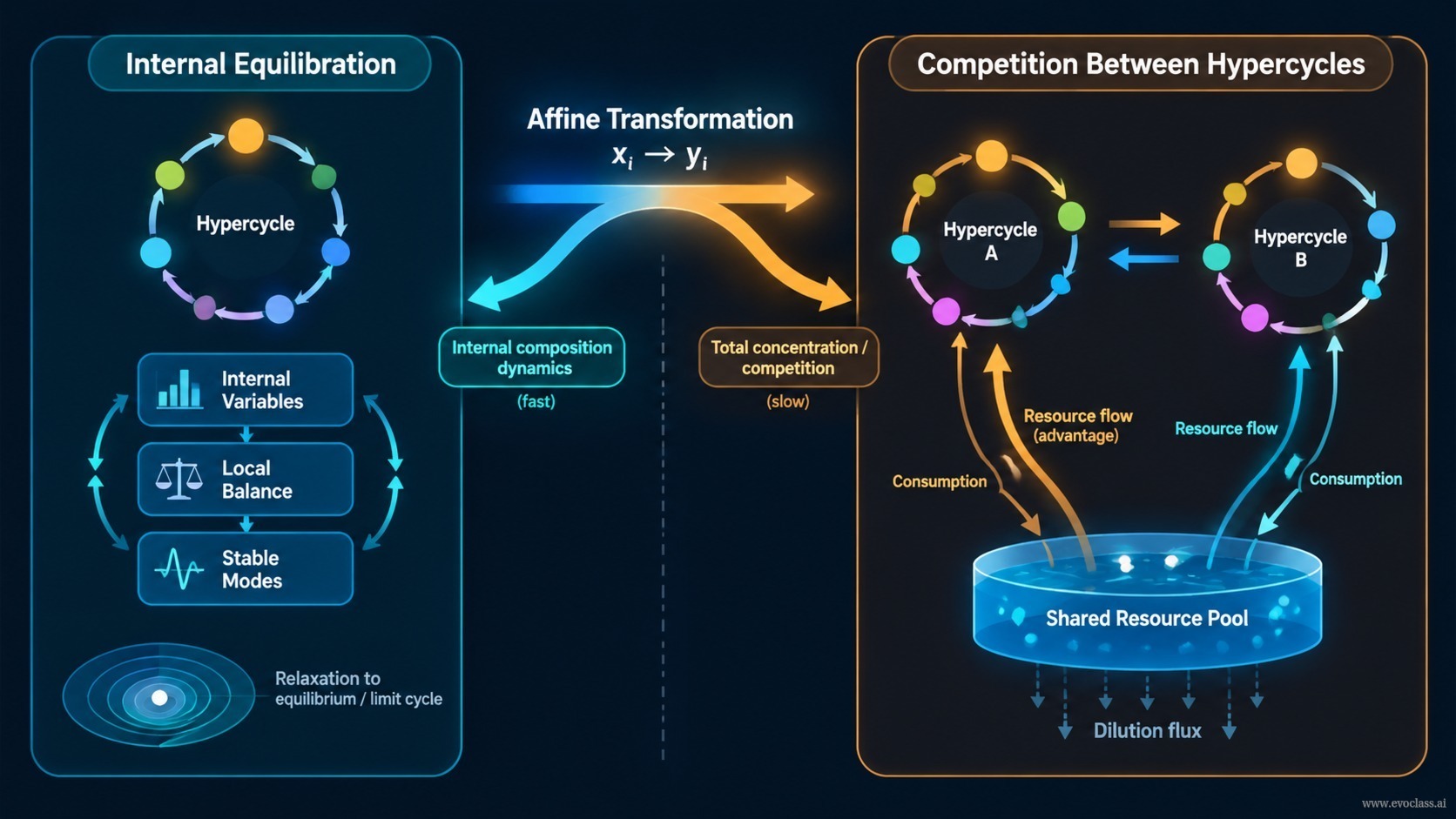
In a population of hypercycles, the dynamics naturally separate into two levels: the internal equilibration of relative concentrations within each hypercycle, and the competition between different hypercycles for shared resources or under a total-concentration constraint.
Internal equilibration describes how the relative concentrations of the molecular species within a single hypercycle relax toward an internal attractor—typically a fixed point or a limit cycle—while the total abundance of the hypercycle may still change. This relaxation is governed by the internal catalytic couplings and does not by itself select among hypercycles.
To analyze these two levels separately, we employ an affine transformation of the concentration variables. Following the structure of the differential equations (6), we introduce new variables yᵢ that isolate changes in total concentration from internal equilibration. Mathematically, this transformation corresponds to shifting the x-coordinate system, a technique well known from linear differential equations. The resulting equations allow the internal relaxation of relative concentrations to be studied independently from the competitive growth of hypercycles.
Competition between hypercycles arises when they share a common resource pool or when the total concentration of all hypercycles is constrained (e.g., by a constant dilution flux). Under such conditions, the expansion of one hypercycle necessarily affects the abundance of others. The affine transformation makes explicit that selection among hypercycles occurs at the inter-hypercycle level, while internal equilibration merely sets the composition within each unit.
The separation is particularly powerful when the timescales differ: if internal equilibration is fast compared to inter-hypercycle competition, each hypercycle can be treated as a coherent selective unit with an effective growth rate determined by its internal attractor. In this limit, the dynamics reduce to a Darwinian competition among hypercycles, with the total concentration constraint acting as a zero-sum game.
However, this separation is an idealization. Nonlinear coupling between internal and competitive variables, translation-coupled hypercycles, or slow internal modes can mix the two levels, limiting the exact independence. In such cases, the full system must be analyzed without the simplifying assumption of timescale separation.
Key Points
- Internal equilibration relaxes relative concentrations within one hypercycle toward a fixed point or limit cycle.
- An affine transformation xᵢ → yᵢ separates total-concentration changes from internal equilibration dynamics.
- Competition between hypercycles occurs under shared resources or a total-concentration constraint.
- Fast internal relaxation allows each hypercycle to be treated as a coherent selective unit with an effective growth rate.
- Selection among hypercycles arises only at the inter-hypercycle level; internal equilibration alone does not select.
- Nonlinear coupling, translation-coupled hypercycles, or slow internal modes can invalidate the exact independence of the two levels.
Internal Equilibration and Competition Between Hypercycles
Block diagram showing the affine transformation of concentration variables xᵢ to yᵢ, separating fast internal equilibration within a hypercycle (left) from slow competitive selection between hypercycles sharing a resource pool (right).