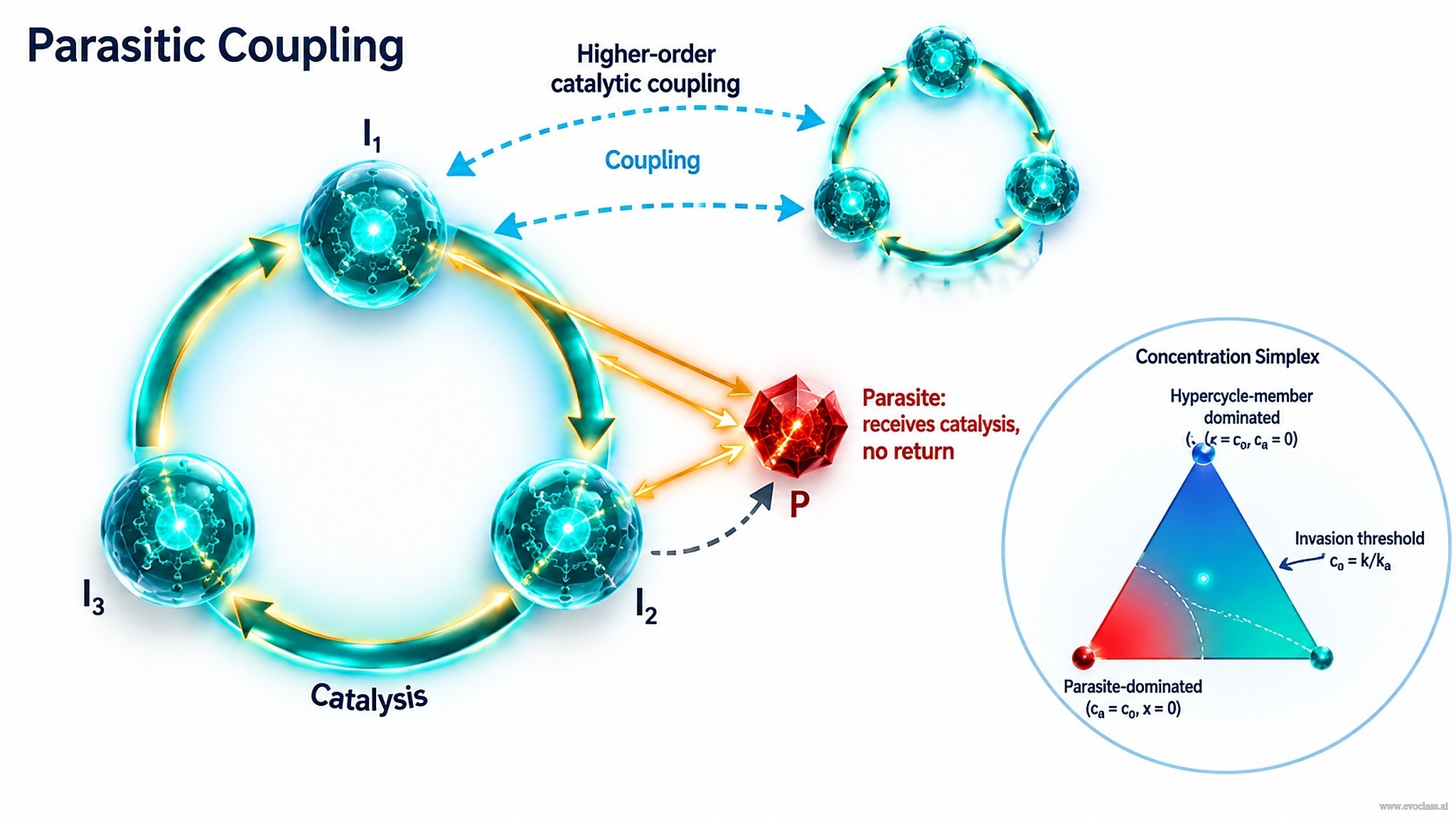
Hypercyclic organization integrates otherwise competitive replicators through catalytic closure, but it remains vulnerable to parasitic exploitation and to error-threshold and information limits. Higher-order catalytic coupling—hypercycles catalyzing other hypercycles—extends this organization hierarchically, yet it also creates new integration and parasite problems.
Parasitic Coupling
A parasite receives catalytic support from one or more hypercycle members without contributing to the hypercycle’s catalytic loop. It exploits the cycle without returning catalytic aid. For a self-reproductive parasite A competing with a hypercycle member x at constant total concentration
ċₐ = kₐ cₐ² − (cₐ/c0)(kₐ cₐ² + k cₐ x)
The system has two fixed points at the corners of the concentration simplex S2: parasite dominance (cₐ = c0,
Integration Problem
Direct ligation into one large replicative unit is prohibitive due to the threshold relation for vₘₐₓ. Integrated units must remain competitive against their own mutants to evolve further and avoid losing their specific information. The allocated integration questions asks: “How can one envisage an integration of competitive molecules, other than by ligation to one large replicative unit, which is prohibitive due to the threshold relation for vₘₐₓ? (Note that the units to be integrated have to remain competitive with respect to their mutants in order to evolve further and not to lose their specific information.)”
Possible routes include:
- Functional coupling: molecules cooperate catalytically without covalent fusion.
- Compartmentalization: components stay together in a bounded volume.
- Hypercyclic organization: competitors are integrated through a catalytic cycle.
Any route must allow the integrated units to remain competitive against their own mutants.
Why Hypercyclic Organization of Separate Genes?
A single large genome accumulates a combinatorial explosion of mutant sequences as its length increases. For 100 sites, there are 100 one-error mutants, 4950 two-error mutants, 161 700 three-error mutants, and so on. Error-free replication becomes impossible beyond the error threshold. Hypercyclic organization distributes the information and allows selection among mutant modules, reducing the maintenance burden of one long genome.
Limits and Improvements
Limits of hypercyclic organization include susceptibility to parasites, error-threshold constraints on total information content, and slow or inefficient coordination between separate genes. Proposed improvements or transitions include tighter structural integration, compartmentalization, and evolution of a single genome that ensures co-segregation of cooperating genes.
Higher-Order Catalytic Coupling
Higher-order catalytic coupling occurs when hypercycles catalyze other hypercycles. This extends integration beyond a single cycle but introduces new parasitic, coordination, and stability challenges. In translation-coupled hypercycles, coupling replication to polypeptide synthesis adds complex formation and association constants; low- and high-concentration limits and saturating kinetics modify the same integration and parasite constraints.
Parasitic Coupling
A hypercycle ring supports a parasitic node that returns no catalytic aid, while dashed arrows show a hypercycle catalyzing a second hypercycle. The inset concentration simplex marks parasite-dominated and hypercycle-member-dominated corner fixed points and the invasion threshold c