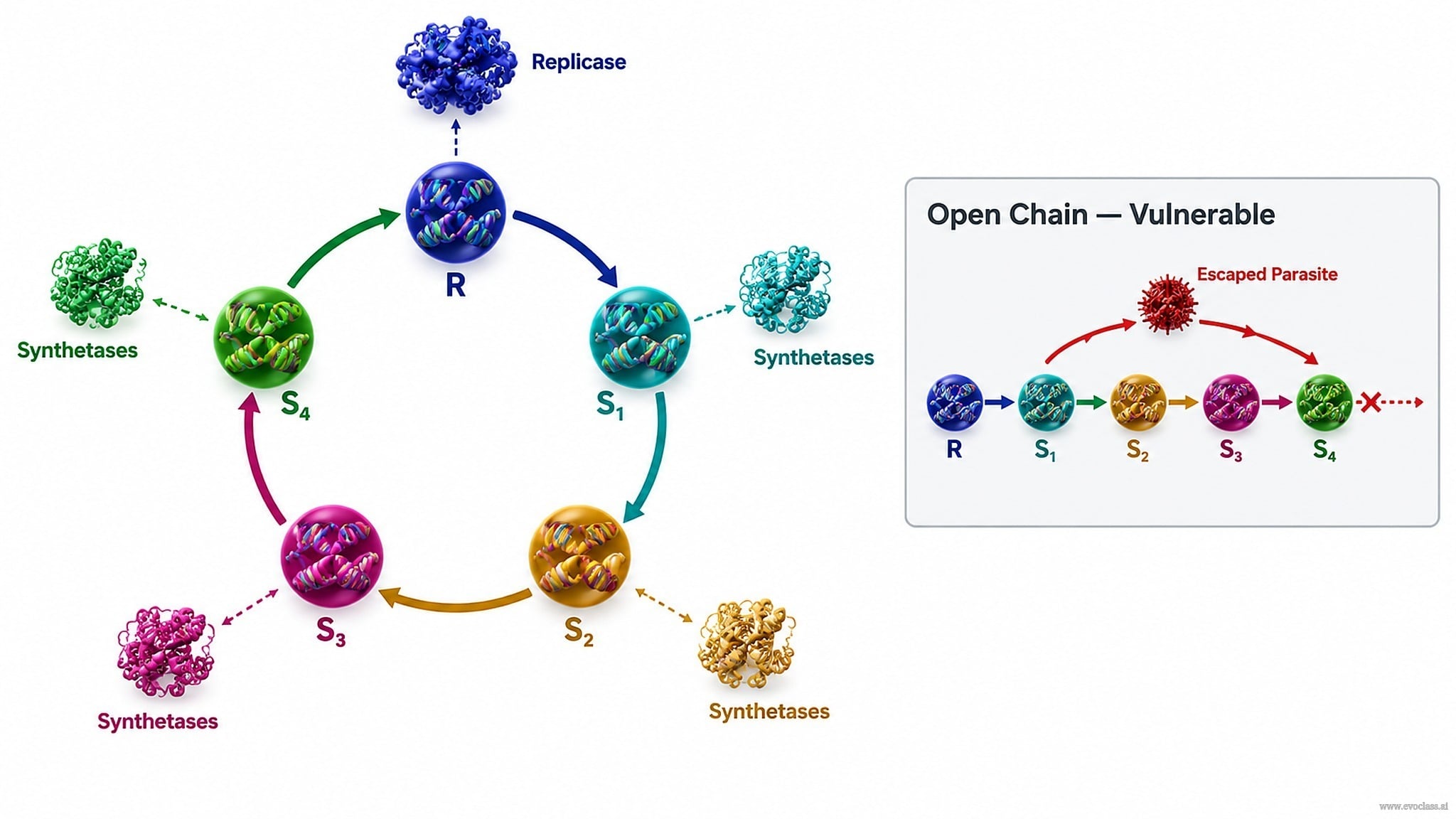
This slide bridges abstract hypercycle dynamics to a concrete primordial molecular scenario: a primitive replication–translation apparatus organized as an RNA hypercycle. The minimal scheme uses RNA strands that encode one replicase and four synthetase functions. The RNAs act both as templates/messages and as catalytic/adaptive molecules, while the encoded proteins catalyze copying and primitive peptide synthesis.
Shared replication and translation terms can be collapsed into a common growth function, allowing hypercycle equations to describe the integrated RNA–protein system. However, encoding these functions alone is not sufficient: if the RNAs remain independent or only linearly coupled, faster or parasitic variants can exploit shared catalysts, and the full messenger set deteriorates through internal competition.
Why a messenger set still deteriorates
A messenger set encoding one replicase and four synthetases does not automatically stabilize when the translated products are diffusible public goods. A faster-replicating RNA or a parasite can use the replicase and synthetases without contributing all functions. Mutant load and selection erode the cooperative set, even though the ensemble may initially grow.
What coupling stabilizes it
Stable integration requires closed cyclic catalytic coupling, in which each member’s product helps replicate or express other members. This mutual dependence suppresses parasites and integrates replication with translation. Growth becomes a property of the whole ensemble rather than of individual templates.
Primitive RNA–Protein Hypercycle
Five RNA nodes encode one replicase (R) and four synthetases (S 1 –S 4). Dashed arrows show translation of diffusible proteins; solid curved arrows show closed catalytic coupling, where each product helps express or replicate other members. The open/linear version lacks this closure and is vulnerable to parasites.