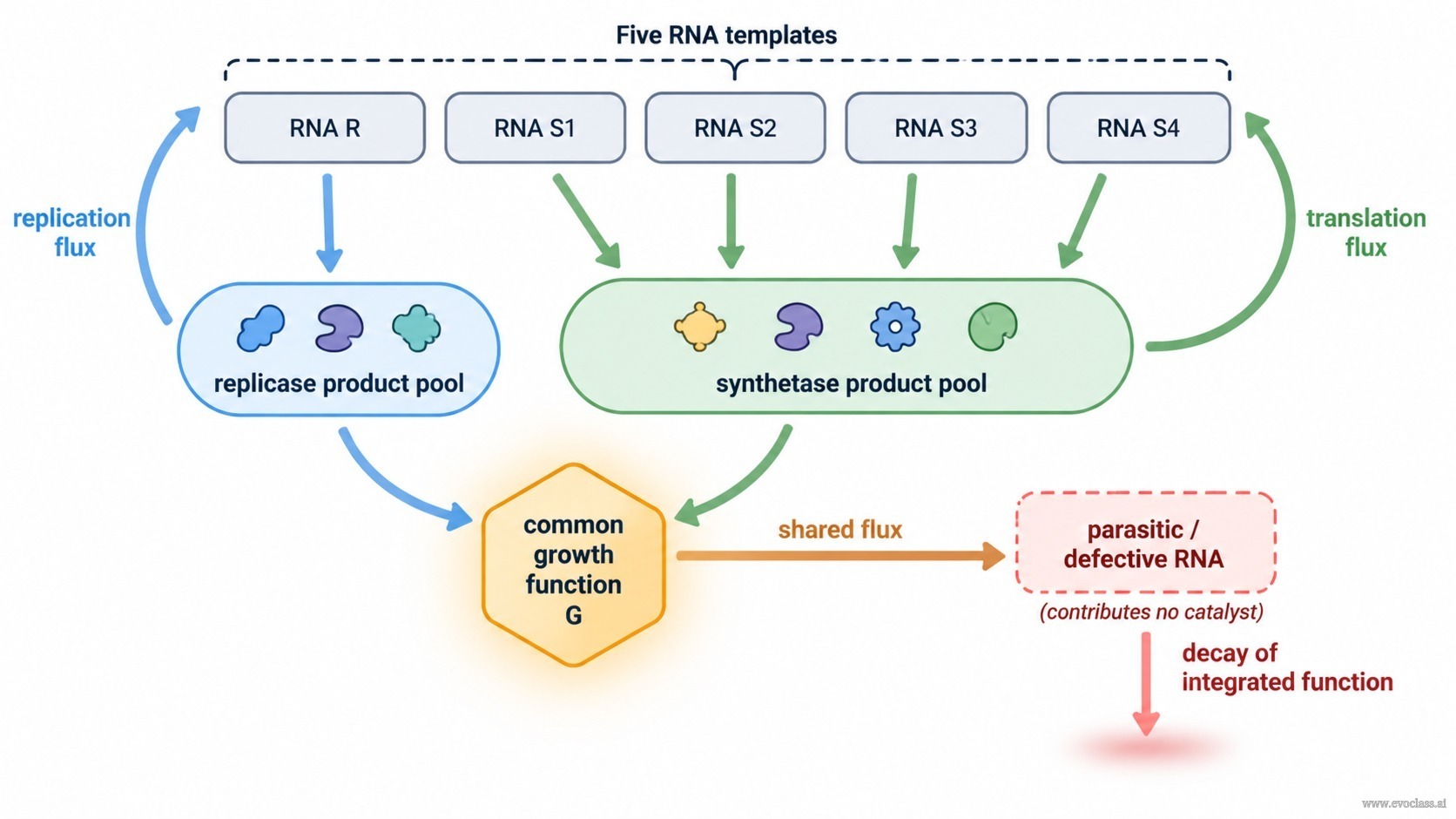
The minimal replicase–synthetase scheme is the smallest translation-coupled hypercycle that can be written as a concrete molecular proposal: a set of RNA strands in which one template (R) encodes a replicase and four templates (S1–S4) encode synthetases. It is deliberately not a single self-replicating RNA. Instead, the scheme is a consortium: the same RNA population supplies both the templates for replication and the messages for translation.
Functional linkage: the replicase products copy all five RNA strands, while the synthetase products enable translation of those same five strands. Because the same population is both template and catalytic product, replication and translation are mutually coupled rather than separate subsystems. This coupling is the architectural core of the minimal hypercycle.
Shared growth reduction: when the catalysts act on the whole set, the individual replication and translation terms are not private to the strand that encodes the catalyst. They become common-pool terms. Mathematically, the coupled system reduces to a single common growth function G for all strands. Each strand’s net growth can be written as a collective contribution plus a relative-composition term, but the selective reward for producing a catalyst is diluted because every member draws on the same growth flux.
Decay mechanism: because all members draw on the same growth flux, a mutant that reduces or omits catalytic production still receives the shared benefit. If such a variant replicates faster—for example, because its RNA is shorter—it can increase in relative frequency without contributing replicase or synthetase activity. This dilutes the functional catalysts and allows parasitic or degenerate strands to accumulate. The minimal scheme alone therefore is not sufficient for robust Darwinian integration.
Stability implication: to suppress decay, additional organization is required. Compartmentalization, spatial structure, or hypercyclic closure can make a strand’s survival depend on its own catalytic contribution by co-localizing catalysts, templates, and products. Such organization maintains stoichiometric balance and prevents the common growth flux from being captured by non-productive variants.
Analytical nuance: in the source treatment (pages 66–76), the shared-growth reduction is exposed through an affine transformation of the population variables. The transformation separates the collective growth mode from the relative-composition modes. The common growth mode describes the expansion of the whole ensemble, while the remaining modes describe how the composition changes—including the invasion of parasitic or defective strands. This coordinate change clarifies why shared growth cannot selectively reward each component’s catalytic contribution.
Minimum Replicase and Synthetase Scheme
Five RNA templates—R encoding a replicase and S 1 –S 4 encoding synthetases—feed into replicase and synthetase product pools. Both pools converge on a common growth function G. A dashed parasitic RNA receives the same flux but contributes no catalyst, causing decay of integrated function.