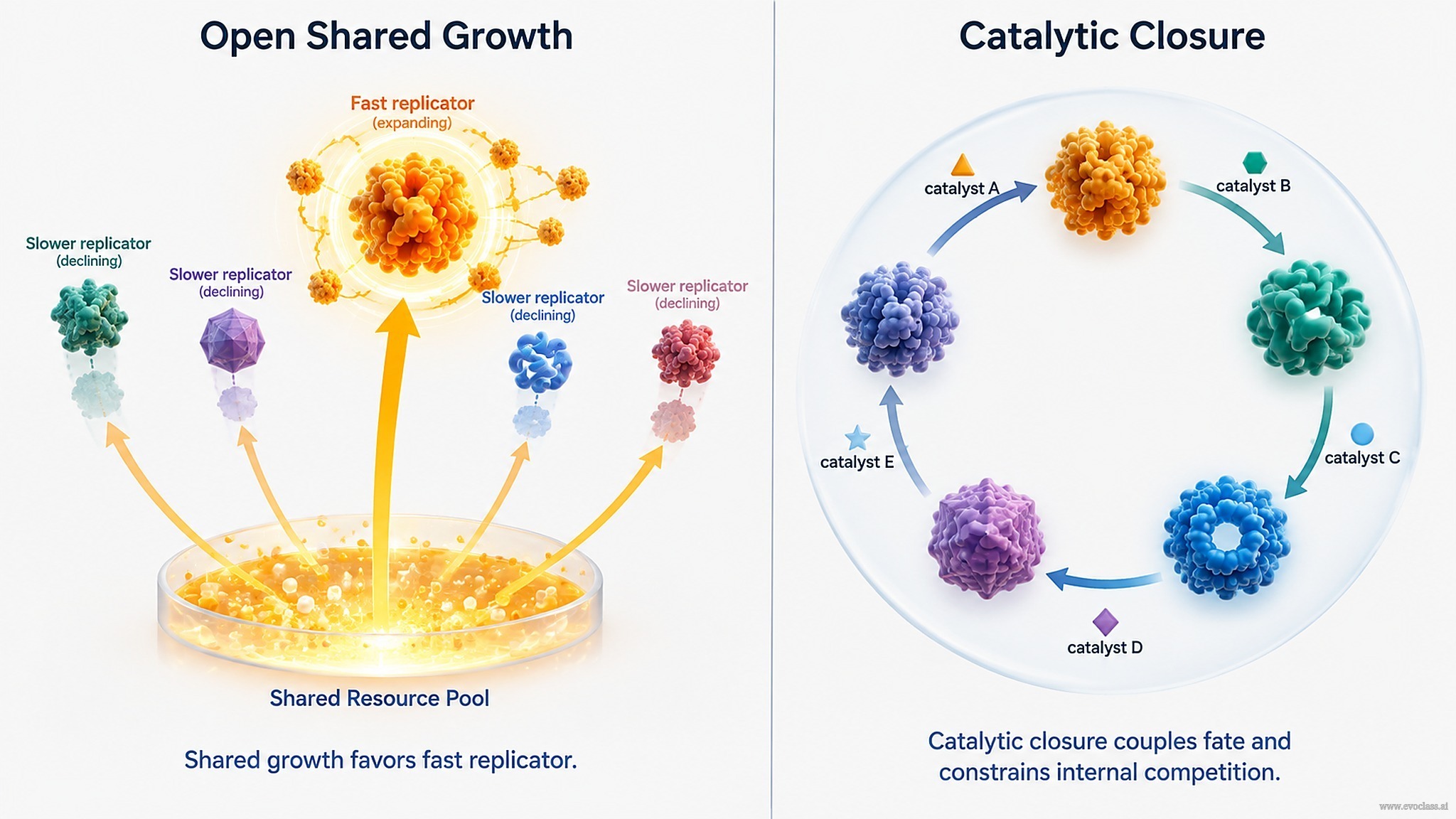
In a translation-coupled hypercycle, functional coupling alone is not enough. Suppose a set of RNA strands encodes one replicase and several synthetase functions, and all strands share the same replication and translation machinery. The shared terms collapse into a common growth function. Then a strand that is replicated faster—or translated more efficiently—can expand at the expense of the others, and the ensemble decays through internal competition. This is shared growth, not catalytic closure.
Catalytic closure converts the same set into a reciprocally dependent cycle. Each member's replication or translation is catalyzed by at least one other member. Growth becomes collective: a fast replicator cannot sustain rapid growth indefinitely if the catalyst it needs is produced only by the member it would otherwise displace. Internal competition persists over precursors, energy, translation capacity, and catalytic efficiency, but cyclic dependency constrains it.
Stabilization depends on coupling strength relative to intrinsic growth differences. Perturbative selective-value analysis is valid when wkm ≪ Wmm − Wkk (cf. Table 2). Higher approximations use
From hypercyclic closure to structural integration
Hypercyclic closure stabilizes translation-coupled cooperation, but it has limits. Parasitic mutants can accept catalysis without contributing, and internal imbalances among members can destabilize the cycle. These limitations help explain the later shift toward complete structural integration of genes/genomes: once genes are physically linked and co-replicated as a genome, the closed catalytic link is replaced by a structural unit, reducing the opportunity for parasites and stabilizing cooperation.
Open Growth vs Catalytic Closure
Left: open shared growth lets a fast replicator expand while other members decline. Right: a closed catalytic cycle couples each member's replication or translation to another member, so no single node can sustain rapid growth alone and internal competition is constrained.