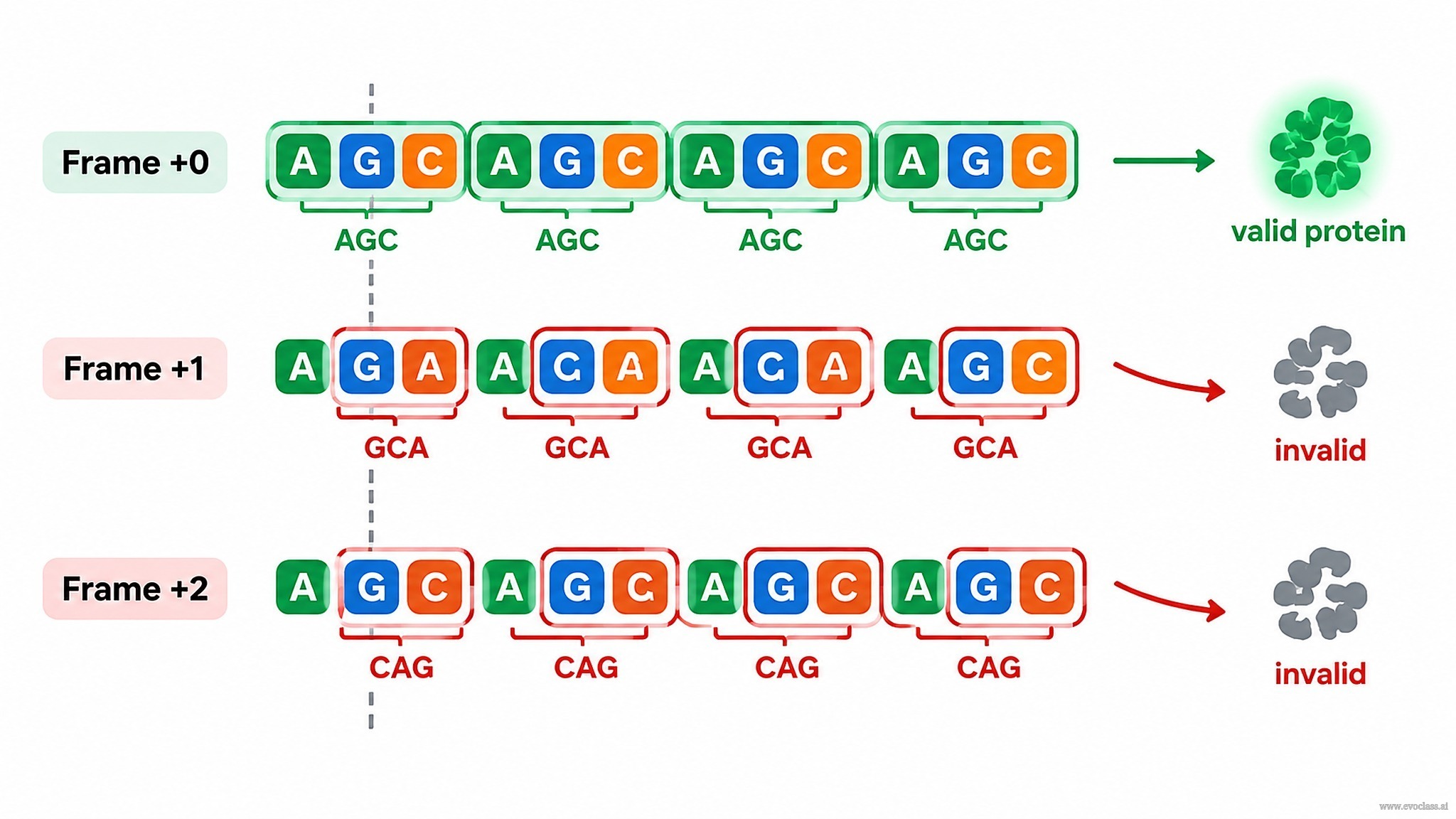
Once a primordial message is written in triplets, the first thing it must guarantee is readability in exactly one register. A coding frame is comma-free when the single, correct partition into triplets carries the whole message, so that a +1 or +2 frame shift does not generate a second, still-valid stream of codons. In the hypercycle setting this is a minimal coding requirement rather than a stylistic nicety: the message must specify its own reading frame without punctuation and without a mature translation apparatus to police the register.
Why the Frame Must Specify Itself
- Unique partition: the message must define one and only one way of cutting the strand into triplets. No punctuation, spacer, or template-boundary signal can be assumed at this stage.
- Comma-free read-off: a shift by one or two nucleotides must fail to produce another valid sequence of codons. If a shift still yields valid codons, the same polynucleotide can encode more than one product.
- Frame coherence: if slippage yields alternative valid codons, translation can deliver corrupted, chimeric or truncated peptides. A coherent frame protects the encoded product from overlapping, competing interpretations.
- Constraint on the code, not on one sequence: the requirement acts on the permitted codon set, so that valid triplets are organised such that frame shifts fail for the class as a whole, not merely for one lucky molecule.
Fidelity Savings Before Proofreading
In the hypercycle and error-threshold context, comma-free organisation lowers the fidelity burden: frame errors are stopped at the level of the code and are never expressed, which matters precisely while proofreading and a complex translation machinery are still absent. This requirement is separate from, and logically prior to, the stability calculation of the cycle itself. It constrains the sequence space available to early replicators, whereas the error threshold asks whether a given cycle can persist under mutation pressure. Specific pattern solutions such as RRY or RNY belong to the adjacent development; here the general criterion is simply the preservation of a single reading register.
Comma-free reading frame
The same nucleotide run A G C A G C A G C A G C read in the +0 register yields the valid message AGC AGC AGC AGC, while the +1 register reads GCA triplets and the +2 register reads CAG triplets. Because GCA and CAG are not RRY codons, the shifted registers cannot be translated as the same message, so the framing itself blocks competing, overlapping interpretations.