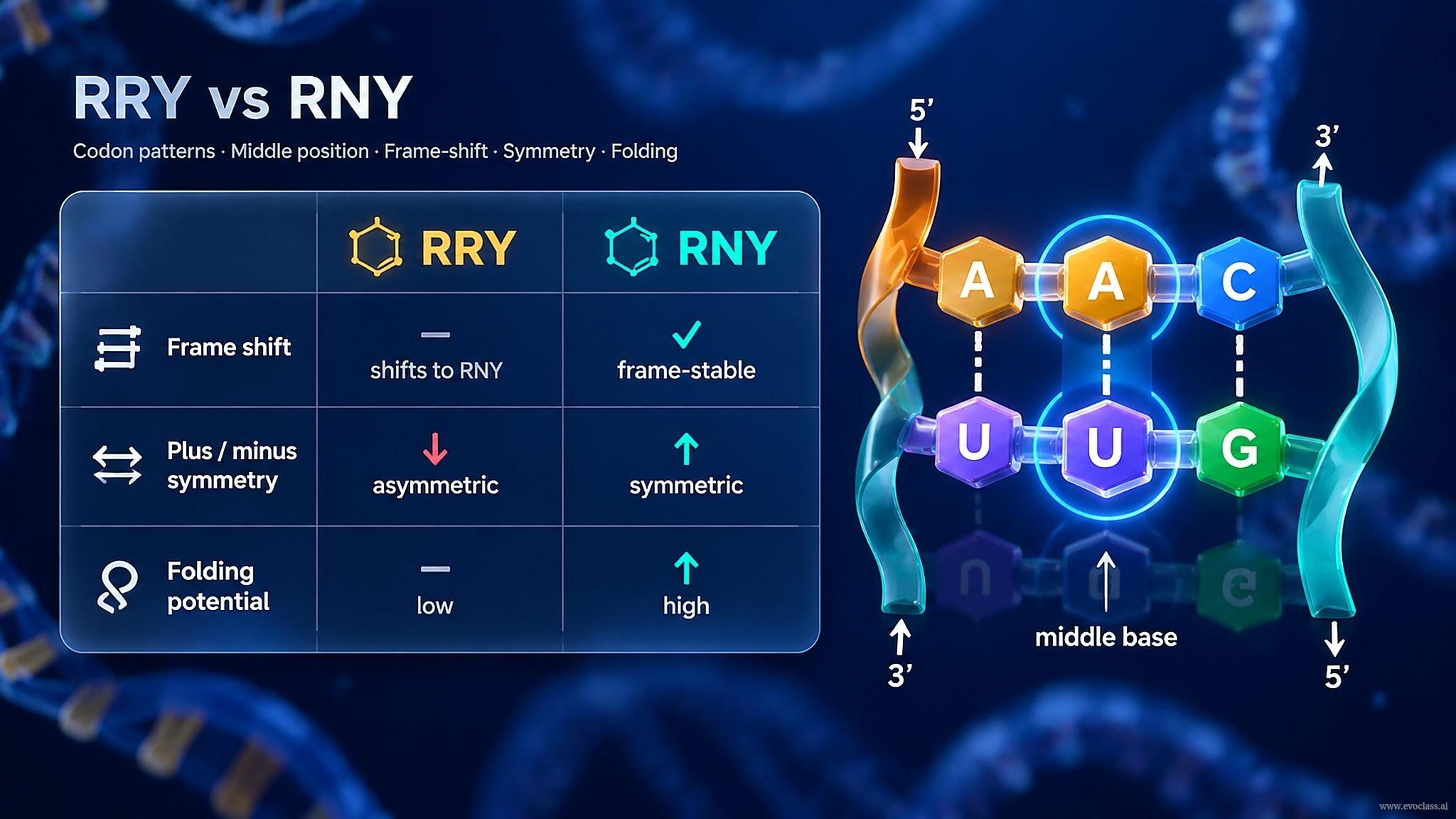
In primordial coding, the pattern of bases within each triplet determines whether the message can be read in a single frame without ambiguity. Two alternative patterns have been proposed: RRY and RNY. Here, R denotes a purine (A or G), Y denotes a pyrimidine (C or U), and N denotes any base. The RRY pattern requires a purine at the first and second positions and a pyrimidine at the third (R-R-Y). The RNY pattern requires a purine at the first position, any base at the middle, and a pyrimidine at the third (R-N-Y). Thus, RNY is broader and contains RRY as a subset because the middle position may be either a purine or a pyrimidine.
Comma-Free Read-Off
For a triplet code to be comma-free, only the correct reading frame should produce valid codons. In a concatenated sequence of RNY codons, shifting the frame by one or two bases disrupts the required pattern. For example, if the correct frame begins with R at position 1 and ends with Y at position 3, a +1 shift would start with the original base 2 and end with the next codon’s base 1, so the third position would no longer be constrained to Y. Similarly, a +2 shift fails. The middle “any” base in RNY does not rescue shifted frames because the third position must still be Y. For RRY, the fixed middle purine adds a further restriction: shifted frames would require a purine at the second position and a pyrimidine at the third, which is not guaranteed.
Plus/Minus Strand Symmetry
The reverse complement of an RNY codon is also RNY, because R pairs with Y and N pairs with N. This means that if the plus strand carries a coherent RNY message, the minus strand—synthesized as the reverse complement—also carries a coherent RNY message. In contrast, the reverse complement of RRY is RYY, not RRY. Therefore, an RRY plus strand does not imply an RRY-coded minus strand; the minus strand would have a different pattern and would not be read as RRY.
Internal Folding and Read-Out Trade-Offs
RNA secondary structure depends on self-complementarity. Because RNY is reverse-complement symmetric, folded or duplexed regions can remain RNY-like on both strands. This creates a competition between folding (which can stabilize structure) and read-off (which requires a single-stranded, accessible frame). RRY’s asymmetry makes the complementary strand non-RRY, narrowing the folded structures that can preserve readable codons. Consequently, RNY may allow both strands to serve as messages, but at the cost of increased folding interference, whereas RRY restricts coding to one strand and may reduce folding competition.
Example
Consider the RNY codon 5′-AAC-3′. Its reverse complement is 5′-GUU-3′, which still fits R-N-Y: G is a purine (R), U is a pyrimidine (Y), and U is a pyrimidine (Y). Now consider the RRY codon 5′-AGC-3′. Its reverse complement is 5′-GCU-3′, which fits R-Y-Y (
RRY vs RNY Comparison
A comparison of RRY and RNY codon patterns showing differences in middle-position constraint, frame-shift read-off, reverse-complement symmetry, and implications for plus/minus strand coherence and internal folding.