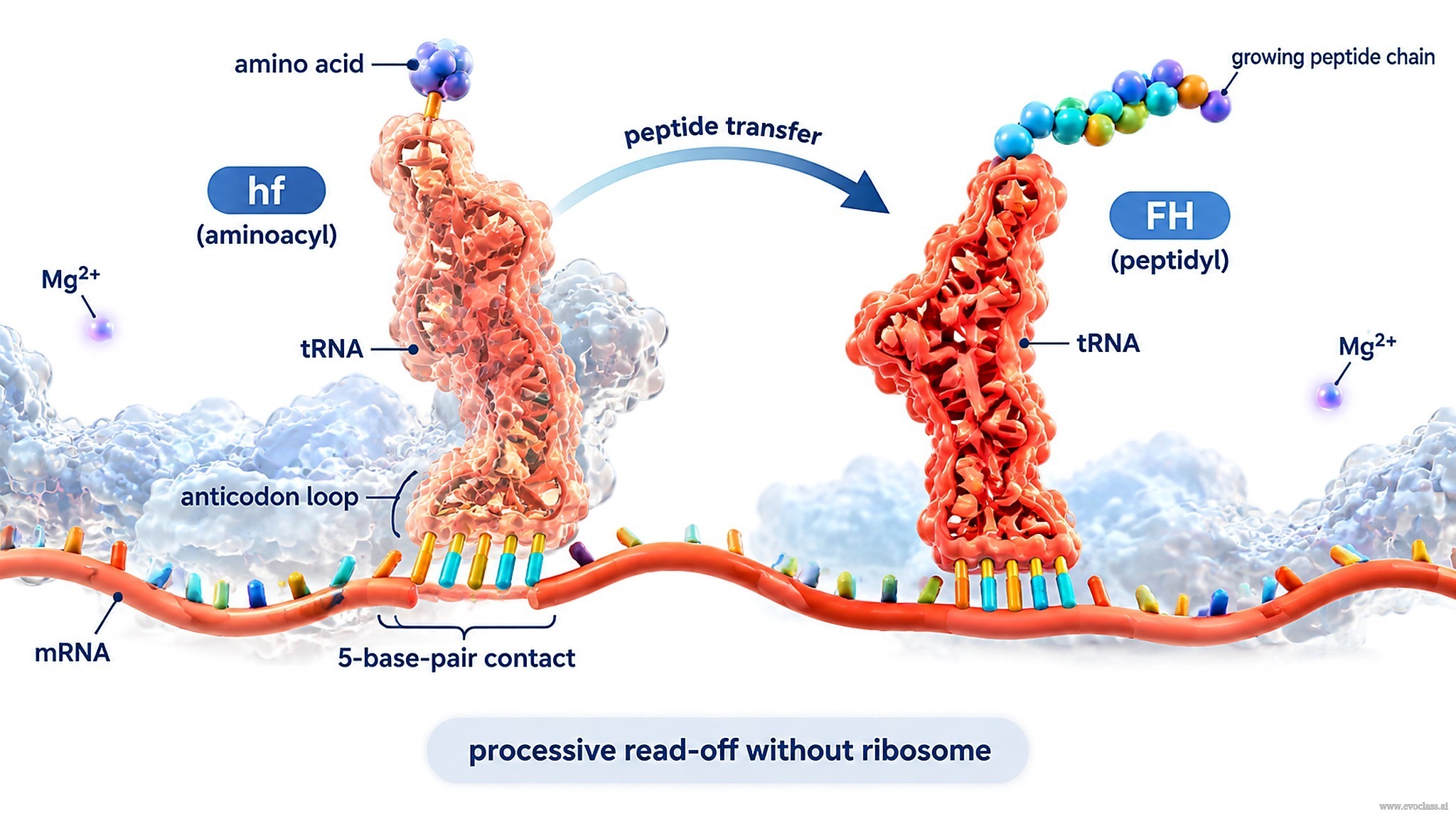
The ribosome-free peptide-transfer model addresses a central problem in primordial translation: how a growing peptide chain can remain attached to a messenger RNA and be extended without a ribosome. The proposal is that a peptidyl-tRNA can stay bound to the message through a five-base-pair contact between its anticodon loop and the message.
Crucially, the tRNA does not have a single fixed shape. Its configuration depends on what it carries. When the tRNA is attached to a single amino acid, it adopts the hf configuration. When it is attached to a peptide chain, it adopts the FH configuration. The transfer of an amino acid to the growing peptide chain flips the tRNA from hf to FH (cf. Fig. 49).
This hf → FH switch is the key mechanistic step. It provides a way to read off the message processively without a sophisticated translation apparatus: the tRNA remains anchored by the five-base-pair contact, and each peptide-transfer event changes its conformation, allowing the next codon to be engaged. In the hypercycle framework, this ribosome-free peptide transfer can support early functional coupling between RNA and peptide products.
Why Five Base Pairs Matter
The standard codon–anticodon interaction involves three base pairs. In the ribosome-free model, the anticodon loop makes a five-base-pair contact with the message. This additional pairing is what holds the growing peptidyl-tRNA on the message when no ribosome is present. Without it, the peptidyl-tRNA would not remain stably attached during repeated elongation steps.
Two Configurations, One Switch
The tRNA configuration is not arbitrary; it is set by the cargo. A tRNA carrying an amino acid is in the hf state. A tRNA carrying a peptide chain is in the FH state. When the amino acid is transferred to the peptide chain, the tRNA flips from hf to FH. This conformational switch is coupled to the chemistry of peptide-bond formation (cf. Fig. 49).
Processive Read-Off Without a Ribosome
The hf → FH switch explains how the message can be read off processively without a sophisticated translation apparatus. Each peptide-transfer event both extends the chain and changes the tRNA conformation, allowing the next codon to be engaged while the five-base-pair contact keeps the complex attached. This provides a plausible primordial mechanism for translating a message into a peptide without ribosomes.
Ribosome-Free Peptide Transfer
The growing peptidyl-tRNA stays attached to the message through a five-base-pair contact between the anticodon loop and the message. The tRNA adopts the hf configuration when carrying an amino acid and the FH configuration when carrying a peptide chain; transfer of the amino acid to the peptide chain flips the tRNA from hf to FH, enabling processive read-off without a ribosome.