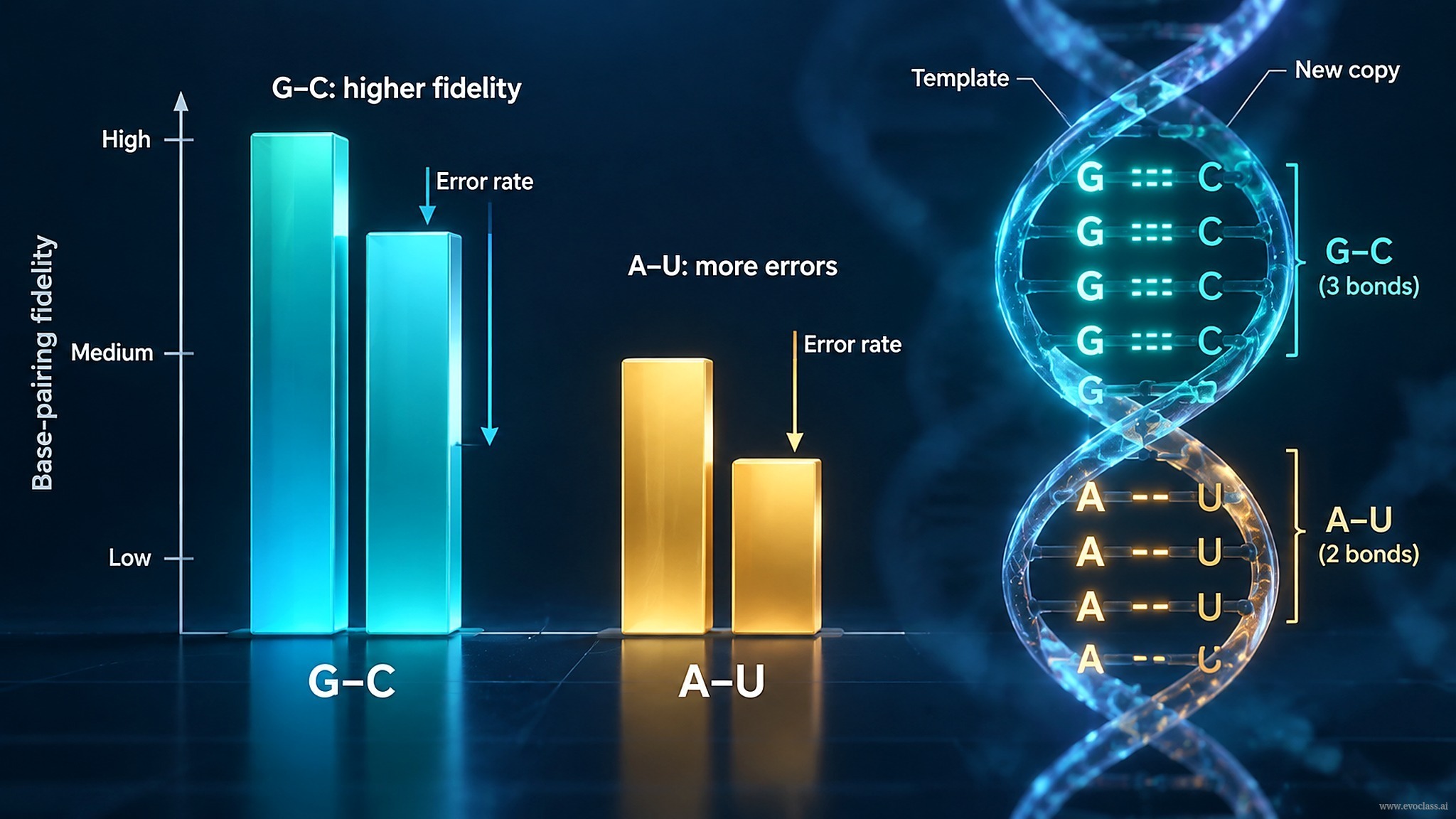
In the prebiotic world, not all sequences could be copied with equal reliability. The GC-rich replication and fidelity filter describes how precursor abundance and base-pair thermodynamics bias which sequences can be faithfully regenerated. Because G–C pairing is more stable than A–U pairing, GC-rich templates and their complements experience fewer copying and pairing errors, making them more reproducibly regenerated across generations. This establishes GC-rich sequence space as a plausible early reservoir for molecules that must both serve as stable interaction partners and be copied with enough fidelity to carry information.
Core Concepts
- Nucleotide abundance and base-pair stability jointly constrain reliable copying; not all sequence compositions are equally accessible or reproducible.
- G–C pairs are more stable than A–U pairs, reducing thermal and mispairing fluctuations and supporting higher replication fidelity.
- Higher fidelity makes GC-rich sequences more reproducible across generations, favoring their retention under mutation–selection balance.
- For early adapters and messengers, GC richness satisfies two coupled demands: stable adapter–messenger interaction and accurate replication.
Comma-Free Read-Off and Unsymmetric GC Patterns
Comma-free read-off adds a structural constraint: the GC pattern must be unsymmetric rather than symmetric, so frames can be distinguished. A symmetric GC pattern would create frame ambiguity, whereas an unsymmetric pattern ensures that only one reading frame is translated coherently.
Error Threshold and Information Length
In error-threshold terms, any local fidelity increase raises the sustainable information length; GC-rich replication therefore enlarges the sequence space that can support early coding and adaptor functions. The replicator equation ẋ = (
Example: Antiparallel Adapter–Messenger Pair
An antiparallel adapter–messenger pair composed mainly of G and C would have more stable complementary pairing and fewer copying errors than an AU-rich alternative. The aligned check asks: “which are complementary if aligned in an antiparallel fashion.” This choice was dictated by four arguments: stability of adapter–messenger interaction and fidelity of replication, both favoring GC combinations to start with; comma-free read-off in translation requiring an unsymmetric GC pattern; and the error-threshold benefit of higher fidelity. Suggested answer: GC combinations favor stable adapter–messenger interaction and high-fidelity replication; comma-free read-off then requires an unsymmetric GC pattern rather than a symmetric one.
GC vs AU Replication Fidelity
A bar chart comparing G–C and A–U pairs in duplex stability and replication fidelity, alongside an antiparallel adapter–messenger schematic. The GC-rich sequence shows higher stability and fidelity, and its unsymmetric GC pattern supports comma-free read-off.