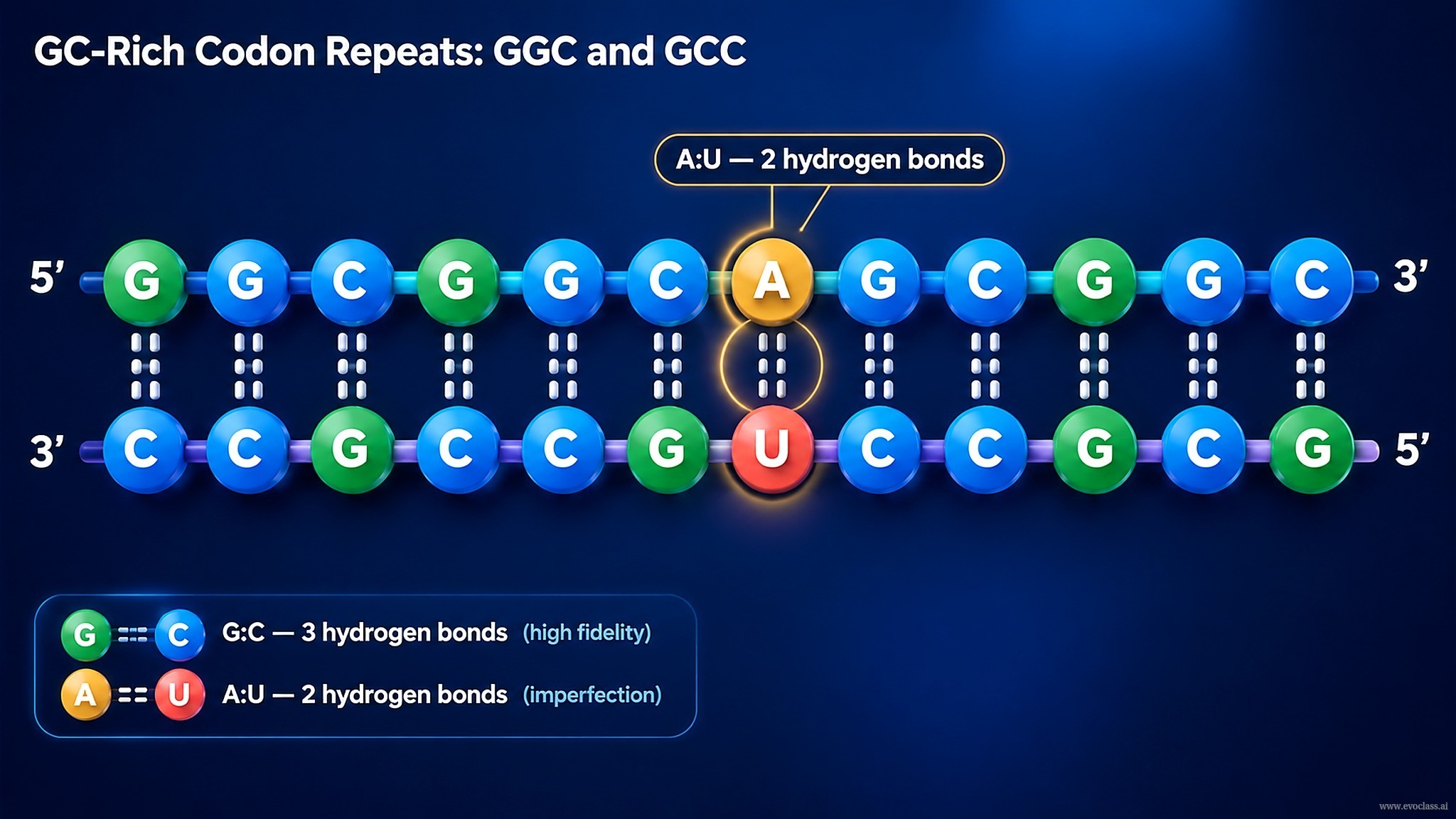
The first codon pair proposed in the GC-rich primordial code is 5'-GGC and 5'-GCC. This selection is not arbitrary: it is driven by the physical chemistry of nucleotide pairing and the need for high-fidelity replication before the error threshold allows stable information to be maintained.
Both GGC and GCC are GC-rich, consisting only of guanine (G) and cytosine (C). G:C base pairs are stabilized by three hydrogen bonds, whereas A:U pairs have only two. This makes GC-rich sequences less error-prone during template copying. In early replication, where error rates were high, using GC-rich codons helped keep the coding frame below the error threshold—the maximum error rate that still permits maintenance of functional genetic information.
Additionally, 5'-GGC and 5'-GCC are reverse complements across antiparallel strands. This means that a GGC codon on one strand pairs with a GCC codon on the opposite strand, forming a stable GC-rich duplex. Such a lattice can support repeated sequence motifs and facilitate replication.
Rare A or U substitutions within this frame are treated as imperfections or mutations. They introduce weaker pairing and are thought to represent the mutational pressure that the first codon pair had to resist. Over time, some of these imperfections may have been selectively advantageous, but initially they were errors to be minimized.
Key Points
- The first codon pair is 5'-GGC and 5'-GCC.
- Both codons are GC-rich, avoiding error-prone A/U-rich alternatives.
- GC content is compatible with high-fidelity template copying, helping the coding frame remain below the error threshold.
- GGC and GCC are reverse complements, supporting stable GC-rich duplex motifs.
- A/U substitutions in this frame are treated as imperfections or mutations.
GC-Rich Codon Lattice
Two antiparallel strands with repeating 5'-GGC-3' and 5'-GCC-3' blocks. G:C pairs (three hydrogen bonds) provide high-fidelity replication, while rare A:U substitutions (two hydrogen bonds) are imperfections.