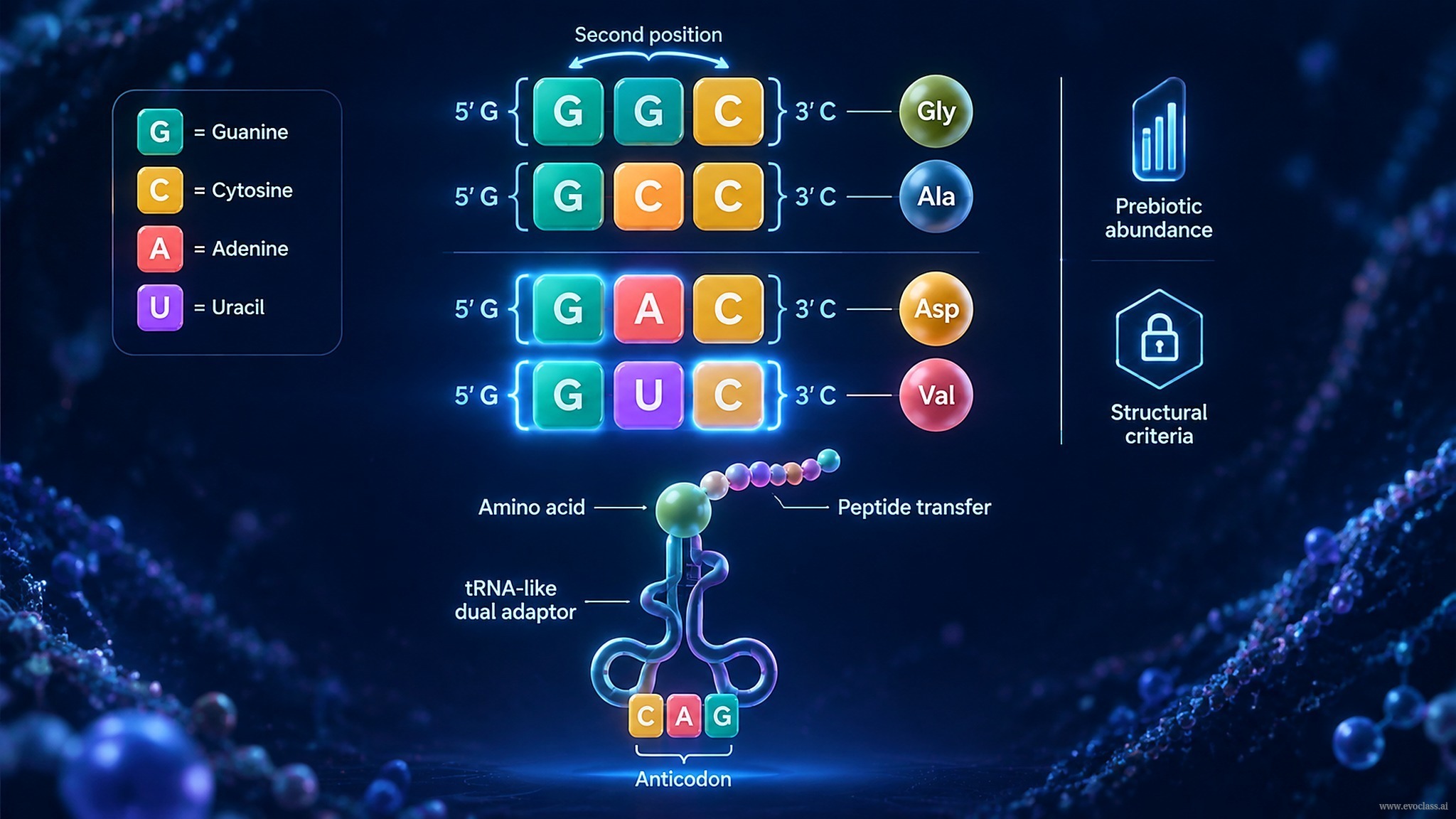
How does the primordial genetic code grow from a two-codon proto-code toward the primary amino acid alphabet? This slide treats code enlargement as a constrained, stepwise process, not a sudden jump to the full 64-codon table. The starting point is the pair GGC and GCC, selected earlier for G–C-rich replication, high fidelity, and a coherent comma-free reading frame. The first extension adds GAC and GUC, assigning aspartic acid (Asp) and valine (Val) to the early code. Canonically: GGC → Gly, GCC → Ala, GAC → Asp, GUC → Val.
Why this extension is combinatorially simple
All four early codons share a fixed frame: 5′ G ... 3′ C. Only the second position changes — it samples G, C, A, and U. This gives a compact combinatorial route: once the G–C frame and its replication fidelity are established, new assignments can be explored by varying a single position. The extension to GAC and GUC is therefore a natural next step within an already robust framework.
What limits the primary alphabet
Not every amino acid can join. The primary set is constrained by prebiotic abundance and structural criteria: only sufficiently common amino acids with suitable side-chain chemistry, and compatibility with RNA adaptors, activation, and peptide transfer, can enter the code. A plausible origin of translation also requires reproducible RNA molecules as large as tRNA, able to act as dual adaptors and messengers, plus a primitive peptide-transfer mechanism and fidelity sufficient to maintain assignments.
Coupling to the hypercycle
Code extension is a coupled molecular-selection problem. New codons must either improve the translation-coupled hypercycle or at least not destabilize it, and the whole system must remain within error-threshold limits. This slide is a bridge from the first two codons toward the primary alphabet; it does not yet cover the complete later codon assignment table or the full synthesis of translation.
Codon-frame extension
The early code extends from two codons (GGC, GCC) to four by adding GAC and GUC. All four share a fixed 5′ G and 3′ C frame, so only the second position varies, sampling G, C, A, U. Entry of new amino acids is filtered by prebiotic abundance and structural criteria.