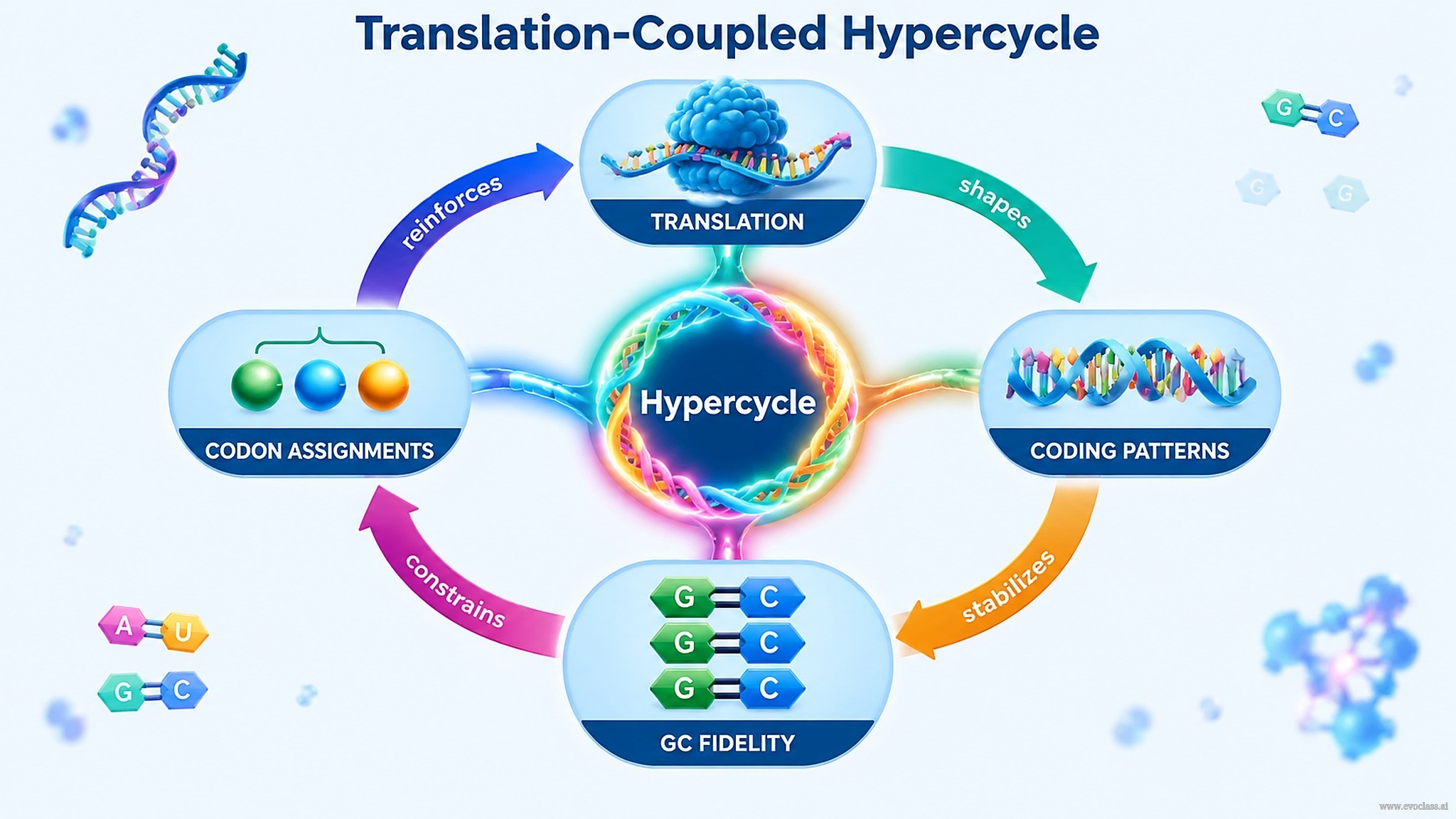
This page integrates three previously separate strands into one coherent prebiotic scenario: translation-coupled hypercycle dynamics, primordial coding logic, and GC-rich RNA chemistry. The synthesis shows that a realistic hypercycle cannot be assembled from shared replication and translation terms alone; it requires a closed catalytic link among RNA-encoded functions.
From a Decaying Ensemble to a Closed Catalytic Link
A minimum scheme in which a set of RNA strands encodes one replicase and four synthetase functions illustrates the problem. When replication and translation terms are shared, they collapse into a single common growth function, so the ensemble decays through internal competition. The missing ingredient is a closed catalytic link: each RNA-encoded function must contribute to the replication or translation of the others, so that the collective persists as a hypercycle rather than as a collection of competing templates.
Primordial Coding and Ribosome-Free Read-Off
Primordial coding must solve frame coherence, comma-free read-off, and ribosome-free peptide transfer. A primitive message can be read through tRNA-like adapters that switch between the hf and FH configurations during peptide transfer (cf. Fig. 49). The identity of the active configuration depends on whether the tRNA-like molecule carries an amino acid or is attached to a growing peptide chain. Transfer of an amino acid to the peptide chain flips the adapter from hf to FH, allowing processive read-off without a sophisticated translation apparatus. The five-base-pair anticodon-loop contact and two loop conformations keep a growing peptidyl-tRNA attached to the message. Frame coherence and comma-free decoding ensure that read-off remains in register and does not collapse into overlapping or alternative reading frames.
GC-Rich Chemistry and Early Codon Assignments
GC-rich sequences provide greater duplex stability and fidelity, making them likely precursors for the first reproducible adapters and messengers. AU imperfections can later introduce selectively relevant variation. Early codon assignments, such as GGC/GCC and the subsequent GAC/GUC step, are interpreted through physical chemistry and nucleotide abundance, not through a fully modern translation apparatus. The aperiodic GC lattice with selectively advantageous AU imperfections, and the structural criteria behind the primary amino acid alphabet, complete the picture.
These strands are not independent innovations. Coding patterns constrain translation-like transfer, translation-like transfer requires catalytic closure, and GC-rich chemistry sets the stability threshold for both. The resulting scenario treats the origin of translation and the origin of the genetic code as coupled molecular problems.
Synthesis of Translation and Primordial Coding
This concept map integrates closed catalytic linkage among RNA-encoded functions, primordial coding with frame coherence and comma-free read-off, ribosome-free peptide transfer via the hf/FH adapter flip, GC-rich fidelity and stability, and early codon assignments such as GGC/GCC. Arrows indicate mutual constraints and feedback among translation, coding, and hypercyclic organization.