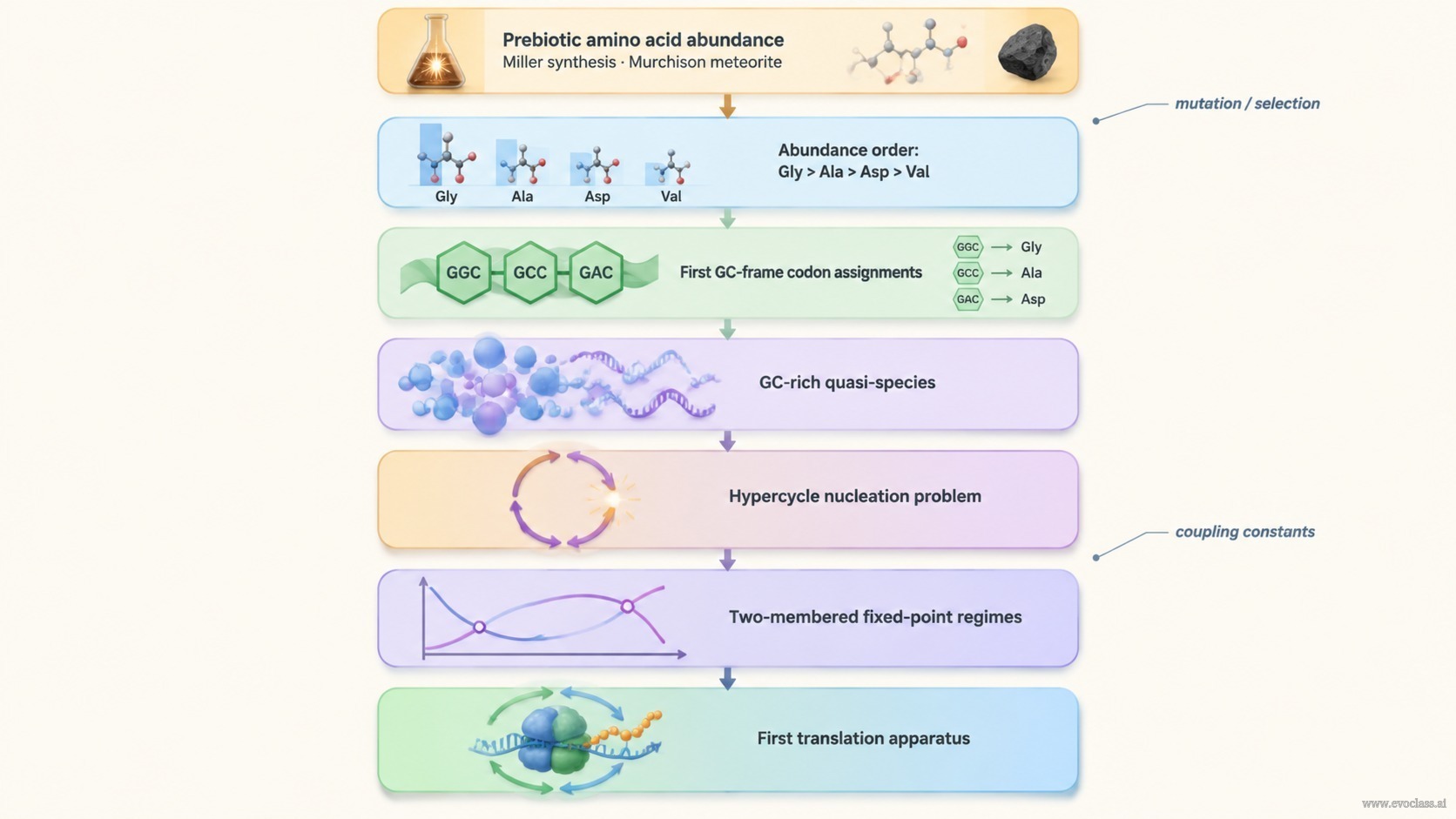
The origin of translation is usually imagined as the sudden assembly of a ribosome. This slide takes a different route: it begins from the prebiotic abundance of amino acids and asks which higher-order organization the first translation apparatus must have been part of.
From prebiotic chemistry to a first alphabet
Simulated prebiotic synthesis (Miller-type experiments) and the organic inventory of the Murchison meteorite converge on a restricted family of aliphatic amino acids. Rather than an even mixture, the yields and meteorite abundances are strongly biased: glycine dominates, followed by alanine, aspartic acid and valine. This bias is the raw material from which a first genetic alphabet could be drawn.
Abundance order and the first GC-frame codons
The order Gly > Ala > Asp > Val is used to order the first GC-frame codon assignments. Codons assembled from G and C map onto the simplest and most abundant amino acids first, so that chemical abundance and early coding pattern are aligned. Under this reading the earliest coding system is a GC-rich one, and its assignments are a consequence of availability rather than chance.
The nucleation problem of a hypercycle
A hypercycle behaves differently from a single autocatalytic replicator. One replicator can, in principle, begin from a single template copy; a cyclic network cannot, because closing the loop requires all of its members to be present at the same time. The first translation apparatus is therefore not an isolated molecular invention. It has to be assembled gradually out of a GC-rich quasi-species, with mutation and selection adding and refining its components step by step until the cycle closes.
Fixed points of the two-membered hypercycle
Fixed-point analysis of a two-membered hypercycle shows that the outcome depends on the relative coupling constants linking the members. Three qualitative regimes appear: outright competition, in which one member outcompetes the other; selection of either member, depending on the initial conditions; and mutual hypercyclic stabilization, in which each member strengthens the other. Only the last regime supports a translation-coupled apparatus, because it is the case in which RNA replication and peptide synthesis reinforce one another instead of competing.
Translation as a threshold, not an invention
The picture that emerges is that the first translation apparatus is a threshold in a hypercyclic system linking RNA replication, peptide synthesis and catalytic closure. The guiding question is XI. How to Start Translation? The roadmap above answers it: the starting point is chemical abundance, and the endpoint is a self-reinforcing cycle reached through mutation, selection and sufficient coupling.
Prebiotic Amino Acids and the First Translation Apparatus
A staged roadmap connects primordial amino acid abundance (Miller-type synthesis and Murchison meteorite data) to the first translation apparatus. It passes through the abundance order Gly > Ala > Asp > Val, the earliest GC-frame codon assignments, a GC-rich quasi-species, the nucleation problem of a hypercycle, and the fixed-point regimes of a two-membered cycle, ending at a translation apparatus held together by RNA replication, peptide synthesis and catalytic closure.