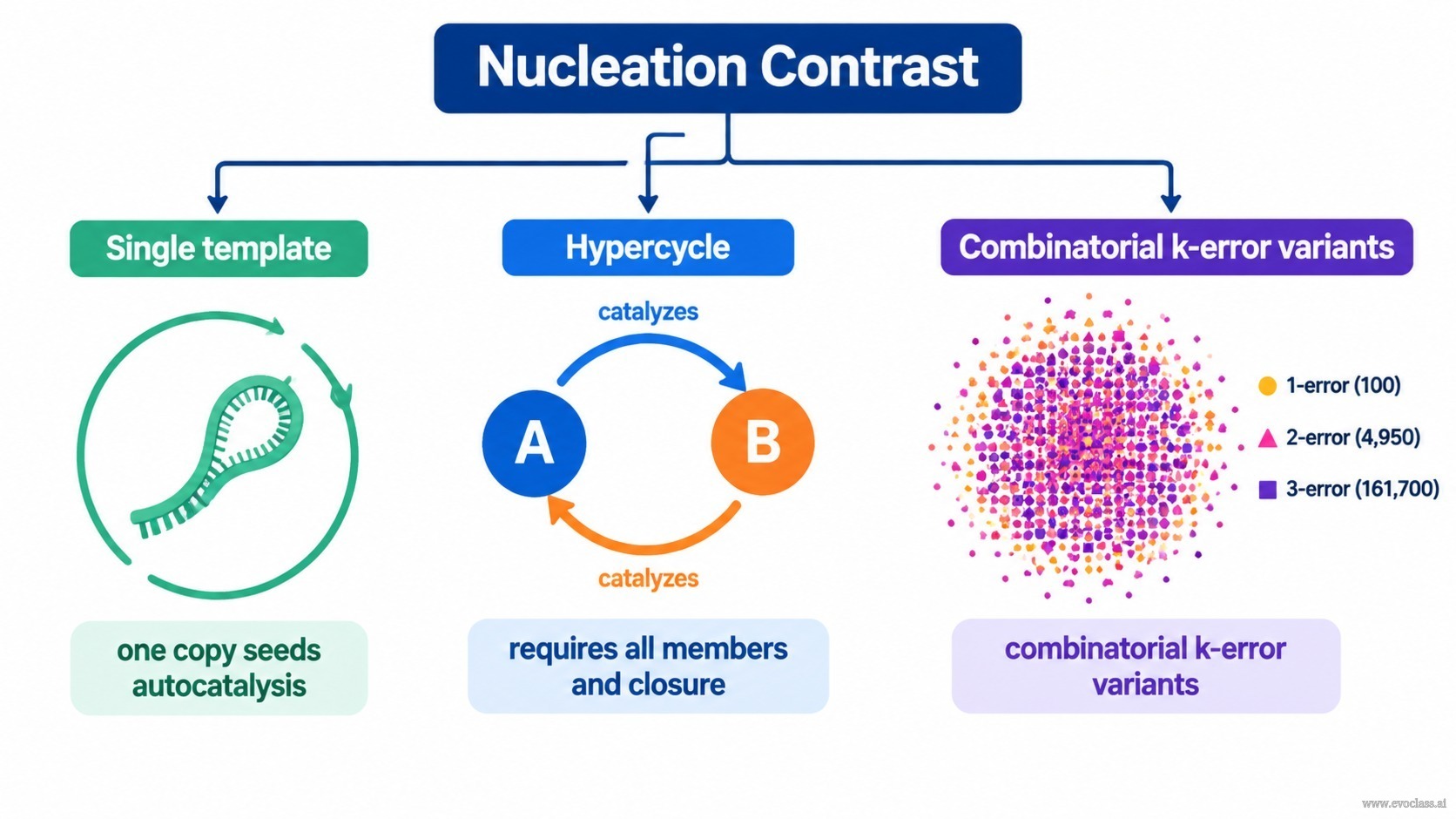
An autocatalytic replicator can begin from a single template copy: once one molecule is present, it can direct its own synthesis and amplify. A hypercycle is different. It is a closed cycle of mutually dependent replicators: each member is amplified or supported through the catalytic activity of another member, and closure is essential. This creates the nucleation problem.
Because a hypercycle requires every member of the cycle to be present and functionally linked, a single mutant gene—even a catalytically active one—cannot establish a hypercycle. The cycle remains open. Isolated replication or catalysis does not create the mutual dependency network that defines a hypercycle.
Stochastic and Combinatorial Barriers
Nucleation also requires sufficient initial amounts of all cycle members. Otherwise stochastic loss, dilution, and decomposition remove the components before the closed cycle can grow faster than its parts decay. The transition from a single replicator to a hypercycle is therefore threshold-like or cooperative: partial cycles and incomplete sets may not exhibit hypercyclic growth.
Mutant combinatorics make the start even harder. For a sequence of length
For these reasons, a hypercycle is more plausibly nucleated gradually from a GC-rich quasi-species through mutation and selection than assembled de novo from a single template or a single mutant gene.
Nucleation Contrast Diagram
A branching diagram contrasts a single-template autocatalytic replicator, which can seed growth from one copy, with a closed hypercycle that requires all members and closure, and with the combinatorial cloud of k-error mutants that makes de novo nucleation unlikely.