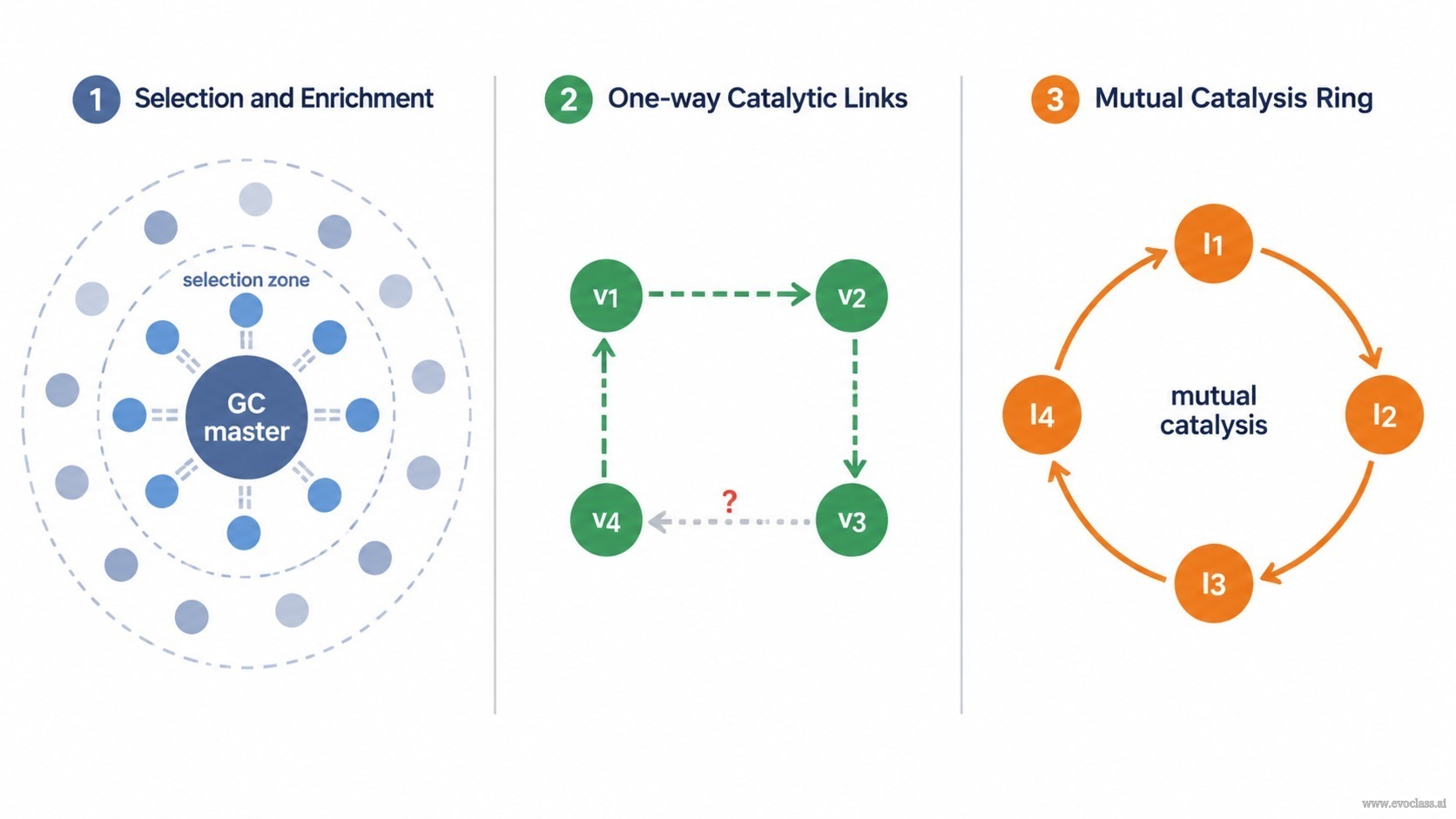
A hypercycle is a closed set of replicators that catalyse one another's replication. Because the cycle is defined by mutual catalysis among several distinct sequences, it cannot nucleate from a single template copy: one molecule does not contain the whole cyclic function, and its first copy has no catalytic partners with which to close a loop. Hypercyclic organisation therefore cannot appear abruptly; it must be assembled gradually at the level of a population, and the most plausible cradle for that assembly is a GC-rich quasi-species.
Why one template cannot start a cycle
An autocatalytic replicator is self-sufficient: a single strand that templates its own copying grows exponentially from one molecule, because the molecule and its product carry the same function. A hypercycle is not of this kind. Its defining property is a closed loop of catalytic support in which member i enhances the replication of member j, which enhances k, and so on until the loop returns to i. Strip out any single member and the remaining members no longer regenerate it. Consequently, the first copy of any one member is a dead end: it has no complementary partners, and no closed catalytic cycle exists to amplify it preferentially.
A GC-rich quasi-species supplies the raw material
A quasi-species is not a single sequence but a mutationally connected cloud of related sequences distributed around a dominant, master-like sequence. In a GC-rich pool this cloud is unusually well stocked. Every additional G–C pair contributes a third hydrogen bond, so GC-rich stems melt at higher temperature, fold more reliably and tolerate more point mutations before their secondary structure collapses. The reservoir therefore combines two things the nucleation problem requires at once: a high local diversity of variants with altered loops, stems and surface geometry, and enough structural stability that individual variants remain functional long enough to be tested by selection.
Mutation explores coupling, selection keeps it
Mutational exploration is what actually searches the space of interactions. A point substitution can reshape a hairpin, expose a new binding surface, or recruit a metal-ion-dependent catalytic centre, changing the weak coupling coefficient
From quasi-species organisation to hypercyclic organisation
As links accumulate, the mutant distribution changes shape. Diversity is no longer spread around a single master sequence; it condenses toward a small subset of mutually catalytic templates, and ring closure occurs only once enough links exist for the network to be closed rather than merely open or branched. Before closure the ensemble behaves as a quasi-species with some correlated variants. After closure, growth is cooperative and super-additive: the cycle multiplies as a unit, and because each member feeds the next, the coupled set can outgrow an isolated quasi-species competing for the same monomers and replicase. This is how a hypercycle could appear without any preformed multi-gene genome — by recruitment and integration of mutant genes already present in the GC-rich reservoir. The underlying fixed-point analysis of the two-membered case makes the same point in rate-coefficient form: whether the pair ends in competitive exclusion, selection of one member, or stable hypercyclic coexistence depends only on the relative magnitudes of self-enhancement and mutual enhancement, and the criterion generalises to three-membered and n-membered cycles.
When the route fails
- Replication fidelity must stay above the error threshold. If the mutation rate is too high, the reservoir dissolves into a diffuse cloud in which no variant persists long enough to establish a link.
- Functional compatibility matters: members must not interfere destructively with one another's folding or catalysis, otherwise the accumulating links cancel instead of reinforcing.
- Parasite load must stay low. A selfish template that is efficiently replicated thanks to the emerging cycle, but catalyses nothing back, drains the shared resources and can destabilise the network before it closes.
Worked sketch. In a GC-rich RNA pool, a dominant GGC/GCC-like sequence and its mutants form a quasi-species. A mutant may weakly assist replication of a neighbouring sequence, and selection preserves both partners because their joint yield exceeds what either achieves alone. Further mutations generate reciprocal assistance, the branch that was missing is filled in, and a two-membered or larger cycle closes. Once closed, hypercyclic growth outcompetes the isolated quasi-species that gave rise to it.
Emergence from a Gc-Rich Quasi-Species
Three stages read left to right. First, a GC-rich master sequence sits at the centre of a mutational cloud, with an inner selection zone marking the variants that are progressively enriched while stable GC base pairs protect their folded structures. Second, the surviving variants are joined by weak, one-directional catalytic links, and one connection is still dotted because the network is not yet closed. Third, those links become reciprocal and the network closes into a hypercyclic ring in which each member catalyses the next, so the set as a whole can outgrow an isolated quasi-species.